Part I · Store Consciousness
Verse 9 · Ripening and Emancipation
The ground of the mind, where all our seeds are kept — and how they ripen into the worlds we live in.
 ×
×
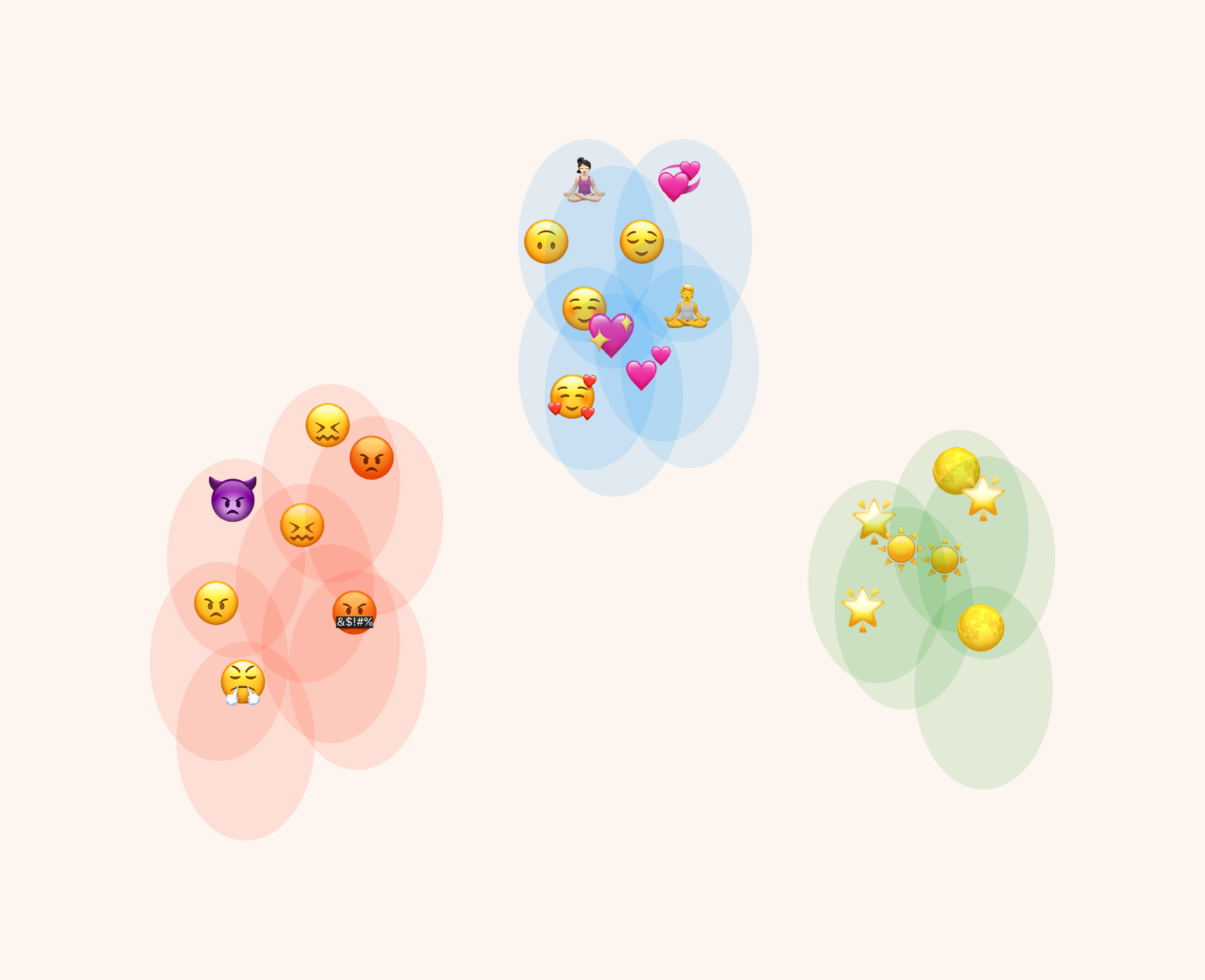
All manifestations bear the marksof both the individual and the collective.The maturation of store consciousness functions in the same wayin its participation in the different stages and realms of being.
This page is our current understanding, written as we work through the book together — it changes as our understanding changes.
09.20Crossing into the Realm of Form
Leaving the desire realm behind — the first steps into the realm of form.
The Reading
Verse 9 reads:
All manifestations bear the marks of both the individual and the collective. The maturation of store consciousness functions in the same way in its participation in the different stages and realms of being.
The words to hold onto are the different stages and realms of being. The six destinations of the desire realm — the hells, the hungry ghosts, the animals, the asuras, the gods, and the humans — now lie behind us. We step up out of desire altogether, into the next of the three great realms: the realm of form. The human state is what makes this step possible. Of the six destinations, only the human mind is steady enough for the gathering that concentration asks of us, because suffering and happiness are fairly evenly mixed there and we can still reflect and choose.
Thầy — Thich Nhat Hanh, as his students call him — describes the step. “When we choose to live simply and abandon some of our craving,” he writes, “we are in the realm of form. In this realm we suffer less and can experience a little happiness.” Elsewhere he says the desire realm is a house on fire, and that we are the ones who light it, through our own wrong perceptions. When we turn toward the realm of form, we step a little way out of the flames.
The Teaching
A map of the mind, not a map of the heavens
First, what are these realms for? The three realms, the nine stages, the six destinations are not a picture of the universe we are asked to believe in. They are a map for recognising our own states of mind. They are useful because once we can name where we are, we can do something about it. If we notice we have been “born” into a heaven of comfort and forgetfulness, we can remember how quickly it passes, and let that wake us up. Without the map we stay lost, caught in a state we cannot even name. The map is the diagnosis. The breath, as we will see, is the medicine.
The three realms
While we are still caught in our wrong perceptions, we can find ourselves in any of three realms, each subtler than the last. The desire realm is the world of ordinary sense experience, driven by wanting, aversion, and ignorance; we suffer here because we are always chasing things or running from them. The realm of form is subtler, reached through deep concentration: the coarse desires fall quiet, we suffer less, and we taste a small but real happiness — though a faint attachment to a separate self still lingers. The formless realm is subtler still: pure, boundless awareness with no sense of material form, where suffering remains only because wrong perceptions remain and old cravings lie dormant.
Each realm, Thầy stresses, is made by the shared consciousness of those who live in it, and all three can be touched right now, within us and around us. All three are samsara — the round of birth and death we keep turning in. Freedom is outside all three.
The nine stages
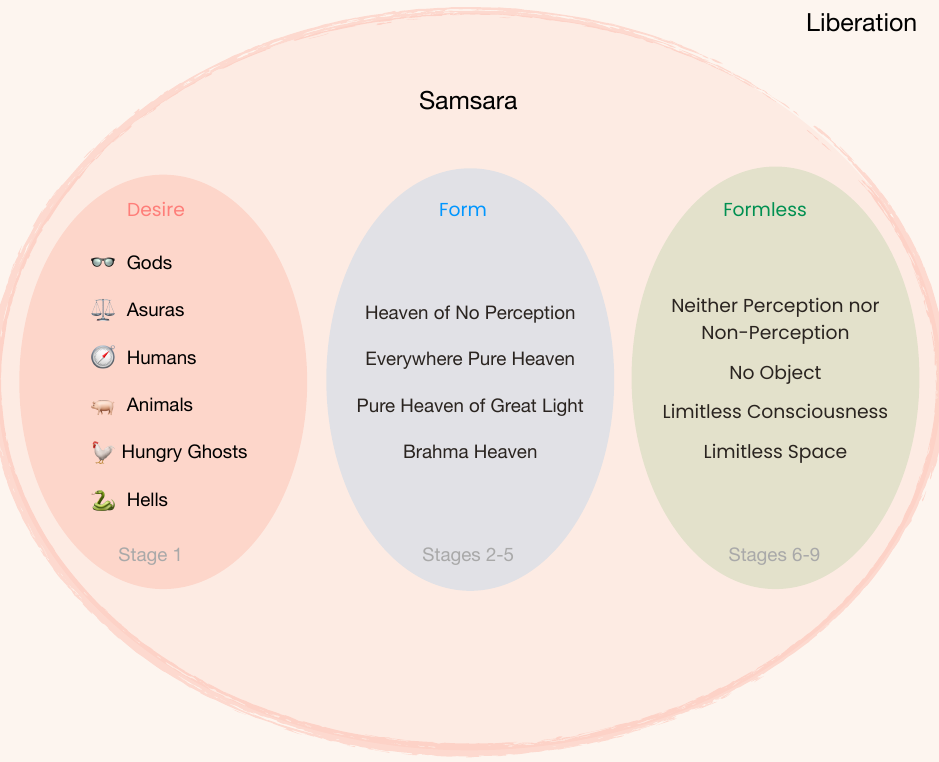
The one desire realm, plus four levels of form and four of the formless, make nine stages in all:
- The Realm of Desire — its six destinations: gods, asuras, and humans above; animals, hungry ghosts, and hell beings below. (the ground already behind us)
- Brahma Heaven — the first dhyāna
- The Pure Heaven of Great Light — the second dhyāna
- The Everywhere-Pure Heaven — the third dhyāna
- The Heaven of No-Perception — the fourth dhyāna
- The Realm of Limitless Space — first of the formless
- The Realm of Limitless Consciousness
- The Realm of No Object
- The Realm of No Perception and No Non-Perception
Stages two through five are the realm of form, and they are where we go next. (Dhyāna simply means deep meditative concentration.)
Concentration is the doorway
The realm of form is not a far-off place to be reborn into. It is a state of mind, and we reach it through concentration. Here is why concentration, of all things, is what carries us across.
The realms differ by how gathered the mind is. In the desire realm the mind never rests: it roams the senses, chasing the pleasant and fleeing the unpleasant, landing on one thing after another. Concentration is simply the opposite movement — drawing the mind back from that roaming and settling it on a single, quiet object, like the breath. So the moment the mind gathers and craving falls still, we have already stepped out of the desire realm. We have not gone anywhere. We have changed what the mind is doing.
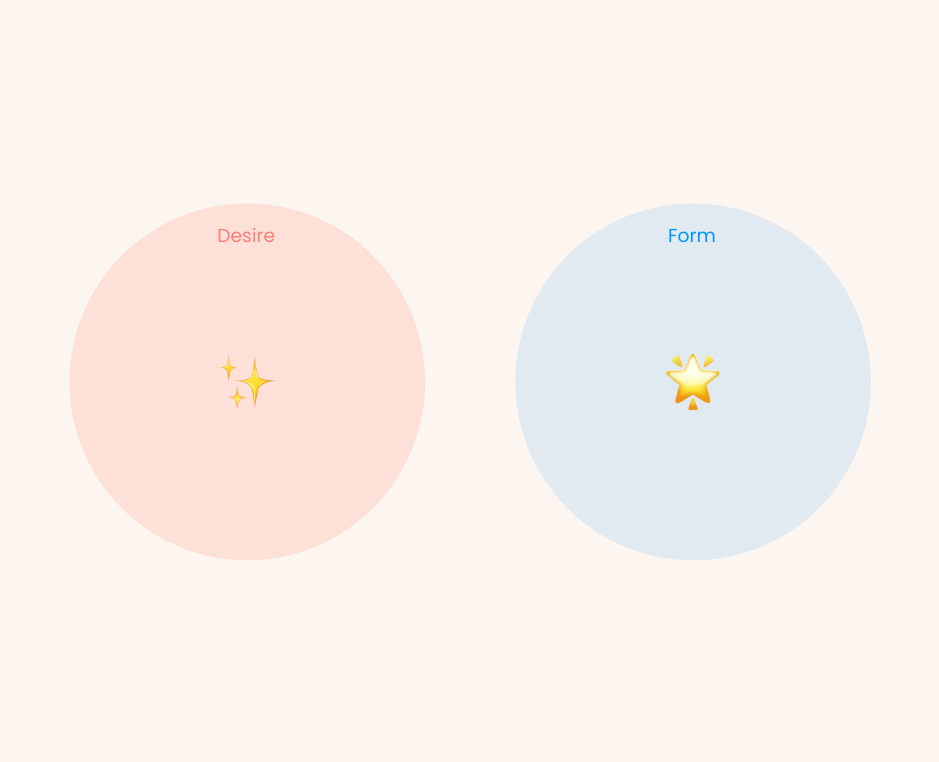
In fact, the realm of form simply is that gathered state. Its four levels are the four dhyānas — four depths of concentration. We do not enter them after concentrating; they are the concentration itself. Concentration is the vehicle the whole way up, and insight is what finally frees us from the realms altogether. (For how the four heavens line up one-to-one with the four dhyānas, see Going Deeper.)
This also shows what the five hindrances really cost us. They are often described as energies that keep us bound to the desire realm. They actually block concentration, the gathering of the mind. And since that gathering is the one way out, blocking it is exactly how they keep us stuck.
Quieting the five hindrances
Before the mind can gather and settle toward the first dhyāna, five familiar energies have to grow quiet: desire, aversion, drowsiness, restlessness, and doubt. Each clouds the mind and blocks concentration in its own way. (The five hindrances are not this book’s frame — the word does not appear in Understanding Our Mind at all. They are not foreign to Thầy either: they sit in the Discourse on the Four Establishments of Mindfulness, which he translated and taught from, where his own wording is sensual desire, anger, dullness and drowsiness, agitation and remorse, doubt. We use the plainer everyday names here, and the picture below is drawn to them.)
It helps to see them in three natural groups. Two pull and push: desire draws the mind toward what it wants; aversion shoves it away from what it cannot bear. Two throw off our energy: drowsiness is too little — the mind dull and sinking — and restlessness is too much — the mind agitated and scattering; concentration needs the middle, alert but settled. And one undercuts the wish itself: doubt, the wavering that drains our resolve before we even begin.
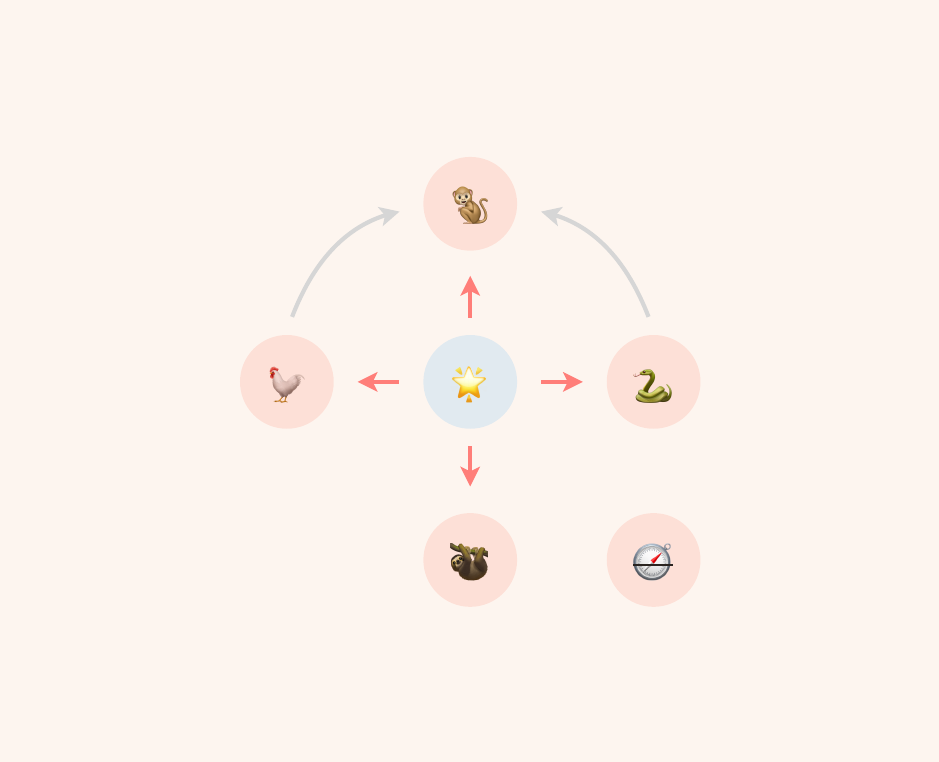
Two of these appear here for the first time as named mental formations — drowsiness and restlessness — and the crossing brings three more into view as well. Going Deeper defines the two that are new here, and sets out the two ways the hindrances undo concentration: scattering the mind, and letting it sink.
The full awareness of breathing
To quiet the hindrances and gather the mind, Thầy gives us a concrete practice: the Full Awareness of Breathing, the sixteen breathing exercises he unfolds in Breathe, You Are Alive!
The sixteen move through four areas in turn — the body, the feelings, the mind, and the objects of mind. We do not need all sixteen here; the first four are enough. Resting the attention on the breath and letting the body settle is itself the medicine: as the body calms, the hindrances quieten and the mind begins to gather.
The first tetrad
The first four exercises — the breath-and-body set — are the hindrances’ direct antidote:
- Breathing in a long breath, I know I am breathing in a long breath. Breathing out a long breath, I know I am breathing out a long breath.
- Breathing in a short breath, I know I am breathing in a short breath. Breathing out a short breath, I know I am breathing out a short breath.
- Breathing in, I am aware of my whole body. Breathing out, I am aware of my whole body.
- Breathing in, I calm my whole body. Breathing out, I calm my whole body.
Resting on the breath gives the mind one thing to hold, so desire has nothing to chase and aversion nothing to push against. Awareness of the whole body then works on the energy pair from both sides. It rouses a dull, sinking mind and gathers a scattered one, until the mind reaches the balance concentration needs: alert but settled. Calming the body releases the agitation that feeds restlessness. And the steady return to the breath, again and again, quietly builds the confidence that loosens doubt: we stop wondering whether the practice works, because we can feel it working.
As the hindrances fade, the joy and happiness of the first dhyāna arise on their own. We do not manufacture them. They are what is there once the noise dies down, and a bodily ease comes with them. (These four exercises bring us to the threshold. The joy and happiness that meet us there are the next two exercises in the sutra: Breathing in, I feel joyful and Breathing in, I feel happy.)
Thought gathered, not stopped
One misunderstanding sits right at the doorway: that concentration means switching thinking off. It does not. The gathered mind is not an empty mind — thought is present either way. What changes is not whether the mind thinks but how its thinking is arranged. The scattered mind keeps leaping: a thought here, another there, each landing on a new object. The gathered mind rests its thinking on a single object and stays. Entering the first dhyāna is the end of the leaping, not the end of thought.
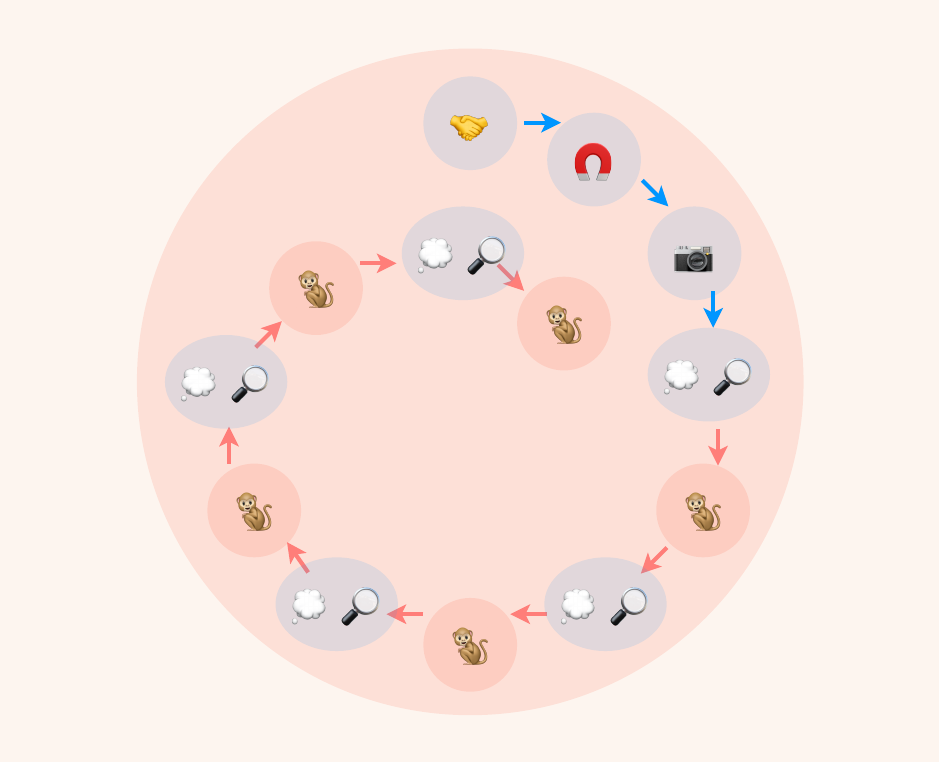
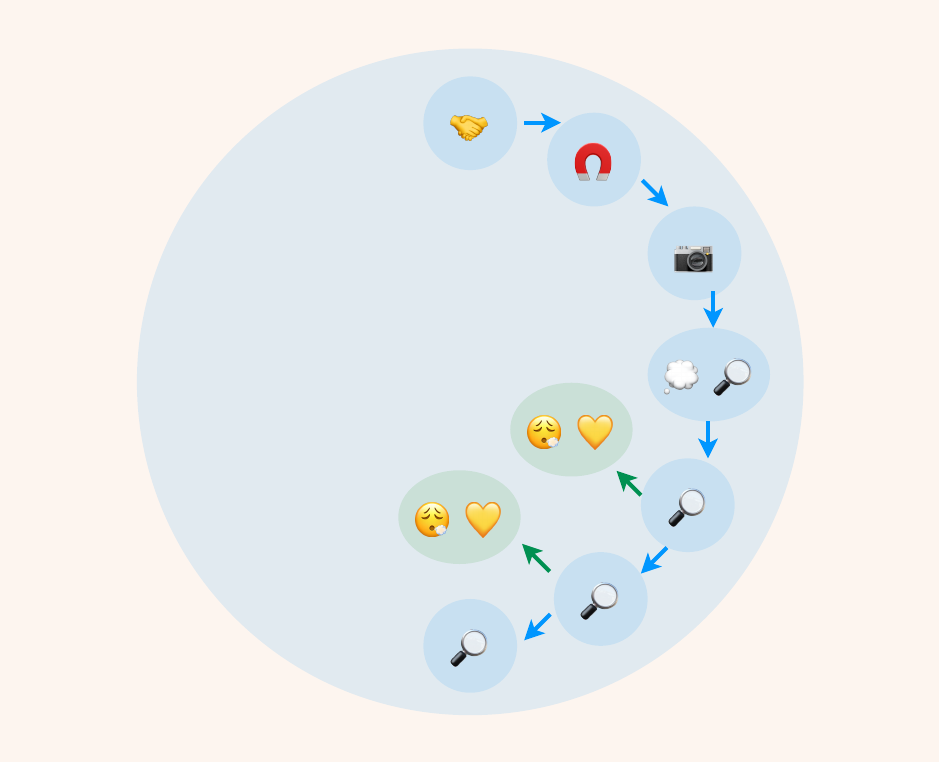
Later, on entering the second dhyāna, even this quiet, directed thought is released, and the thinking mind falls fully silent. For now we simply gather. The mind is not blank. It is resting wholeheartedly on one thing. (Going Deeper looks closer at the two small movements of thought that do the gathering — vitarka and vicāra — and at papañca, the runaway proliferation of thought that scatters us.)
What comes next
Here we reach the threshold and step into the first dhyāna: the hindrances quiet, the mind gathers, and joy and happiness arise on their own. The realm of form has three deeper levels. Each one opens when we let go of what brought us to the level before, not when we reach for more. That is where the next reflection takes up the path.
Contemplation Questions
When have you set something down — a craving, a wanting — and found, to your surprise, that you suffered less, that some ease arrived on its own?
Have you ever tasted the quiet happiness of a gathered, concentrated mind — in meditation, or in ordinary life: absorbed in work, in music, in a long walk?
What helps you “live simply and abandon some of your craving” — and what makes it hard?
And of the five hindrances — desire, aversion, drowsiness, restlessness, doubt — which one most often pulls you back into the desire realm?
Carry whichever of these stays with you — into your own quiet reflection, or into conversation with others.
Going Deeper
A few notes for anyone who wants to follow a thread further. Open whichever one interests you.
The five mental formations that surface here
Understanding Our Mind works through a list of fifty-one mental formations — the states and movements of mind the book names one by one, and which our own Inner Landscape lays out as a map. The crossing into the realm of form brings five of them into view for the first time. Two are hindrances we have just met:
- Drowsiness — a heaviness that sinks over the mind, draining its clarity and energy so it fogs and withdraws from its object, sliding toward sleep.
- Restlessness — the mind’s agitation: an unsettled energy that flits from one object to the next and cannot rest on any, the very opposite of the stillness concentration needs.
(Both belong to the group called the Eight Greater Secondary Unwholesome formations.)
Three more surface as we describe the crossing itself: Dispersion — the scattering of the mind, concentration’s direct mirror — and the two forms of directed thought met below, Initial Thought (vitarka) and Sustained Thought (vicāra). The other three hindrances — desire, aversion, and doubt — were named earlier in Verse 9.
The hindrances along two axes — scatter and sink
Seen together, the five hindrances undo concentration in two ways. Some scatter the mind: desire, aversion, and above all restlessness fling it across object after object. The pull of desire and the push of aversion don’t only distort the mind’s hold on its object — they stir it up and feed the restless agitation, so the three together scatter the mind. That scattering even has its own name among the fifty-one formations: dispersion (vikṣepa), the direct mirror of concentration. Others make the mind sink: drowsiness dulls and contracts it. (Doubt, meanwhile, saps the will to gather at all.) So concentration is undone from both sides — scattered or sunk. Quieting the hindrances stills both movements at once, and the mind, left to itself, gathers: dispersion gives way to concentration, its mirror.
This 2 + 2 + 1 grouping is a way of seeing the five, not a fixed doctrinal division — but it is well grounded. The tradition treats the two energy faults exactly this way, and teaches the seven factors of awakening as their remedy: three rousing factors for dullness, three calming factors for agitation, with mindfulness holding the balance.
Why the four heavens are the four dhyānas
The nine stages line up neatly, Brahma Heaven with the first dhyāna, the next heaven with the second, and so on, because the realm of form is made of concentration. Its four levels are the four dhyānas, four depths of the gathered mind. They are not realms we enter after concentrating; they are the concentration itself, named as heavens. To concentrate deeply enough that sensual craving drops away is, by definition, to be in the realm of form. And the same movement, refined further, carries on upward: the formless realm is reached when concentration releases even the subtle form. Concentration is the vehicle the whole way up; insight is what finally frees us from the realms altogether.
Vitarka and vicāra: placing and sustaining
We can watch the gathering happen in two small movements of thought. Vitarka, initial thought, places the mind on its object; vicāra, sustained thought, keeps it there. The old image is a bell: vitarka is the strike, vicāra the lingering ring. The whole difference between the scattered and the gathered mind is how this pair is arranged. The scattered mind strikes a new bell every moment — place, drop, place again — firing vitarka over and over onto fresh objects, and that endless re-striking is the proliferation of thought. The gathered mind strikes once and rests in the ringing: a single placing, then quiet sustaining on the one object. The two movements are the same. The arrangement is the opposite.
This is why concentration is a gathering and not a suppression: vitarka and vicāra are not thought’s enemies but the same faculty aimed rather than scattered. (In strict Abhidharma the two arise together in the first dhyāna and both fall away at the second; “strike once, then sustain” is the bell image for that, not a claim that one outlasts the other.)
A note on papañca
Throughout, we have spoken of the mind’s endless proliferation of thought. The tradition has a name for it: papañca (Sanskrit prapañca) — the runaway elaboration of a single perception into a branching tangle of thoughts, opinions, and stories about ourselves, each spinning off the last, until we are carried far from what is actually in front of us.
This is not Thầy’s word. In Understanding Our Mind he speaks plainly of the discursive mind, and of the Buddha’s own image of mind-consciousness as “a monkey, grasping this branch and that.” Papañca is the wider tradition’s technical term for the same thing, useful here to name precisely what the breath is quieting. It is at home in this text’s own school, though: in Yogācāra — the teaching of the brothers Asaṅga and Vasubandhu — the store consciousness carries the seeds of prapañca, and liberation is described as niṣprapañca, the going-out of proliferation.
Papañca is not the same as vitarka, the directed thought that concentration gathers; it is what vitarka becomes when it runs unchecked. The classic account (the Honeyball Sutta, MN 18) traces its arising: from contact comes feeling, from feeling perception, from perception thinking, and from thinking, proliferation — the very chain the first tetrad of breathing works back down, settling body and feelings so the proliferation has nothing to climb. Its deeper roots are three: craving, conceit, and views. Loosening them quiets papañca at its source; in the meantime, each return to the breath gathers it, one stream at a time.
The levels of thought
It helps to see all of this as one ladder. What we have been calling “thinking” is not a single thing but a whole range — from the most tangled activity down to the barest awareness — and the practice is a descent of its rungs.
At the top is proliferation — papañca — thought breeding thought, one perception snowballing into a branching tangle of stories and opinions. Beneath it is ordinary discursive thinking — vikalpa, the mind’s everyday work of naming, comparing, judging, planning — the raw material that proliferation runs away with. Quieter still is directed thought, the pair we met above: vitarka, initial thought, placing the mind on its object, and vicāra, sustained thought, keeping it there — still thinking, but a single stream held on one thing. This is as far down as the first dhyāna reaches.
Below directed thought the activity thins into something that is less thinking than simple presence. There is mindfulness — smṛti, Pali sati — the object held in awareness and recognised, with no commentary laid on top; then attention — manasikāra — the mind merely turning toward an object, the bare orienting before any elaboration; and at the base, bare knowing — vijñāna — awareness simply registering that something is present. When this knowing rests without construction — nirvikalpa — nothing at all is added, and the ladder has run out.
Two things are worth keeping straight. The rungs are a continuum, not a staircase with fixed steps: the mind slides up and down them constantly. And this blends two vocabularies — the meditation tradition’s (vitarka, vicāra, sati, manasikāra) and this book’s own Yogācāra language (vikalpa, papañca, and the mano-vijñāna where discursive thought runs) — the first laid alongside Thầy’s teaching as scaffolding, not his own frame. Two more faculties sit on a different axis, of quality rather than quantity: concentration is what carries the mind down the ladder, and insight is what the settled mind can then see. The dhyānas are simply this descent made deep — the first still holds directed thought; crossing into the second, vitarka and vicāra fall away and the discursive mind goes quiet, the very step this reading leads toward.
The beings of the form heavens
As the four form heavens rise, Thầy observes, their beings grow steadily more unified. In Brahma Heaven (the first dhyāna) their bodies differ but they think alike; in the Pure Heaven of Great Light (the second) their bodies are alike but their thinking differs; by the Everywhere-Pure Heaven (the third) they are alike in both body and mind; and in the Heaven of No-Perception (the fourth) perception is no longer accompanied by ideation. This is the same movement the whole reading has traced: as concentration deepens, the scattered many draw toward one.
09.21Deeper by Letting Go
Letting go is what takes us deeper — we dwell in the first dhyāna’s gathered joy and happiness, then release thought and the second opens. Nothing is added; something is set down.
The Reading
Verse 9 reads:
All manifestations bear the marks of both the individual and the collective. The maturation of store consciousness functions in the same way in its participation in the different stages and realms of being.
The word to hold onto this time is stages. The four dhyānas are not four destinations stacked one above the other. They are four depths of a single ripening, the same store consciousness participating a little more quietly at each one. That is why the four dhyānas can be described as one movement rather than a sequence of arrivals.
The previous reading crossed a border. The six destinations of the desire realm were behind us, the five hindrances had grown quiet, the mind had gathered on the breath — and we arrived at the threshold of the first dhyāna, the first of the four levels that make up the realm of form. This reading crosses no border between realms. We stay inside the one we reached, and go further down into it.
Thầy’s own gate into this realm is a modest one, and worth keeping in view the whole way. “When we choose to live simply and abandon some of our craving,” he writes, “we are in the realm of form. In this realm we suffer less and can experience a little happiness.” That is not a feat of concentration. It is a setting-down, and what follows from it.
That sentence is the whole of this reading. The realm of form has four levels, and not one of them is reached by trying harder. Each opens when we let go of what carried us to the level before.
The Teaching
Concentration is the gateway
First, a short reminder, because everything here rests on it.
The three realms are states of mind. Where we find ourselves depends on what the mind is resting on, and on how gathered it is. The desire realm is the mind never resting — roaming the six senses, chasing what is pleasant, fleeing what is not. Concentration is simply the opposite movement: the mind gathering onto a single object, like the breath.
And the realm of form is that gathered state. Its four levels are the four dhyānas — not places we enter after concentrating, but the concentration itself, at four depths. So the moment the mind unifies and attachment falls quiet, we have already stepped out of the desire realm.
One thing from the previous reading is easy to mislay, so it is worth saying again: thought is not silenced at this door. It has simply stopped wandering.
There is a word for the gathering, and Thầy uses it: ekāgratā, one-pointedness, with his image of the mind as a swarm of bees that will only settle once the queen is there to settle around. The object comes first; the gathering forms around it. (That teaching sits far ahead of us, at Verse 27, and Going Deeper follows it properly.)
Four levels, one movement
The realm of form has four levels, each quieter and more gathered than the last. We do not reach them by trying harder, or concentrating more fiercely, or adding anything at all.
Each one opens as we let go — releasing the very thing that carried us to the one before. That is the whole movement, and it runs in one direction only: we go deeper not by reaching for more, but by setting down what we hold.
This reading goes as far as the second dhyāna, which is far enough to see the pattern. The next reading takes the rest.
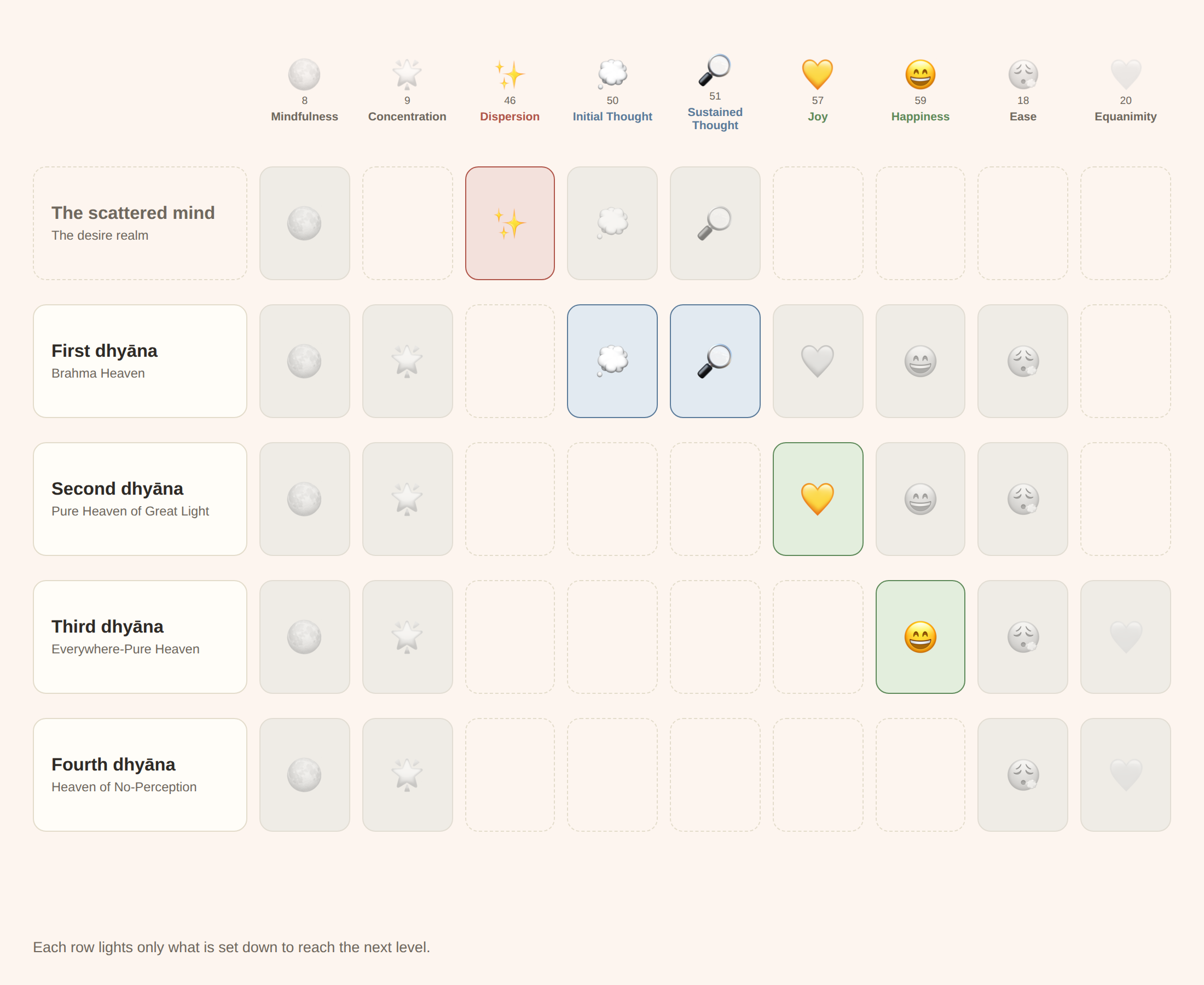
And it is worth saying at the outset, because the four levels can so easily read as a scoreboard: there is nothing to attain. Nothing here is a rank. Each level is simply what is left when something else has been released.
(The tidy scheme of factors present at the first level and released in sequence is an older tradition’s machinery rather than this book’s own — in Understanding Our Mind Thầy gives us the four heavens and does not run the analysis. We use it because it names precisely what falls away and what stays, the way the previous reading used the five hindrances, and we say whose it is.)
Gather thought — the first dhyāna
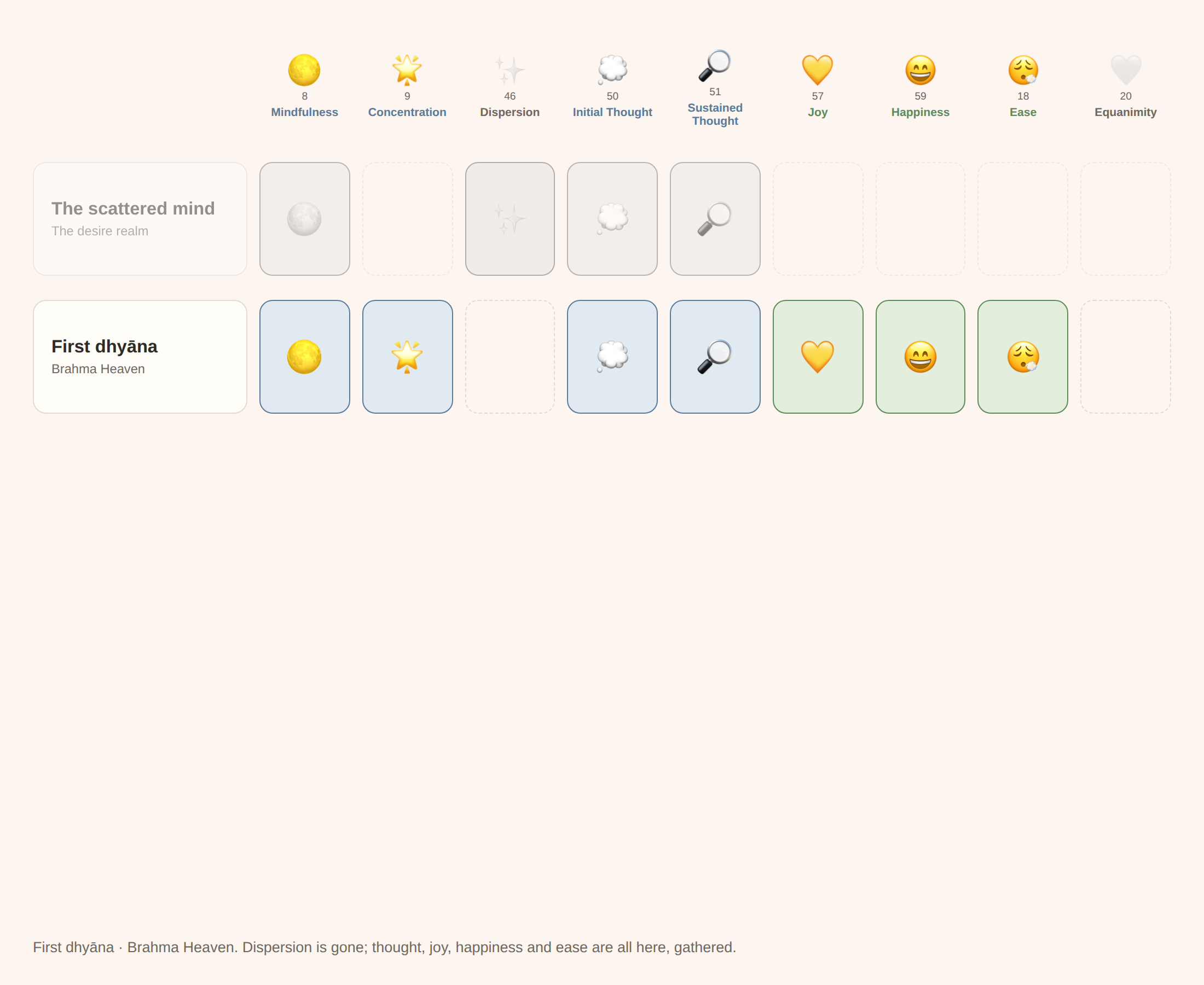
As the breath quiets the hindrances, the mind gathers and settles, and we have crossed into the first dhyāna: Brahma Heaven, the first level of the realm of form.
It is a gathered mind, but not yet a silent one. Thought is still present — placed gently on its one object, and resting there. We are concentrated, and still quietly thinking. (These are the two small movements the previous reading met: vitarka, which places the mind on its object, and vicāra, which keeps it there.)
Now notice what actually brought us here. We did not add anything. We let go of what was scattering us. Nothing produced the gathering. The hindrances stopped preventing it, and the mind, left to itself, gathered.
So the first dhyāna already shows this reading’s main point, one level before we state it. (The notes at the end explain why that is a precise claim and not a poetic one: dispersion is concentration’s mirror, and restlessness cannot be present in the same moment as a gathered mind.)
Joy and happiness arise on their own
Two things arise at this first level, and nobody asks for them:
- Joy — a quiet gladness, a lift in the heart.
- Happiness — a settled wellbeing that needs nothing added.
(Neither is among the classical fifty-one. Thầy added thirteen formations of his own to the list, and these are two of them.)
We do not manufacture them. They are what is there once the noise dies down, the natural feeling of a mind that has stopped grasping. At this level they come from leaving things behind: stepping back from wanting, setting the world’s demands down.
Ease comes in alongside them, body and mind no longer struggling. It is worth marking the difference now, because it pays off later: joy and happiness will both be set down as the levels deepen. Ease never is. It is still there at the fourth, after happiness itself has gone.
That is the surprising thing. We reached for nothing, and something arrived, because we set something down.
A taste of the first dhyāna
Most of us have already tasted a little of this, without ever calling it a dhyāna.
Washing the dishes, and for once only washing the dishes — the warm water, the weight of the bowl — with no running commentary underneath. A walk in the bush where, somewhere along the way, the arguing in the head goes quiet and there is just the path and the breath. Music you fall so far into that you forget to be a person listening to music.
These are already the realm of form — Thầy’s modest gate, met in an ordinary afternoon. Nothing was renounced; something was simply not being chased for a while, and a little happiness came in behind it.
They are not yet deep. The first dhyāna is this same movement — attachment easing, the mind gathering, joy and happiness arising on their own — only quieter, and lasting longer. The difference is degree of gathering, not a rule that says the senses have to be shut off before it counts. These everyday tastes are light and passing, but they are already the thing itself. What comes next is letting go a little more and letting it settle deeper on its own.
Release thought — the second dhyāna
Now we release the one thing still moving: thought itself.
The quiet placing and sustaining of the mind on its object falls away, and the inner talk goes silent. The joy and the happiness do not leave — but their source changes. In the first dhyāna they rose from stepping back, from what we had set down. Here they rise from the concentration itself. This happiness no longer depends on leaving anything behind. It comes from a gathered mind resting in its own depth.
Out of that stillness comes a settled clarity. Thầy’s name for this second level is the Pure Heaven of Great Light: “there is much light in this world” — the light is the heaven’s, in his telling, not a description of the mind.
Again, letting go is what took us deeper, and the happiness only grew.
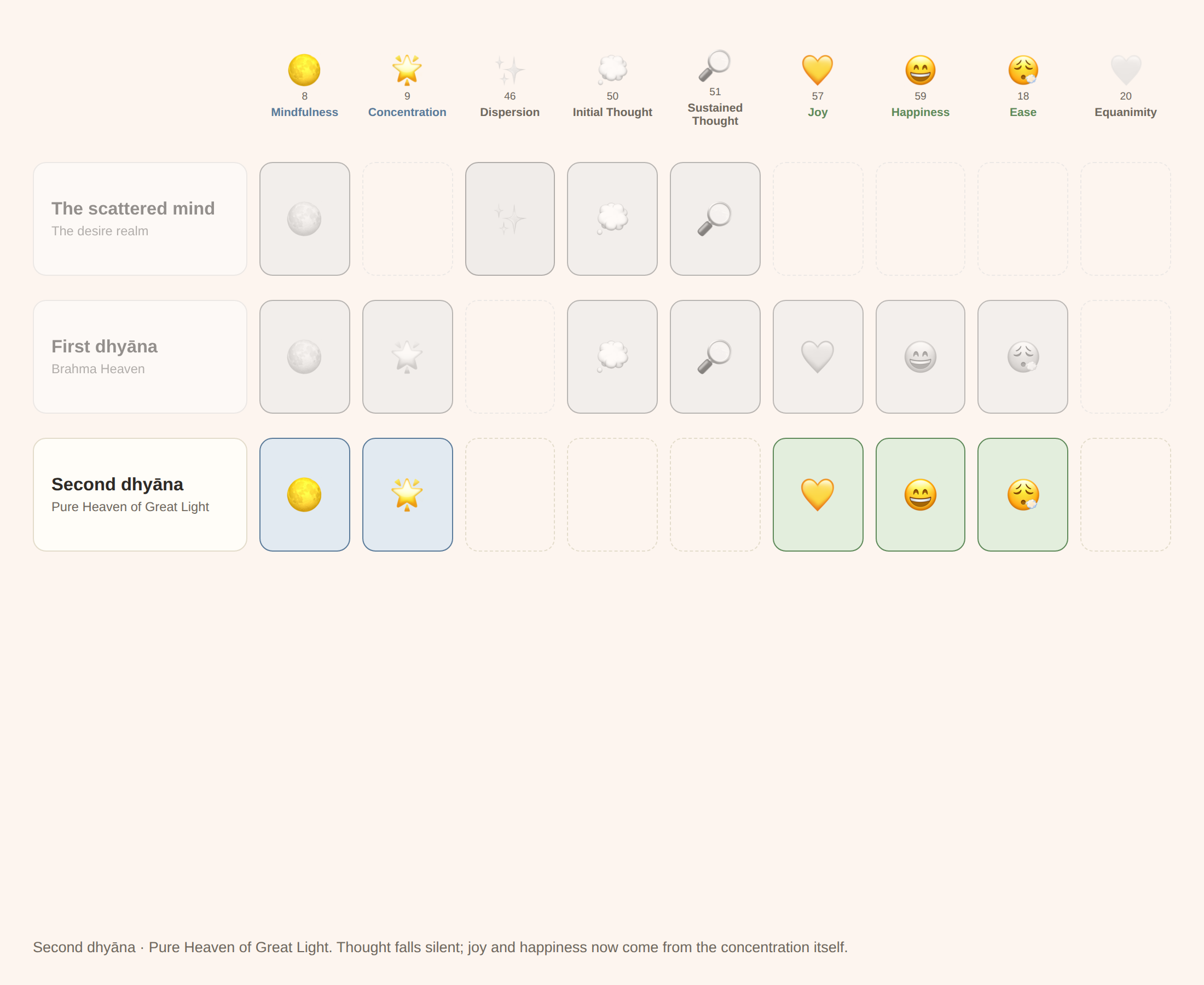
(The older tradition says something more precise about what arrives when thought goes — and its answer is faith, of all things: once the agitation of thinking stops, the mind runs clear and what is felt is confidence. Thầy says none of it, and our own list has no formation for inner clarity. Going Deeper sets out both, and why the table lights nothing new here.)
What comes next
Two more depths of stillness remain. Joy is released and the third level opens; happiness itself is released and the fourth. Each is the same move we have made twice already, and neither asks for anything to be added. That is where the next reflection takes up the path.
Contemplation Questions
When have you tasted the quiet happiness of a gathered mind — absorbed in work, in music, on a long walk?
What helps you live a little more simply and loosen some of your desires — and what makes it hard?
This reading says we go deeper by letting go. What is one thing you would have to set down?
Carry whichever of these stays with you — into your own quiet reflection, or into conversation with others.
Going Deeper
A few notes for anyone who wants to follow a thread further. The reading only says “the mind gathers”; these are the notes behind that phrase.
The word for it: ekāgratā
Every time we say “the mind gathers,” or “comes to rest on one thing,” we are naming something the tradition has a word for — and so does Thầy. He writes:
“In Buddhist meditation, we practice concentration, bringing everything into sharp, clear focus. This practice is called one-pointedness of mind (ekagrata). The object of our concentration — the queen bee around which our swarming thoughts can gather — may be our breathing, a leaf, a pebble, a flower…”
The image just before it is the one to keep: mind consciousness as a swarm of bees, “buzzing around wildly and not concentrating in any one spot. Only when the queen is present will all of them gather together.” So our plain phrasing is not a substitution for the technical term — the gathering is his own image for it.
This comes from Verse 27, “States of Mind,” which reads: “Mind consciousness operates in five ways — in cooperation with the five sense consciousnesses and independent of them, dispersed, concentrated, or unstably.” Notice that 09.20 already borrowed the dispersed half of that line, as dispersion, concentration’s direct mirror. The bees are the concentrated half of the same line. (Verse 27 is a long way ahead of us — this is a forward glance, not a verse we have reached.)
Gathering is concentration — not a step toward it
It is tempting to picture gathering as an early, weaker thing that ripens into concentration proper. In this school it is not. Concentration (samādhi) is defined as one-pointedness; the two words name one factor from outside and from inside. That is why concentration is present at every level of the form realm: it is not that concentration accompanies the gathering, it is that being gathered is what concentration is.
This is also where our text parts company with the Theravāda Abhidhamma, and the difference matters. There, one-pointedness is a universal — faintly present in every moment of mind, so it never really arises, it only strengthens. In this school, samādhi is one of the five particulars — the formations that come up only in relation to particular things. It arises under the right conditions and is otherwise simply absent. So in our reading the gathering genuinely begins; it is not a dial being turned up on something already running.
(A small caution on words: it is tempting to call one-pointedness the “seed” of concentration. Better not — bīja, seed, is doing specific work elsewhere in this book, in the store consciousness.)
What has to be there first: mindfulness
If anything precedes the gathering, it is mindfulness. Thầy says so on the same page as the bees: “The stronger and the clearer our mindfulness, the more stable our concentration. Mindfulness always brings about concentration.”
So the two formations that carry through all four dhyānas are not merely a pair of constants — they stand in order. Mindfulness holds the object in view; the gathering forms around it. And there has to be an object: bees do not gather without a queen, which is why the breath is given to us first, before anything is said about depth.
Why it arises by removal, not by effort
Gathering is not manufactured. It is what the mind does when nothing is scattering it.
The formations make this a precise claim rather than a poetic one. Dispersion is concentration’s exact mirror — where one gathers the mind onto a single object, the other flings it across many. And restlessness simply cannot be present at the same time as concentration; they are mutually exclusive. So quieting the hindrances does not cause the gathering. It stops preventing it. As 09.20 put it: still both movements — the scattering and the sinking — and the mind, left to itself, gathers.
So the first dhyāna already shows the whole point of this reading, one level before we state it. We do not add concentration in order to cross into the realm of form. We set down what disperses, and find that we have crossed. Releasing thought to open the second dhyāna is the same move again, one turn deeper.
The three that work together — and the one that never leaves
At the first level, three things are in play: vitarka places the mind on its object, vicāra keeps it there, and the one-pointedness is the unification they hold in place. They arise together and support each other; it is not that the two movements manufacture the third and hand it over. They are one event described two ways — what the gathering does, and what being gathered is.
And the touch is lighter than “holding” suggests. The old similes: vitarka is the bee flying to the flower, or the bell being struck; vicāra is the bee hovering there, or the sound ringing on — or a bird, wings beating to take off, then gliding with wings still. By this level the hindrances have already settled, restlessness among them, so nothing needs to be gripped: the mind rests on one thing rather than being made to stay. (These similes are Visuddhimagga commentary, not the book’s own — scaffolding, useful for precision, not to be attributed to Thầy.)
Then, level by level, everything else is set down. Thought is released and the second opens — and the tradition marks the deepening exactly there, naming the second dhyāna’s unification of mind (ekodibhāva) only once applied and sustained thought have stilled. Joy is released entering the third, happiness entering the fourth. The one-pointedness is never released. It only grows purer as the rest falls away.
The classical formula for the deepest level names three: equanimity, mindfulness made pure, and one-pointedness — upekṣā-smṛti-pariśuddhi, purity of mindfulness due to equanimity. Our own table shows four, because it also keeps ease, which is never released at any level. It is the same picture with one more column.
One boundary worth marking: the tidy scheme of five factors present at the first dhyāna, released in sequence, is Theravāda Abhidhamma and Visuddhimagga systematisation, not this book’s own machinery. Thầy gives us ekagrata at Verse 27 and the four heavens in Chapter 9, and he does not run the five-factor analysis anywhere in this book. In the discourses themselves, unification is named explicitly only from the second dhyāna onward. We use the scheme because it names precisely what falls away and what stays — the same way 09.20 used the five hindrances — and we say whose it is. (In another of his books he does describe these levels, and differently; that is the last note at the end of the next reading, Everywhere Pure.)
What arrives when thought goes
We describe the second dhyāna by what leaves: the placing and sustaining of the mind on its object fall away, and the inner talk stops. But the older tradition also names something that arrives in the space that leaving makes — and it is not what most people would guess.
The discourses describe the second dhyāna as having “inner clarity and unification of mind” (ajjhattaṁ sampasādanaṁ, cetaso ekodibhāvaṁ) — two things said of it that were not said of the first. Vasubandhu, whose verses we are reading, is more specific. In the Abhidharmakośa he lists the second dhyāna’s factors as inner clarity, joy, happiness and one-pointedness, and then identifies the first of them outright: śraddhā prasādaḥ — “purity is faith.” Once the agitation of thinking stops, he says, the mind-stream runs clear, and what appears is confidence — the confidence of someone who can now see for themselves that the noisier level really can be set down.
So the deepening is not only subtraction. Something clarifies. Faith — which the Inner Landscape defines as “confidence and trust that rest on understanding” — is, on this reading, the second dhyāna’s own flavour.
Two things need to be held alongside that.
The first is that Thầy does not say any of it here. He runs no factor analysis of the dhyānas in this book: prīti — joy as a factor of a level — does not appear in Understanding Our Mind at all, and sukha appears only far away at Verse 47, nowhere near the four levels. His four dhyānas are four heavens, described from outside. Of this one he says only: “The Pure Heaven of Great Light. This is the second level of the realm of form… There is much light in this world. The bodies of the beings of this world here are alike but their way of thinking differs.” The light belongs to the heaven in his telling — it is a name for the place, not for an inner clarity.
The second is that this is scaffolding, like the five hindrances in 09.20 and the five-factor scheme above — borrowed machinery, useful because it names things precisely, and not to be attributed to the book.
It is also why the release table lights nothing new at the second level. There is no formation in the fifty-one for inner clarity; the nearest is faith, which is not one of the columns and is nowhere tied to the dhyānas. Showing an empty gain there is the honest reading of our list, even where the classical list would fill it.
Ease and happiness — not one becoming the other
Once the fruits start being set down, a fair question arises: is ease (praśrabdhi) an earlier form of happiness (sukha)? Does one turn into the other as the dhyānas deepen?
The tradition gives two answers, and they disagree — but not in a way that matters for us.
In the discourses they are distinct, and they stand in order. The sequence runs confidence, gladness, joy, ease, happiness, concentration — saddhā → pāmojja → pīti → passaddhi → sukha → samādhi. Ease comes first and conditions happiness. Calm settles; wellbeing follows from the calm. Nothing turns into anything.
Vasubandhu gives the other answer. In the same passage that makes inner clarity into faith, he writes praśrabdhiḥ sukham ādyayoḥ — in the first two dhyānas, the “happiness” is ease. It is not a precursor to it. It is the same thing under a second name.
Both agree on the point that matters. Ease is never one of the things released. It belongs among the factors present in any wholesome state of mind, so it is still there in the fourth dhyāna, after happiness itself has been set down — which is exactly why it cannot be a cell that goes dark. What the fourth level releases is happiness as a factor of that level, not tranquillity as such.
That is why the table lights happiness and leaves ease out of the sequence altogether. That is not because ease and happiness are different kinds of thing, which Vasubandhu would dispute. It is because ease never enters the sequence in the first place.
Ease does have a column of its own on the tables, sitting between happiness and equanimity: blank in the scattered mind, since agitation and ease cannot be present at once, and there from the first dhyāna onward. It is simply never lit as a release. That is rather the point of giving it a column — on the tables that show what is present at each level you can watch it arrive with the first dhyāna and still be standing at the fourth, after happiness itself has gone dark. (One caveat, for the first two levels only: on Vasubandhu’s reading the ease cell and the happiness cell there are the same fact shown twice. We keep both, because Thầy’s fifty-one number them separately.)
09.22Everywhere Pure
The third dhyāna — we let go of joy itself, and what is left is not a thinner joy. It is the thing joy had been standing in front of.
The Reading
Verse 9 reads:
All manifestations bear the marks of both the individual and the collective. The maturation of store consciousness functions in the same way in its participation in the different stages and realms of being.
The previous reading stayed inside the realm of form and went one level further down into it — resting in the first dhyāna, then letting go of thought so the second could open. This reading does the same thing once more, with one surprise: this time we let go of something that is not a fault. We let go of joy.
That is worth pausing on before we start, because it changes what kind of teaching this is. Up to this point, everything set down has been something we were better off without: craving, anger, restlessness, the mind’s endless commentary. From here on, what we release is good. Joy is a wholesome state. Nothing is wrong with it. And still it is what stands between us and something quieter.
Thầy’s gate into this realm remains the modest one: “When we choose to live simply and abandon some of our craving, we are in the realm of form.” That is not a feat of concentration. It is a setting-down, and what follows from it.
The Teaching
The two that brought us here
Before going deeper, it is worth naming what carried us across the border in the first place, because it is easy to confuse it with what happens next.
Thầy’s own sentence about the crossing describes a mental formation we have already met. To abandon some of our craving is non-attachment — not merely the absence of greed, but a warm, positive movement toward contentment and sharing. Beside it stands non-aversion, goodwill in place of pushing away. The desire realm, in Thầy’s description, is where we touch craving, anger, arrogance and delusion; those two formations are the direct antidotes to the first two.
So the crossing out of the desire realm is their work. What happens inside the realm of form is different work. From the first dhyāna onward, what is released at each step is not an affliction at all. It is thought, then joy, then happiness. Each of them is harmless, and each of them is simply in the way of what lies beneath it.
Holding those two apart keeps this reading from sounding like more renunciation. There is a fuller note on it at the end.
What gathering is
The mind scatters on its own. Thầy calls this dispersion, and he is blunt about how much of our life it accounts for: “We live in dispersion and forgetfulness much of the time… caught by the past and future, running in every direction.”
Dispersion is one of the fifty-one mental formations, and it is concentration’s exact opposite. Concentration gathers the mind onto one thing; dispersion spreads it across many. The two cannot be present in the same moment, which is why removing one is the same act as arriving at the other.
The gathering has a name — one-pointedness, ekāgratā — and Thầy gives us his image for it: mind consciousness as a swarm of bees, “buzzing around wildly and not concentrating in any one spot. Only when the queen is present will all of them gather together.” The queen is not a metaphor left hanging. He says what she is: “the object of our concentration… may be our breathing, a leaf, a pebble, a flower.”
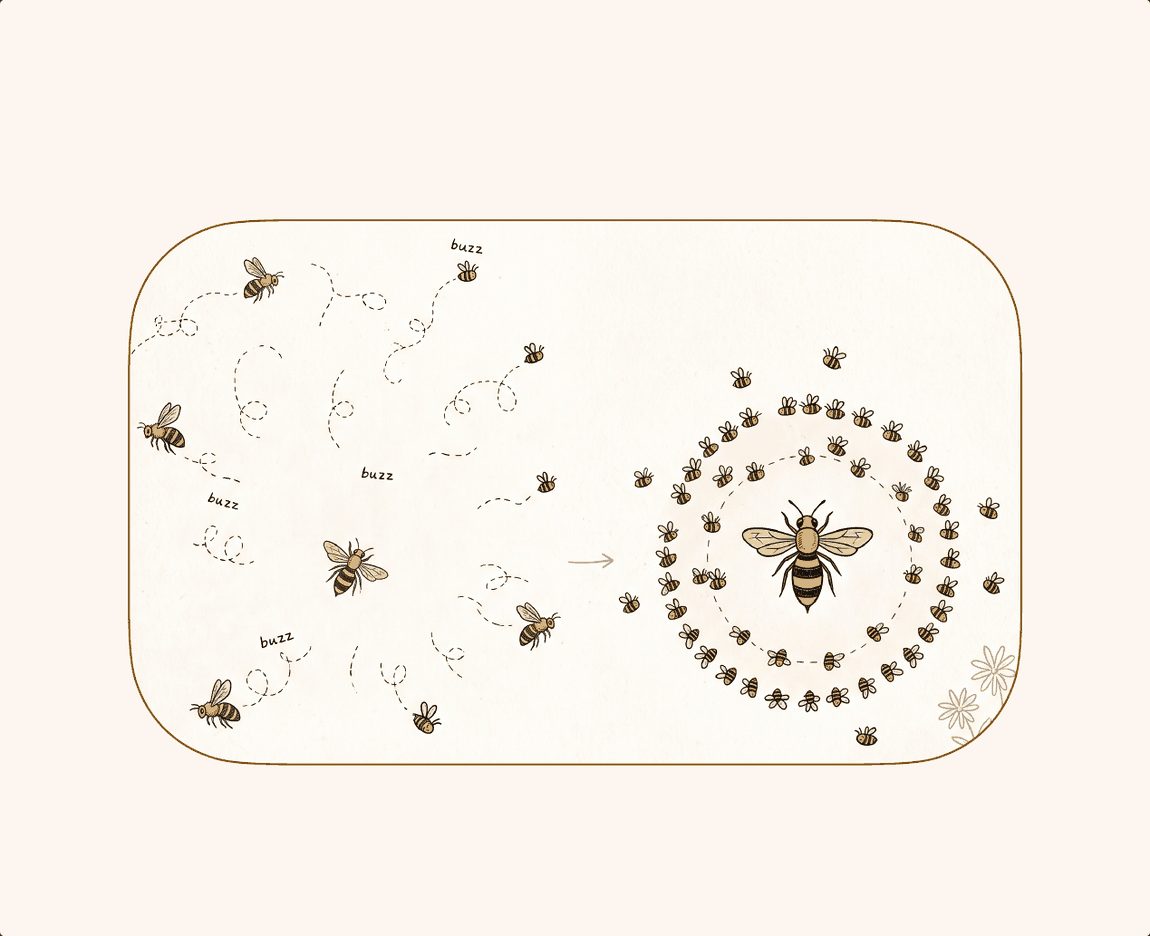
So there is something for us to do, and Thầy is not vague about it. He speaks of methods, of effort, of a lens focusing sunlight until it burns, of sitting meditation as work we make an effort at. But notice what the effort is for. It is not there to manufacture stillness. It is there to stop the scattering. The bees are not persuaded into formation; they settle because the queen is there and nothing is driving them apart.
And this is the one thing we never let go of. Thought is set down, then joy, then happiness — but the gathering stays, and it grows clearer as everything else falls away.
(This teaching sits at Verse 27, “States of Mind,” a long way ahead of where we are. We borrow it because we need it now. The step-by-step account of what is released at each level is borrowed too, from an older tradition’s machinery — the same way 09.20 borrowed the five hindrances. Where it comes from, and what Thầy himself says about it, is the last note at the end of this reading.)
The third dhyāna — Everywhere-Pure Heaven
Two depths of stillness remain, and each opens the same way: we let go of what brought us to the level before.
Here we let go of joy. It served us well. But joy has a lift to it, an excitement that still moves the mind, and it turns out that the mind can be quieter than joy allows. So we let that go too.
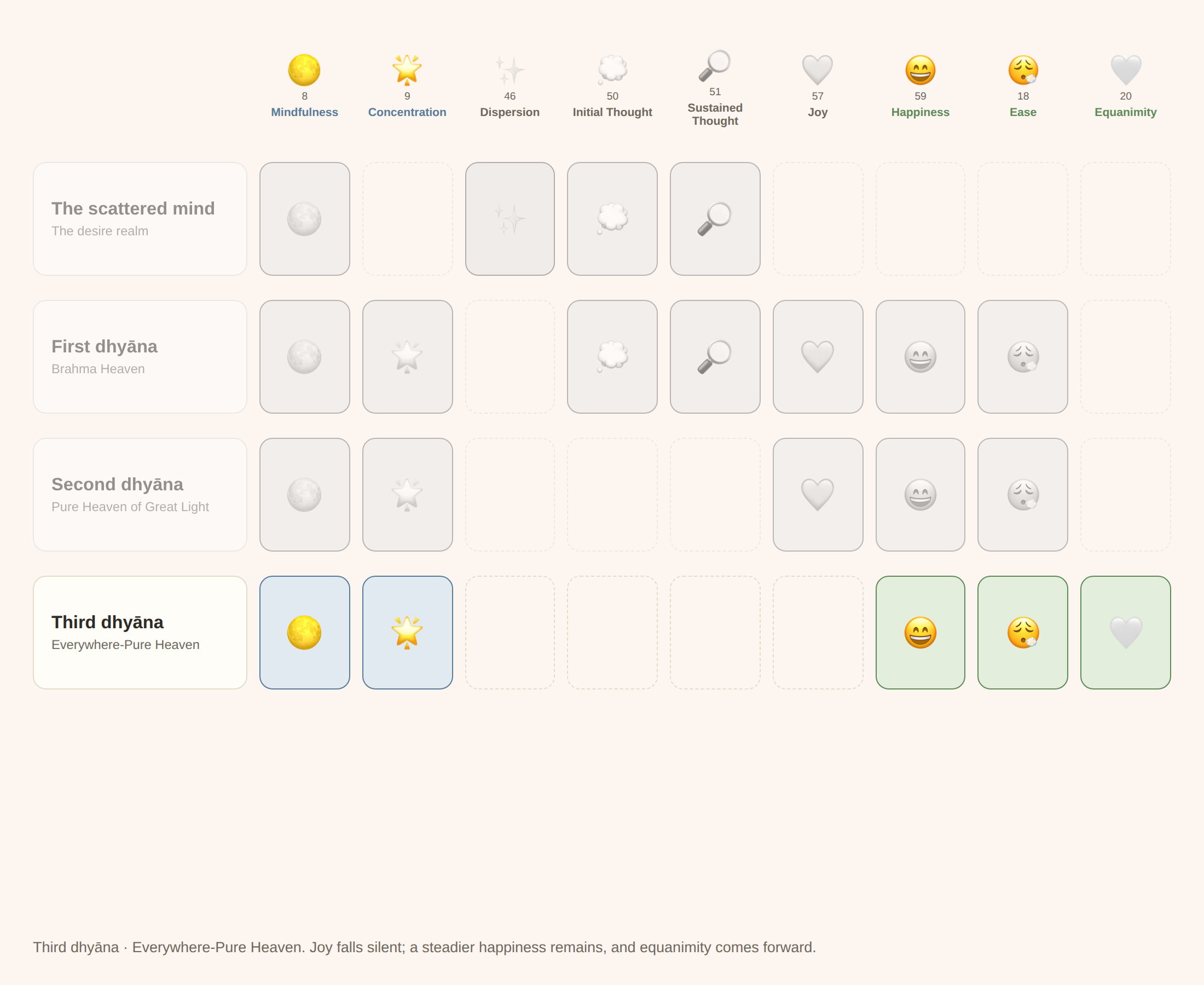
What takes its place is a quieter happiness — not the brightness of joy, but a deep, even steadiness, with equanimity and quiet mindfulness alongside it. The mind is no longer stirred. It is simply calm.
Thầy’s own description is short: “The Everywhere-Pure Heaven. This is the third level of the realm of form… it is very peaceful and pure. The beings who live here are exactly alike in body and mind.”
Not a state you reach alone
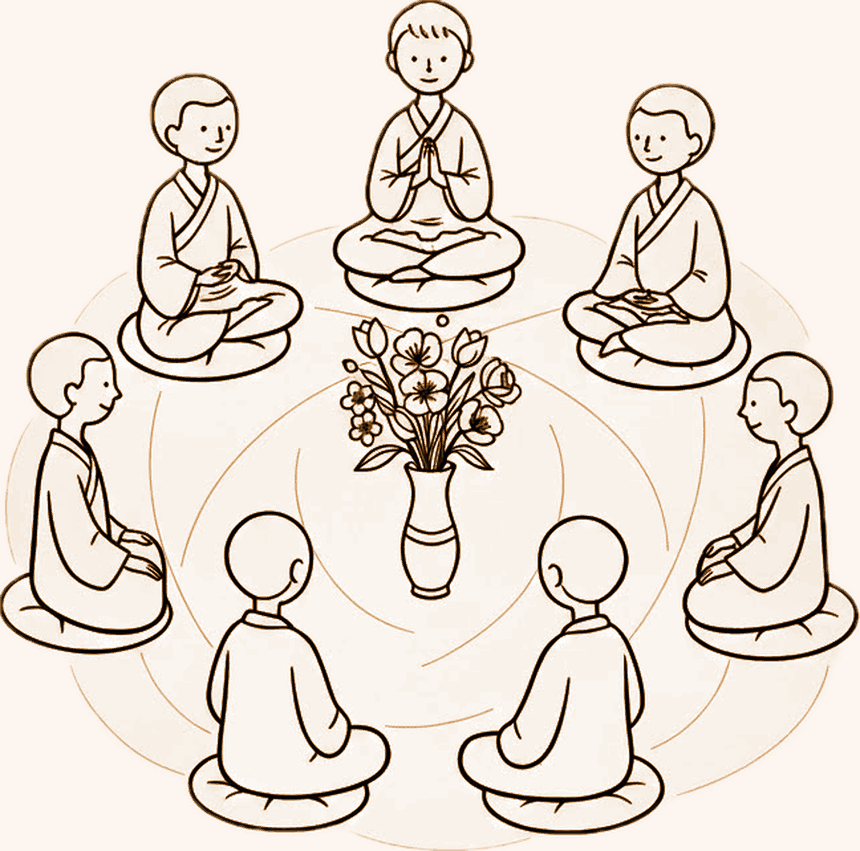
That last phrase — exactly alike in body and mind — is a description of a group, and it is not incidental. Every one of Thầy’s four dhyānas is described this way: as a heaven with inhabitants, never as an experience one person has. And a few lines later he says plainly what the whole scheme rests on: “The three realms and the nine stages are present because of the cooperation of the consciousnesses of many people.” His example is the community he lives in.
This can sound at first like a change of subject — as though the realms had stopped being states of mind and become external circumstances instead. They have not. The collective is still consciousness. It is simply more than one mind’s worth of it. That is exactly what our verse says: all manifestations bear the marks of both the individual and the collective. A quieter life is easier to live among people who are living one, and harder among people who are not. That is not a sociological observation. It is what the verse says.
What arrives as joy leaves
The old discourses describe this level in a set phrase: with the fading of joy, we rest in equanimity, mindful and clearly aware. Three qualities come forward as one departs.
Our own map can show two of them. Equanimity arrives here for the first time, and mindfulness has been steady all along. For the third — clear awareness — the fifty-one have no entry at all. They carry only its opposite, Lack of Discernment, for when it is missing. So the table shows one arrival where the phrase names three, and that is a difference between two lists rather than a disagreement about the teaching.
Either way, the point survives: this is not only a subtraction. We put one thing down, and the ground underneath turns out to be steadier than what we let go of.
A taste of the third dhyāna
We have already lived a little of this. It was not a rehearsal for the third dhyāna. It was the same movement, in a light and passing form.
After the guests have gone. The house was full all day; now the door is closed, the dishes are stacked, and you sit down in the quiet. The buzz has drained out of the room, and what’s left isn’t a let-down — you’re content, and nothing needs to happen next.

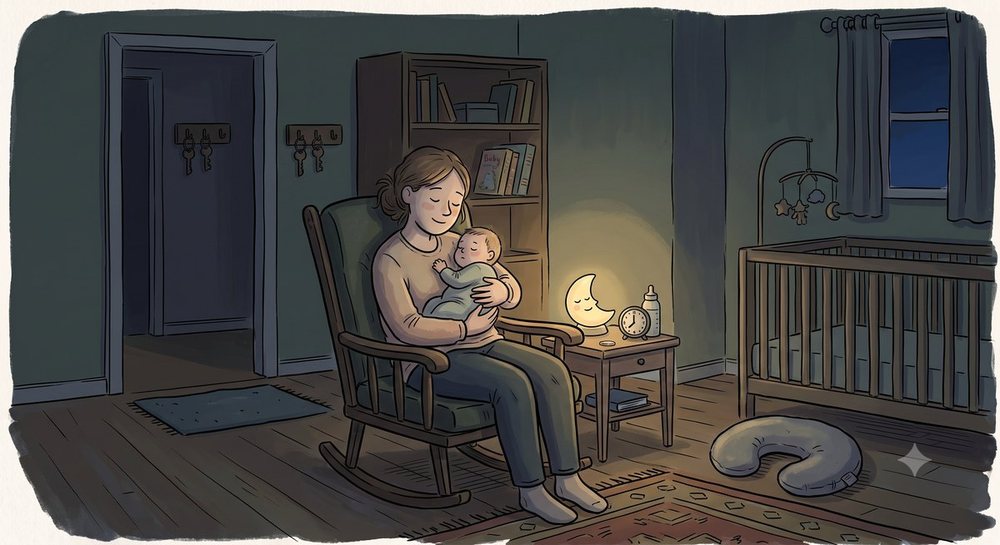
Holding a sleeping baby. The excitement passed hours ago. The room is dark, she is heavy and warm, and you’re happy just to sit there. You don’t want anything else.
Love that has been around a long time. Early on it had a flutter, a charge. That went years ago. What replaced it doesn’t sparkle, and you wouldn’t trade it back.
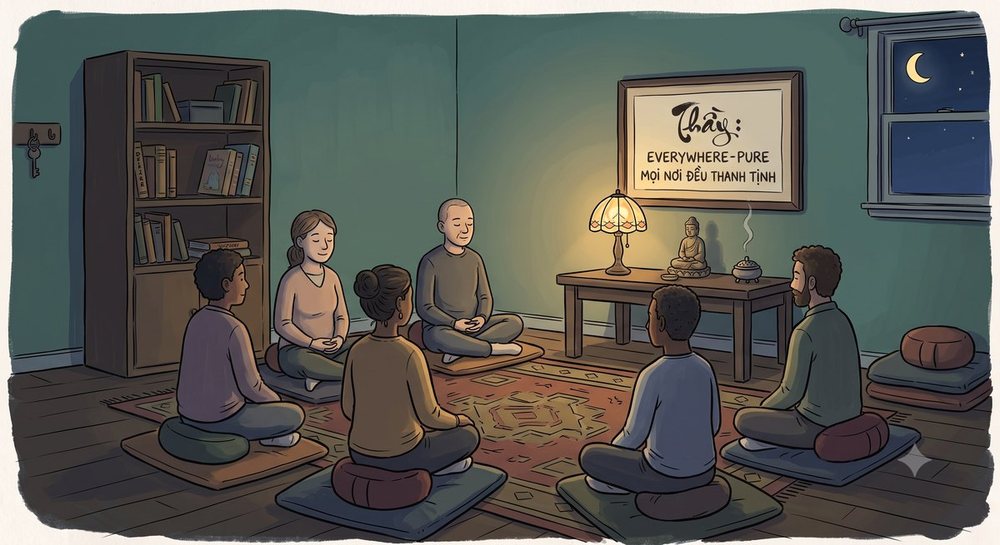
A sangha that has sat together for years. At the start it was exciting — a new group, a new practice, the energy of beginning. That wore off a long time ago. What’s here on a Tuesday night is quieter, and nobody would call it thrilling — but nobody wants the old days back either. Thầy’s name for this level is Everywhere-Pure.
A life you have simplified. Fewer things, fewer plans, less to keep track of. The relief of first letting go has faded; what remains is plain and steady.
Each time, something bright left, and what stayed was quieter and better. That is the movement the third dhyāna is made of. The quiet that remains is not a thinner joy. It is the thing joy had been standing in front of.
One limit: Thầy describes the realm of form as a way of living, so these examples fit the realm as a whole. He never gives an everyday marker for the third level specifically. So the claim here is about the movement, not about the level — a quiet Tuesday night is not the third dhyāna.
What comes next
One dhyāna remains. The next reading releases happiness itself, comes to the stillest level of the realm of form, and finds that it is still samsara, because what frees us is insight, not the depth of the stillness.
Contemplation Questions
Where in your life have you found that letting go of something opened more peace than holding on ever did?
The dhyānas come to rest in equanimity, not in pleasure. What does equanimity feel like to you, and how is it different from indifference?
Thầy says every realm is made by the collective consciousness of the people who live in it. What are you and the people around you making together?
Carry whichever of these stays with you — into your own quiet reflection, or into conversation with others.
Going Deeper
A few notes for anyone who wants to follow a thread further.
Isn’t letting go of joy just non-attachment?
The answer is no, though the two look identical from outside, because the gesture is the same.
Non-attachment is one of the eleven wholesome formations. What it releases is something that was doing us harm: grasping, craving, the reaching after what cannot satisfy. Its companion non-aversion does the same for the pushing-away. Between them they answer the two dominant marks of the desire realm — craving and anger — which is precisely why Thầy can describe the crossing into the realm of form as choosing to live simply and abandoning some of our craving. That sentence describes non-attachment in everyday words.
What the third dhyāna releases is joy. Joy is wholesome. Nothing is wrong with it. It is not a defilement being cleared, an affliction being answered, or a habit being unlearned — it is a good thing that turns out to be quietly in the way of a better one. The same is true of the happiness released at the fourth level, and of the thought released at the second.
So the gesture is the same and the object is different. And the difference matters for how the whole arc reads. If letting go of joy were non-attachment doing its usual work, the dhyānas would be a purification — a ladder of getting rid of faults, with the pure at the top. They are not. From the moment we cross the border, nothing being set down is a fault, and there is no summit being approached. That is the difference between this and renunciation, and it is why the next reading can be called Nothing to Attain without it sounding like a slogan.
There is also a technical reason non-attachment and non-aversion never appear in the release sequence at all. In the older analysis they belong to the group of factors present in every wholesome state of mind. If a state is wholesome, they are there. So they are present in all four dhyānas and are never let go of — which puts them in the same position as ease, present from the first dhyāna and still standing at the fourth after happiness has gone dark. They are not steps on the way down. They are part of the ground the whole way.
The three qualities, and the one our list has no word for
The phrase quoted above is not a modern gloss. With the fading away of joy, the discourses say, one dwells equanimous, mindful and clearly aware — upekṣaka, smṛtimān, saṃprajānan. It is the stock formula for the third dhyāna, and it appears in the Pali discourses and in the Sanskrit and Chinese Āgamas alike. Vasubandhu’s Abhidharmakośa tabulates it into a tidy list of factors, but it does not invent it. (It is worth knowing whose book that is: Vasubandhu wrote the Kośa before he came over to Yogācāra with his brother Asaṅga, so when we quote it we are quoting the same author whose Thirty Verses Thầy’s Fifty extend, at an earlier stage of his thinking.)
Two of the three sit on our map. Mindfulness (smṛti) is one of the five particulars, present long before the dhyānas begin. Equanimity (upekṣā) is one of the eleven wholesome, and arrives here.
The third does not. There is no positive formation in the fifty-one for clear awareness — saṃprajanya. What the list carries is its absence: Lack of Discernment (asaṃprajanya), the haze of acting without a clear sense of what we are doing. So the table lights one arrival where the phrase names three, and the honest thing is to say so rather than quietly add a column. This is the second time the same situation has come up: at the second dhyāna the older analysis names inner clarity arriving, and the fifty-one have no formation for that either, so the table lights nothing new there too. In both cases we show our own list faithfully and name what it cannot show.
Where the four levels come from, and what Thầy says about them
These readings lean on an account of the dhyānas that Understanding Our Mind does not give, so it is worth setting out where it comes from. The other readings point back here rather than repeat it.
What is in this book. Four heavens, described from outside, in a flat list of nine stages — plus the collective gloss that follows it, and the way-of-living framing in Chapter 3. That is all. He does not say what is present at each level, or what is set down between them. Prīti — joy as a factor of a dhyāna — does not appear in the book; sukha appears twice, far away at Verse 47, and neither it nor “equanimity” ever falls within reach of the four levels.
What is ours. The step-by-step account we have been following — thought released at the second level, joy at the third, happiness at the fourth — comes from the discourses and from the schools that organised them into a scheme. So does the tidy list of five factors present at the first level, and the listing of one-pointedness among them. So do the five hindrances of 09.20. We use it because it names precisely what falls away and what stays, and because the movement it makes visible is one Thầy teaches everywhere in his own voice.
What he says in his other books. He is not silent about the dhyānas outside this one, and what he says there does not match our table. In The Heart of the Buddha’s Teaching he describes the same four levels, and the qualities grow:
“In the form realm, there are four levels of dhyana. Mindfulness, concentration, joy, happiness, peace, and equanimity continue to grow through these four levels.”
Read plainly, that is the opposite of a release sequence. In the same chapter he describes the four formless levels at length, with a reason for each.
And he has a view about where the whole map came from. In Awakening of the Heart, and again in Breathe, You Are Alive!, he makes the case that the four dhyānas and the four formless concentrations are not the Buddha’s own teaching. They appear nowhere in the two sutras he treats as the foundation of meditation practice — the Full Awareness of Breathing and the Four Establishments of Mindfulness. Before his awakening the Buddha learned the formless concentrations from two teachers, “practiced [them] with great success,” then abandoned them, saying they did not lead to freedom from suffering. Thầy’s conclusion:
“…from my research, it seems to me that the Four Jhanas, the Four Formless Concentrations, and the Nine Concentration Attainments were not introduced into Buddhism as Buddhist practices until one hundred years after the Buddha’s passing.”
Just before that sentence he says how he thinks they came in: they “became a part of Buddhist practice after the death of the Buddha, probably due to the influence of the Vedic and other Yogic meditation schools outside of Buddhism.”
And two pages earlier in the same appendix is the sentence that keeps this from becoming a dismissal:
“We need not criticize them for being later teachings, certainly not before we have practiced them and seen for ourselves if they work well.”
So how do we hold these five readings? They are not a report on something the Buddha taught, and they are not a summary of this book. What we have been walking is a map drawn later, which Thầy knows well, describes accurately, and does not treat as essential. It is still worth walking, for the reason he gives — it makes visible a movement that is real, and that he teaches everywhere: we get quieter by putting things down, not by getting hold of them. But where the map and the book differ, the book is what we are studying. And where the map and Thầy differ — as they do about whether joy and happiness grow or are set down — we say so and leave both standing, rather than quietly choosing one.
09.23Nothing to Attain
The fourth dhyāna — even the quiet happiness is set down, and the mind comes to rest in equanimity. The stillest level of the realm of form, and still samsara: what frees us is insight, not the depth of the stillness.
The Reading
Verse 9 reads:
All manifestations bear the marks of both the individual and the collective. The maturation of store consciousness functions in the same way in its participation in the different stages and realms of being.
In the previous reading we let go of joy, and the third dhyāna opened. One thing is still here: the quiet happiness that arrived when joy left. This reading puts that down too, and that is the fourth level — the last one in the realm of form.
Then the reading turns and does what the previous three have been building toward. After four readings going deeper into stillness, it says plainly that stillness is not freedom. The stillest level of the realm of form is still inside the cycle. What gets us out is not a further depth of quiet. It is seeing clearly. Once that is said, the title of this reading stops being a paradox and becomes a description: there was never anything to attain, and every level opened only because something was set down.
The Teaching
The last thing we are carrying
At the third level, joy was released and a quieter happiness remained. Now that goes too — and with it the last stirring of pleasant and unpleasant feeling.
Four things stay. The first is equanimity, which arrived at the third level and is now unmixed. The second is ease, which has been present since the first dhyāna and is never let go of at any point. The third is mindfulness, which has been steady the whole way. The fourth is concentration, the gathering itself, which arose at the crossing and has carried us since.
The mind is even. Nothing lifts it and nothing weighs on it.
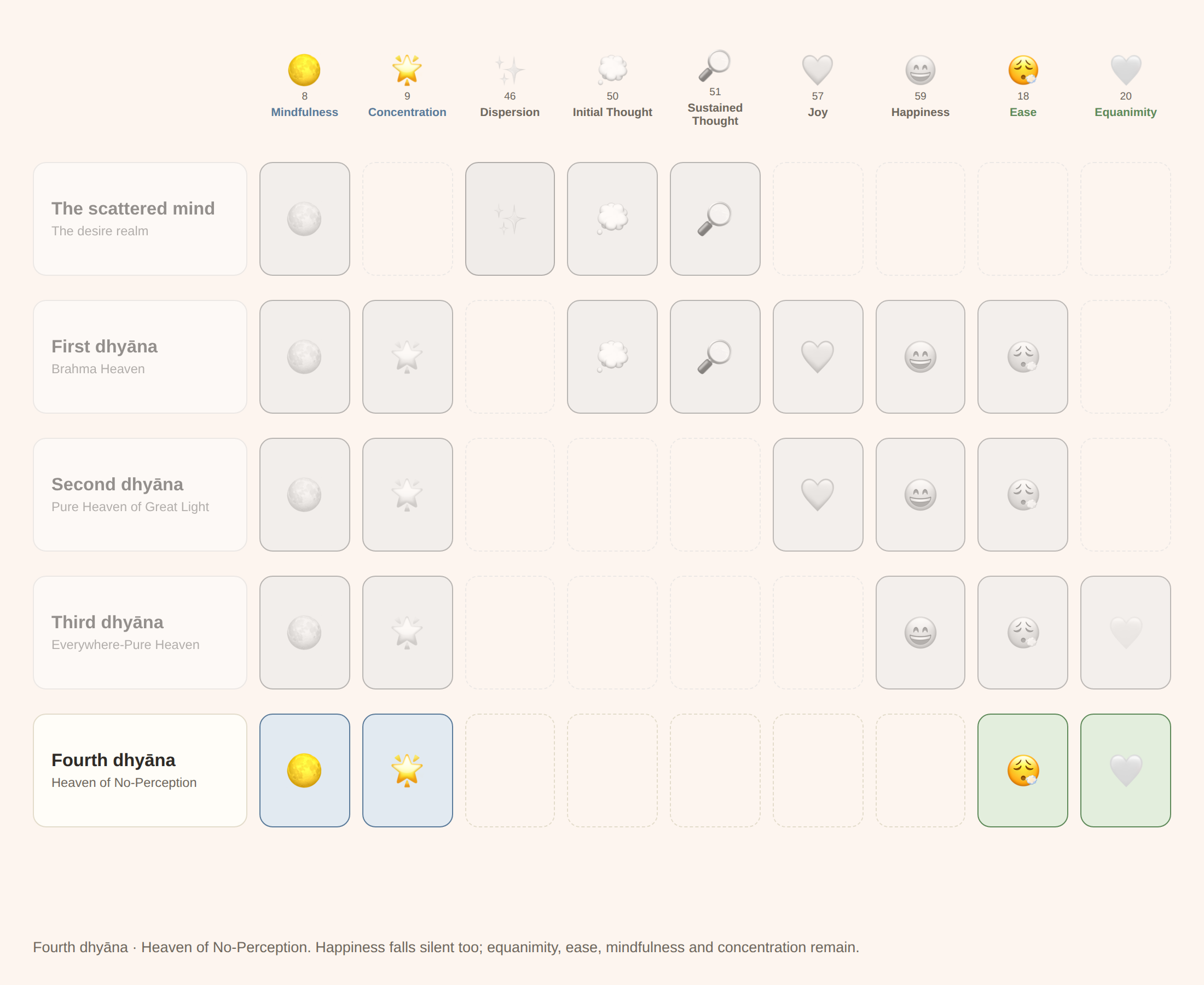
We arrived here by giving things up, not by getting them: thought, then joy, then happiness.
The name says more than he does
Thầy calls this level the Heaven of No-Perception, and it is the highest of the four. The name promises more than he delivers, and the gap is worth a moment.
His actual words are that beings here “do not have perception accompanied by ideation.” Perception has not stopped. Things are still known. The thinking about them has stopped — and that is not news at this level, because the thinking has a place on our map and it went dark two levels back. Initial thought and sustained thought were released entering the second dhyāna. So the fourth level’s name is describing something the table already shows, further up.
That raises the obvious question: why is perception itself not a column on that table? There is an answer, and it is about how the list of fifty-one is built rather than about this level.
Where this comes from
In this book, Thầy’s material is the four heavens, given as a plain list of stages with their inhabitants. He does not say what is released at each step. The account we have been following — thought, then joy, then happiness, each level opening as something is set down — comes from the discourses and from the schools that organised them into a scheme.
Outside this book he says a good deal more, and some of it cuts against our account: in The Heart of the Buddha’s Teaching he describes joy, happiness and equanimity as growing through the four levels rather than being set down, and elsewhere he argues that this whole map arrived in Buddhism long after the Buddha. We have kept our account, because it makes the movement visible and the movement is one he teaches everywhere. But it is not his, and where he differs we say so rather than choose for him. The full version of that accounting is the last note at the end of the previous reading, Everywhere Pure.
Still samsara
And all of this is still samsara.
That is not our editorial gloss on Thầy; it is his own description, and it sits in the commentary on this very verse. Introducing the nine stages, he writes that “realms of being” refers to “the three realms of samsaric existence.” All three — desire, form, formless. The stillest level of the middle one is inside the same cycle as the noisiest corner of the first.
Beyond this stillness is the realm of no-form, four levels further on. Beyond all of the realms is freedom. And the difference between the two is not depth.
The battery and the flashlight
Thầy explains why with a lamp.
“The practice of stopping brings concentration (samadhi). Concentration makes our mindfulness more stable… Concentration is the battery; the flashlight is mindfulness.”
A charged battery is not the same as light shining on something. We can be very still and still not see. That is the whole of the caution, and it is why four readings of deepening quiet do not add up to liberation on their own.
(He says it the other way round elsewhere, and means both: “mindfulness always brings about concentration.” The two grow each other. Neither is the seeing.)
But it would be a misreading, and an easy one to make after four readings on stillness, to hear that as concentration doesn’t matter. Thầy is careful in the other direction too, in the same passage: “With concentration, looking deeply (vipashyana) is much easier. In fact, concentration and looking deeply cannot be separated. As soon as there is concentration, looking deeply is already there.”
So none of this stillness is wasted. It is what makes seeing possible. We still have to look.
What frees us
What frees us is insight.
On our map it has two names. Insight (prajñā) is one of the five particular formations — direct, non-conceptual seeing, knowing the interconnected nature of things not by reasoning about them but by seeing them. Non-delusion is one of the eleven wholesome, and it is the root that transforms delusion at its source. Thầy writes: “Through the practice of looking deeply into the nature of interbeing, delusion or ignorance can be transformed into prajna, wisdom or understanding.”
And where he describes the actual moment of release, he does not describe a depth of stillness at all. Writing about the deepest of the meditative attainments, he says: “the grasping of manas begins to transform, due to the insight that the object it grasps is not self.” He names insight as the cause.
This is also why a level like the fourth dhyāna can be reached and then lost. A passage of Thầy’s is about exactly that, and it uses our own vocabulary: his example is a feeling of joy.
Nothing to attain
After four readings of this, we have added nothing. Every level opened when we let something go.
That has a name in the book, and it is a practice in its own right rather than an attitude: aimlessness, apraṇihita. Thầy puts it as directly as it can be put: “The Buddha advises us not to run away from anything in order to run toward something else. In fact, the practice of Buddhism is the practice of aimlessness, of having no goal (apranihita).”
He calls it the third of the Three Doors of Liberation, after emptiness and signlessness — “common to all the Buddhist schools.”
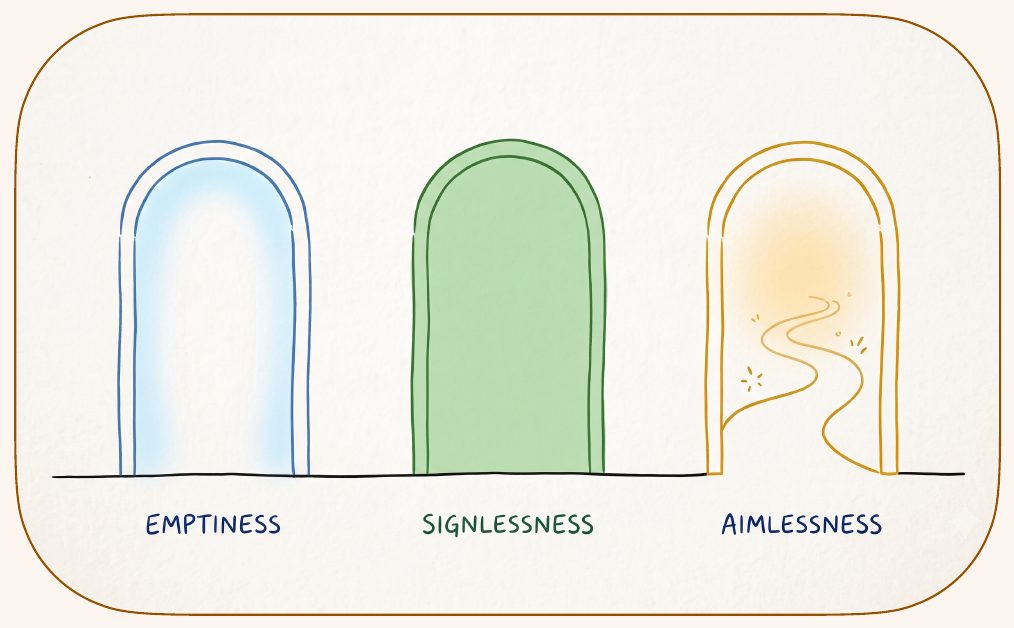
“The third door is aimlessness. We already are what we want to become. We don’t have to become someone else… We simply return to ourselves through mindfulness and touch the peace and joy that are already present within us and all around us. I have arrived. I am already home. There is nothing to do.”
And this reading’s title is his as well. Verse 49 is called Nothing to Attain, and it reads:
Nothing is born, nothing dies.Nothing to hold on to, nothing to release.Samsara is nirvana.There is nothing to attain.
That is forty verses ahead of us, and we are borrowing it early. It arrives here because this is the first place in these readings where it stops being an idea and becomes a description of what we have actually been doing.
What comes next
The realm of form is finished. Before going on, the next reading practises it rather than describing it. Then comes the realm of no-form, four further stages beginning with limitless space, and after that Chapter Nine’s own close, which our verse has been pointing at all along: the law of affinity, and transformation by watering the wholesome seeds.
Contemplation Questions
Thầy says concentration and looking deeply cannot be separated. When has being calm let you see something you had been avoiding?
We have spent four readings letting go, and nothing was ever added. Where do you still practise as though you were collecting something?
We keep meeting the same instruction: there is nothing to attain. What makes that hard to trust?
Carry whichever of these stays with you — into your own quiet reflection, or into conversation with others.
Going Deeper
A few notes for anyone who wants to follow a thread further.
Why perception is not a column on the table
The level is called the Heaven of No-Perception, so the obvious question is why perception is not one of the columns on our table — lit through the first three levels, going dark at the fourth. There are three reasons, and the first is how the list itself is built.
Perception is one of the Five Universals. That group is defined by being present in every single moment of mind; they come along with all consciousness. Thầy lists them at Verse 30 and states it plainly: “All eight consciousnesses are associated with the five universal mental formations.” The Inner Landscape’s entry for perception says the same thing again: it is present in every moment of consciousness. A universal cannot be released, by definition. Nothing on the release table is a universal — every column is a particular, a wholesome or an indeterminate formation, which is exactly why those columns can come and go. A perception column that went dark would put the table at odds with the list it is drawn from.
The second reason is that what the name points at is already on the table, two levels earlier. Thầy does not say perception stops. He says beings here “do not have perception accompanied by ideation.” Perception carries on; the thinking about it stops. And the thinking has a place on our map — initial thought and sustained thought — and both go dark entering the second dhyāna. So a perception column would not only say the same thing twice, it would say it in the wrong place.
The third reason is that it would break the sequence. What is set down at the fourth is happiness, sukha. That is the stock formula of the discourses, and it is the one part of this account that is not borrowed bookkeeping. If we inserted a release the sources do not have, we would lose exactly the credibility the note on sources is trying to earn.
We have met this shape before, running the other way. At the second dhyāna the older tradition names an inner clarity arriving, and at the third a clear awareness, and our fifty-one have no positive entry for either — the list carries only the negation, Lack of Discernment. The decision then was not to “fix” the table: it is showing a different list, not disagreeing with the doctrine. Here the situation is inverted, because our list does have the entry and it is a universal. The decision is the same.
This note does not settle one thing. Elsewhere in the book Thầy describes a realm of non-perception where perception really does stop — “a world in which there is no perceiving” — and he writes about it warmly, quoting the poet Nguyễn Công Trứ: “In my next life, may I not be born human / but as a pine tree singing between heaven and earth.” He never joins that description to the fourth dhyāna, and the two do not obviously agree. We have kept them apart rather than reconciling them on his behalf.
Why the fourth dhyāna can be lost
The reading says you can reach this level and lose it again, and then moves on. Here is where that comes from, because it is the reason these readings have never drawn the levels as a ladder.
At Verse 11 Thầy divides everything into phenomena with leaks and without leaks — āśrava and anāśrava. “With leaks” is his image of a cracked earthenware jar: “there is still something dripping out.” What makes an experience leak is not that it was shallow. It is that it is not yet understood: “the action or experience does not have the nature of true insight and liberation—there is still the possibility of falling down and turning back.”
What makes the passage worth quoting rather than paraphrasing is his example. He does not reach for something obviously fragile. He reaches for a feeling of joy — the same joy the third dhyāna set down:
“Suppose we have a feeling of joy. This feeling may be with or without leaks. If the experience is unstable because our understanding is superficial, our feeling of joy might be leaky. When we discover the truth of something and have understanding and insight, that feeling of joy is pure.”
So the difference between an attainment you keep and one you lose is not how deep it went. It is whether insight was there. That is the same answer this reading gives from the other direction, and it is why the fourth dhyāna is the stillest level of the realm of form and still samsara.
It is also why we have never called the four levels rungs. Thầy uses ladder, climb and rung in exactly two places in this book — at Verse 22 and at Verse 14 — and neither is the dhyānas. A ladder is something you climb and then stand on. This is something you can be at the top of and slide off.
09.24The Practice of Gathering
An evening of practice. Four sessions described the realm of form; this one sat in its doorway for half an hour.
The Reading
Verse 9 reads:
All manifestations bear the marks of both the individual and the collective. The maturation of store consciousness functions in the same way in its participation in the different stages and realms of being.
Four readings took us through the whole realm of form — the doorway, then thought, then joy, then happiness, each level opening as something was set down. Then the last of them said plainly that stillness is not freedom.
This reading teaches nothing new. It takes the first step of that sequence, the gathering that is the doorway, and practises it for half an hour.
The Teaching
Why spend a whole evening not learning anything
There is a particular way of getting the teaching wrong that comes from studying it well. You can follow the four levels, name what is released at each one, hold the whole map in your head — and never once have sat still long enough to feel the mind gather. The four levels are then something you know about rather than something you have been anywhere near.
Thầy is unusually plain about this. The practice is not what you do once you have understood; the understanding comes out of the practice. Reading about the breath is not breathing. And the central claims of those four readings — that the mind settles on its own once nothing is pulling it apart, that letting go takes you further than trying harder — are not claims you can check by thinking about them. You check them by sitting down.
So one reading in five is given to doing it. There are no new terms and no next level. There is half an hour of the first thing.
What we were doing
The desire realm is the mind never resting: roaming from one thing to the next, chasing what is pleasant, getting away from what is not. Concentration is that movement run backwards. It is not withdrawal from the world. It is the mind coming to rest on one thing instead of many.
Thầy’s image for it is in Verse 27: a swarm of bees is scattered until the queen arrives, and then they gather round her. That gathering is one-pointedness, ekāgratā, and in this school it is not a separate quality added on top of concentration — it is what concentration means. The moment the mind unifies, we have already stepped out of the desire realm. That is the doorway, and it was all we practised.
Before the mind gathers, the noisier energies have to quieten. The older tradition lists five, and they are not foreign to Thầy: they sit in the Discourse on the Four Establishments of Mindfulness, which he translated and taught from, as sensual desire, anger, dullness and drowsiness, agitation and remorse, doubt. In Understanding Our Mind he does not use the list at all. He has one word for the state the noisier ones leave us in — dispersion, the scattered mind — and it is dispersion, not the list, that sits on our map as a formation. (Drowsiness and doubt are not dispersion; they undo concentration the other way, by dulling it and by draining the wish to bother. 09.20 has the fuller account.)
And thinking does not have to be switched off at the door. Its habit is to breed more thinking, one thought branching into ten, but nothing is forced out: with less to want and less to push away, there is little left for the mind to spin about and the branching loses its fuel. Thought does not go silent here. It stops wandering. The silence comes later, at the second level, and it comes by itself.
Nothing was added all evening. We stopped scattering, and sat with what that was like.
The Practice
Half an hour, on your own. Sit in a way you can hold for that long. The lines below are all there is — each is said once, and everything between them is silence. They follow Thầy’s first tetrad from the Full Awareness of Breathing: long or short, then the whole body, then the body calming, with his “follow the breath all the way through” between them.
Sit down and let the room settle. Nothing to do, nowhere to go. Three minutes of quiet.
Notice the breath. Is it short, or long? Three minutes.
Follow one breath all the way in, and all the way out. Four minutes.
Now the body. Not any part of it — just that you have one. Four minutes.
Notice it settling. You are not making it settle. Four minutes.
Let the breath be the only thing. When you have gone, come back, without comment. Seven minutes.
Whatever has arrived, let it be here. Don’t reach for it. Three minutes.
Nothing was added. You only stopped scattering. A minute or two.
Then take one breath, and let the room come back.
If a stretch feels long, that is the practice working. Don’t fill it.
The Video
This short film goes with the sitting. It is three minutes long, and it is about the difference between knowing you are in a hole and doing something about it, which is the same point the sitting makes without words.
Getting Out of the Well — a short teaching by Thich Nhat Hanh: https://youtu.be/CyRTGU3xOcg
Contemplation Questions
What did you notice when you stopped adding anything?
What arrived on its own?
Where in your week is there half an hour that could be this, instead of one more thing you have read about it?
Carry whichever of these stays with you — into your own quiet reflection, or into conversation with others.
09.25The Last Four Stages
The realm of no form — stages six to nine, and the end of the nine. The ninth stage is still samsara, and what frees us was never one more stage along.
The Reading
Verse 9 reads:
All manifestations bear the marks of both the individual and the collective. The maturation of store consciousness functions in the same way in its participation in the different stages and realms of being.
The words to hold onto are the different stages and realms of being. There are nine stages and three realms — the realm of desire and its six worlds, then the four levels of the realm of form, and then these last four, which complete the nine.
These four are the realm of non-form. At each one the mind rests on something finer than the level before, until at the fourth there is almost nothing left to rest on. Then the stages run out, and we are still inside them.
None of the nine is a place. They are states of mind, and Thầy says so in this same chapter: “All nine stages exist within us. When one manifests, the others are less distinct but they are nonetheless present.” When the reading says a mind dwells at a level, that is what it means.
The Teaching
Into the realm of non-form
The realm of form ends in stillness. At its fourth level the mind is steady: nothing lifts it up, and nothing drags it down. That stillness is not freedom, and the four stages above it do not change that.
Thầy describes the realm this way:
“In the third realm, the formless realm, materiality is absent. Only energy is present, and this energy manifests as our mind, our anger, our suffering, and so forth. Life continues, but there is no perception of form.”
He also says how we come into it: “Looking even more deeply, we can lessen our attachment to form and begin to dwell in the realm of non-form.”
It is the same move that opened every level below. Nothing is added. This time we put down form itself.
One phrase in that passage is easy to misread: only energy is present. It sounds like a claim about a subtle substance in some other place — a finer stuff the mind meets once matter is out of the way. He means something much more ordinary, and he says so in his own words at the Winter Retreat.
Where this comes from
In this book, Thầy gives each of these four levels a name and a place among the nine stages, and nothing else. The list shows it plainly. Levels two to five each get a sentence about the beings who live there — “bodies different from one another, but they think very much in the same way”, “much light”, “exactly alike in body and mind”. Levels six to nine get a name and a number: “The Realm of Limitless Space is the first level of the realm of non-form.” That is the whole entry.
He says far more elsewhere. In The Heart of the Buddha’s Teaching he names what the mind rests on at each of the four: limitless space, then limitless consciousness, then nothingness, then neither perception nor non-perception. He numbers them differently there — his fifth to eighth are this book’s sixth to ninth — but they are the same four in the same order. And he does not leave them as bare objects. He reads each one through interbeing: space is made of non-space elements, and nothingness is the fruit already in the flower. And his nine and this book’s nine are not the same nine: the two books put freedom in different places.
What he does not give is the movement between them — what falls away at each level, what changes, how one opens into the next. We looked for it in the five of his books this project holds and did not find it. That comes from the Abhidharma, the early commentaries, and we took it from there because without it there is nothing to say about a level beyond its name.
He also thinks the whole scheme arrived in Buddhism about a hundred years after the Buddha died, and that a practitioner can do without it. We come to that later, in his words.
Finer and finer
At each of these four levels the mind rests on something. Each time it is less than the time before.
First the mind rests on open space. Then on the awareness that held it. Then on the absence itself. Then on something so faint you could not say what it is.
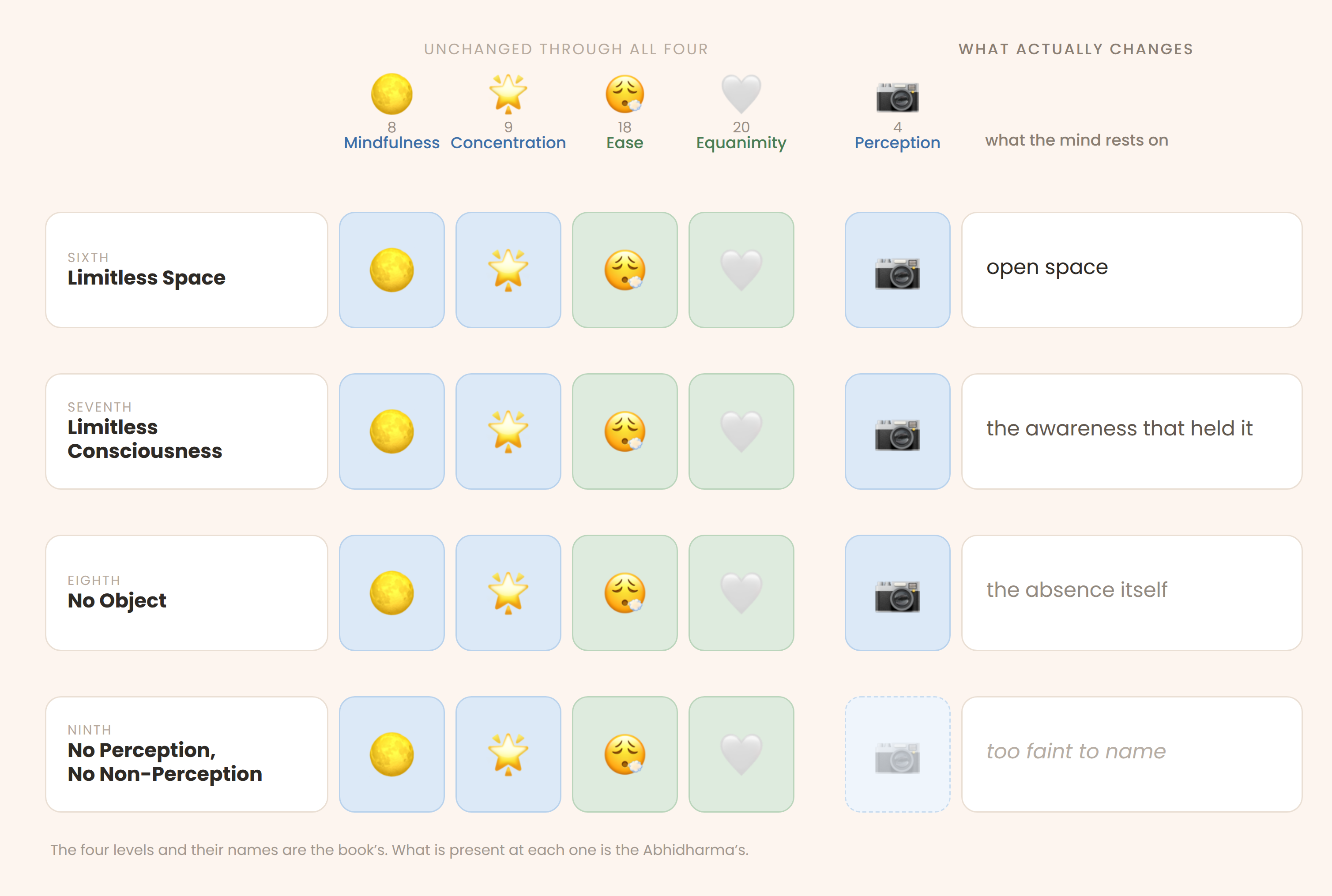
The book’s names for them say the same thing in order: the Realm of Limitless Space, the Realm of Limitless Consciousness, the Realm of No Object, and the Realm of No Perception and No Non-Perception.
You are aware of something the whole way through. That does not change. There is just less and less to be aware of.
Even at the eighth level, where what you are aware of is that there is nothing there, that absence is what you have hold of. The book says why this has to be so, in a passage about perception rather than about these levels: “If there is no object of perception, there will be no perception. There cannot be a perceiver if there is no object to be perceived. Consciousness is possible only when subject and object manifest together.” Subject and object arrive together or not at all. So the mind at the ninth level is doing what mind always does, on a very fine object. That is one reason the ninth stage is still samsara. The book gives its own, in Chapter Three, and it is about the seeds: “In the realm of non-form, suffering still exists because all wrong perceptions have not yet been removed and many desires are still dormant in the depth of our consciousness.” The stillness reaches the surface. It does not reach the store.
Nothing is set down here
Look down the four left-hand columns of the table above. Mindfulness, concentration, ease and equanimity are exactly the same at the ninth level as at the sixth. There are four levels, and nothing is released at any of them. The only thing that changes is what the mind has to work on.
The four levels below these work the other way round. Each one of them opens because something was released:
A taste of it
Three ordinary moments come close.
You are floating on your back in water with your eyes closed, and you stop being able to feel where you end.
You are lost in a piece of music and the room disappears. Afterwards you realise you were awake the whole time, and you were not aware of anything in particular.
It is the last minute before you fall asleep. The thinking has thinned out. You are not thinking, and you are not not thinking.
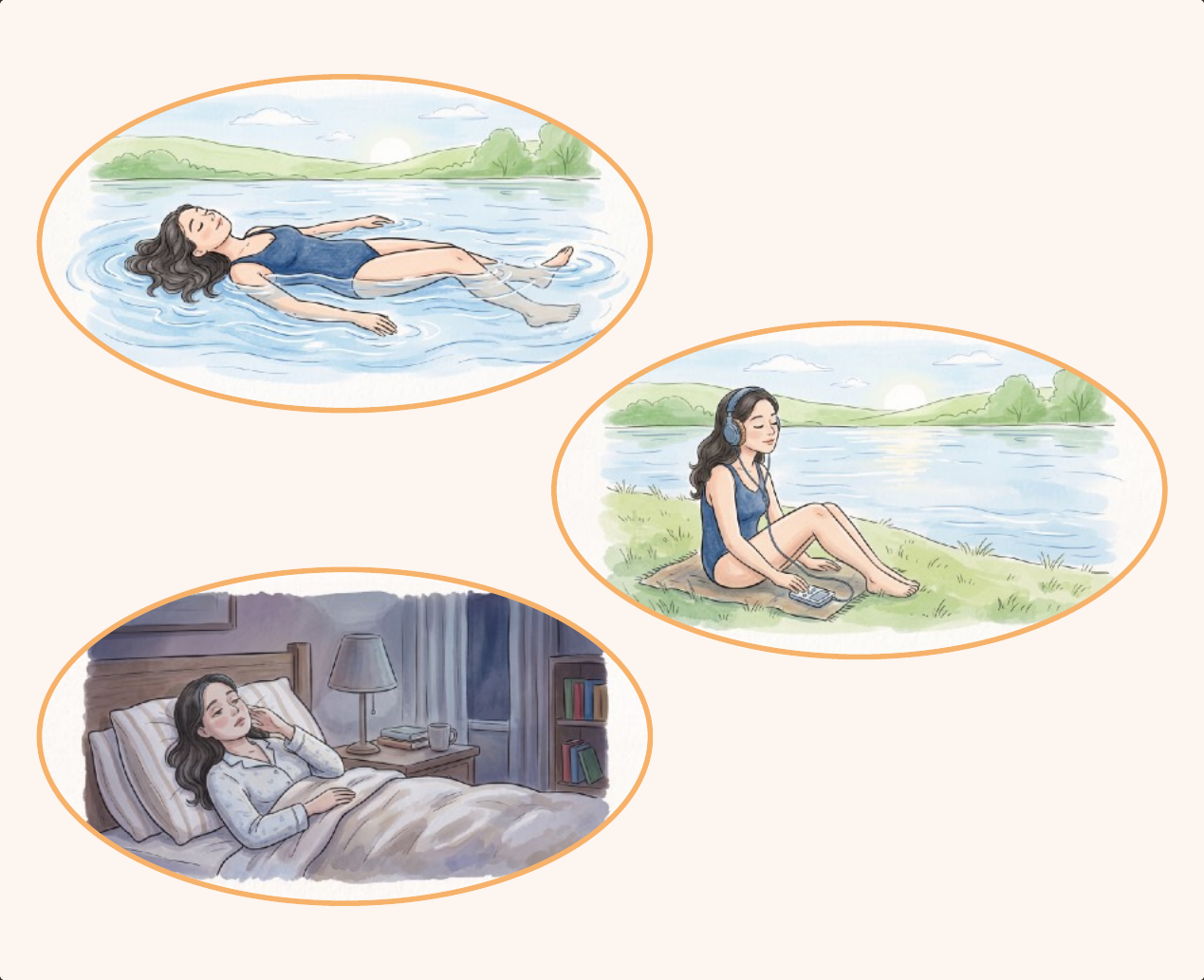
That last one is the closest everyday example, and it still is not the ninth level. As you fall asleep your awareness dims. At the ninth level it is bright, and that is the difference. The book keeps its own short list of the states where the thinking mind stops, and dreamless sleep is on it. These four levels are not.
These are hints. None of them is the thing itself. And none of them fixed anything — you got up the same person, with the same problems waiting for you.
Thầy says in The Heart of the Buddha’s Teaching: “Sometimes we need to escape our problems for relief, but at some time we have to return to face them.”
The end of the stages
That is all nine stages. The realm of desire, four levels of form, four levels of non-form.
There is nothing finer left to rest on. And you are still aware of something.
That leaves one question. Does any of it set us free?
The next reading comes back to these same four levels and looks at what the mind is actually doing at each one. Then it comes to the question.
Contemplation Questions
Have you ever come back from something deeply peaceful — a retreat, a long sit, a holiday — and found the same difficulty waiting for you, exactly as you left it?
When you sit, are you hoping to go deeper, or to see more clearly? Have you noticed a difference between the two?
We ran out of words at the ninth stage. Is there anything in your own practice you have never been able to describe to anyone?
Carry whichever of these stays with you — into your own quiet reflection, or into conversation with others.
Going Deeper
A few notes for anyone who wants to follow a thread further.
What Thầy means by “only energy is present”
Thầy’s description of the realm of non-form rests on one phrase: “materiality is absent. Only energy is present.” He is not reaching for anything mystical there, and we can say what he means because he says it elsewhere, about these same two realms.
At the Winter Retreat, teaching the seeds of store consciousness, he put it this way:
“Matter in Buddhism it’s called rupa… We have the realm of form and we have the realm of non-form. And in one of Thay’s poems, it said what happens when the form comes in touch with the non-form. And in science, it says that when matter comes in touch with… anti-matter, it destroys itself, and it becomes energy. So matter can become energy, and that energy can become matter again, and that nothing is lost and nothing is added to it.”
— What is the Purpose of this Human Life, 5 December 2013
The context matters. He had been asking whether the seeds in store consciousness are innate or newly planted, and answering that in Plum Village we take neither view: the seeds are neither new nor old, neither increasing nor decreasing. That, he says, is the teaching of emptiness — nothing added, nothing lost — and it is the same thing physics calls the conservation of energy. Matter and energy are not two substances, one solid and one subtle. They are one thing under two descriptions, and neither can be created or destroyed.
He returns to it in January with an image the sangha already knows: H₂O is the seed, and cloud and snow are the formation. “Matter is energy, and energy is matter… nothing is dying, nothing from being to non-being.” (What is Emptiness, 16 January 2014.)
So a realm described as having no materiality and only energy is not a subtle substance somewhere else. Nothing has been added to the world and nothing has left it. It is the same reality, without the perception of form.
Where the edge of sleep actually sits
The reading offers the last minute before sleep as the nearest everyday taste of the ninth level, and then pulls the comparison back: as you fall asleep your awareness dims, and at the ninth level it is bright. The book keeps a list that looks as though it settles the question. Read carefully, it does not.
Verse 26 names five conditions in which mind-consciousness stops. The Inner Landscape’s entry for mind consciousness, under Where it stops, sets them out: “Manas and the store never switch off, but mind-consciousness does. Verse 26 names five conditions in which it stops: the state of non-perception, the two attainments (the book’s ‘meditative states of no thinking and no perception’), deep sleep without dreams, and fainting or coma.”
None of the five is one of these four levels. The trap is the first one. The state of non-perception sounds like the ninth level, whose name is No Perception and No Non-Perception — but the book puts the Heaven of No-Perception at the fifth stage, the fourth dhyāna, the top of the realm of form. That is the level we crossed two readings ago, and it is the last row of the release table above. The two names sit three words apart and mean different things.
What is on the list is more interesting than what isn’t. The second and third of the five are the two attainments, and of the deeper one — the attainment of cessation — the book says something it says nowhere about these four levels: “At this stage, manas begins to let go of the store consciousness and the store consciousness is freed.” Manas is the self-grasping that holds the store. Where its grip lets go, something has actually changed.
And the book does not put that state anywhere on the nine stages. It places it “at the eighth stage in the career of a bodhisattva” — a different scale altogether. So the one state in this neighbourhood where the grip gives way is not a rung of the nine. That supports the reading’s argument from another direction: what frees us was never one more stage along.
His nine and this book’s nine are not the same nine
Understanding Our Mind counts nine stages of being: the realm of desire, then four levels of form, then four of non-form. The ninth is No Perception and No Non-Perception, and Chapter Three says suffering is still there.
The Heart of the Buddha’s Teaching counts to nine as well, and gets there another way: “There are nine levels of meditative concentration. The first four are the Four Dhyanas. The next five levels belong to the formless realm.” That is four plus five. So his fifth to eighth are the four levels this reading walks — and he has a ninth above them, which he calls cessation.
That ninth is where he puts the thing this reading says the stages never do: “when the meditator reaches the ninth level of concentration, the stage of arhat, manas is transformed and the internal formations in the store consciousness are purified.”
Breathe, You Are Alive! counts the same material a third way — four jhānas, four formless concentrations, and the cessation attainment making nine.
What to do with three counts. If you read the ninth in one of his other books, it is not the level this reading ends on. This book’s ninth is his eighth. What he calls the ninth is not on this book’s list of stages at all: Understanding Our Mind gives the name cessation to the deeper of the two attainments and places it on the bodhisattva’s eighth stage, not in the three realms — which is where the last note left it. He also reads the word itself differently in the two places. In Understanding Our Mind the attainment of cessation has no feelings and no cognition in it at all. In The Heart of the Buddha’s Teaching he says cessation means the cessation of ignorance in our feelings and perceptions, not of the feelings and perceptions themselves.
The two books are not describing different experiences. They are counting different things. Understanding Our Mind counts stages of being — where a mind can dwell. The Heart of the Buddha’s Teaching counts levels of concentration — what a practitioner can do. Freedom is off the end of the first list and at the top of the second, and neither book is wrong. We are following the first one, because it is the book we are reading.
The nine stages and the sixteen exercises — two different measures
How do these stages relate to the sixteen exercises of mindful breathing, the practice the earlier readings on this verse taught and sat with? They measure different things, and seeing how is worth more than either scheme on its own.
The nine stages measure depth. At every level the same thing is happening — something is being known — and what changes from one to the next is how refined the object is: shapes and edges, then boundless space, then the awareness that held it, then the absence, then something too faint to name. Going deeper does not change what you understand. That is precisely why the ninth stage is still samsara.
The sixteen exercises are not organised by depth at all. They move through four areas in turn — body, feelings, mind, and the objects of mind — and Thầy’s own translation runs:
Third tetrad (mind). 9. “Breathing in, I am aware of my mind.” · 10. “Breathing in, I make my mind happy.” · 11. “Breathing in, I concentrate my mind.” · 12. “Breathing in, I liberate my mind.”
Fourth tetrad (objects of mind). 13. “Breathing in, I observe the impermanent nature of all dharmas.” · 14. “Breathing in, I observe the disappearance of desire.” · 15. “Breathing in, I observe cessation.” · 16. “Breathing in, I observe letting go.”
Notice where concentration falls: the eleventh exercise of sixteen. Everything the nine stages measure sits at roughly one step out of sixteen. And then the sutra does what the nine stages never do. Having gathered the mind, the fourth tetrad does not go on to gather it further — it turns the gathered mind toward what is true of things.
That is the whole difference. The formless levels give the mind finer and finer objects. The fourth tetrad gives it a different way of seeing whatever object is already there — impermanence is not a subtler thing to rest on, it is something you can see in a cup of tea. One refines the object; the other changes how you look at whatever object is in front of you. That is Verse 48 again: “Concentration is the battery; the flashlight is mindfulness.” The nine stages measure how charged the battery is. The fourth tetrad is switching the light on.
There is one more detail, and it takes two translations to see it. The wording above is the one in Breathe, You Are Alive!, the book the sangha was given — the fifteenth exercise is “I observe cessation.” Plum Village’s current translation of the same sutra gives that line as “I observe the no-birth, no-death nature of all phenomena.” Both are his. The second one shows what the first is about: it is the same insight as the energy passage above, “matter and energy are no birth and no death.” The sutra’s fourth tetrad and his teaching on the seeds arrive at one place, and the later wording is where he says so out loud.
The other way of practising, in one sentence
The reading ends on a question, and this note does not answer it — the next reading does. But the shape of the answer is worth having in view, because it is what the nine stages are being measured against.
There are two different things a practice can do with what the mind is holding. It can make it finer, or it can look into it. The nine stages do the first — most plainly in the last four, where every level rests on something less than the level before, and by the ninth there is almost nothing left to rest on. (The four dhyānas below them work by subtraction instead: something is set down at each one.)
Thầy’s own practice does the second. Nothing has to get subtler; you keep hold of one ordinary thing and find everything else inside it — the cloud and the earth in the fruit, the fruit already in the flower. That is what he means by interbeing, and it can be done with a cup of tea in your hand.
The nine stages give the mind less and less to hold; looking deeply keeps hold of one thing and finds everything else inside it. Or, the same thing from the other side: the stages shrink what you are aware of, looking deeply opens it.
That is why the stillest of these stages is still samsara. Making the object finer is not the same as seeing through it, and only the second one frees us.
09.26What Perception Is Doing
The same four formless levels, watched from inside the mind. Perception never stops, and the awareness you turn toward at the seventh is not a self standing behind you.
The Reading
Verse 9 reads:
All manifestations bear the marks of both the individual and the collective. The maturation of store consciousness functions in the same way in its participation in the different stages and realms of being.
The previous reading walked the last four of the nine stages from the outside: at each one the mind rests on something finer than the level before, and by the ninth there is almost nothing left to rest on. This reading takes the same four levels and watches them from inside. The question is a narrow one. What is perception doing at each level, and what does it have hold of?
To answer it we need one more piece of the mind than the earlier readings have used. The book calls it a sign, and it comes first.
The Teaching
What perception makes
Perception is the part of the mind that recognises and names. It is one of the five universal mental formations, contact, attention, feeling, perception and volition, which Thầy says “are called universal because they are active in all eight consciousnesses.” Wherever there is a moment of consciousness, perception is in it. Hold on to that fact. It does most of the work in this reading.
Here is what happens when the senses meet something. Our senses come into contact with a form: a bowl of oranges on a table. Perception makes a sign of it. The sign has two forms, an image of the bowl and a name for it, and the store keeps each of them as a seed. From then on, when we meet the bowl, it is the sign we meet.
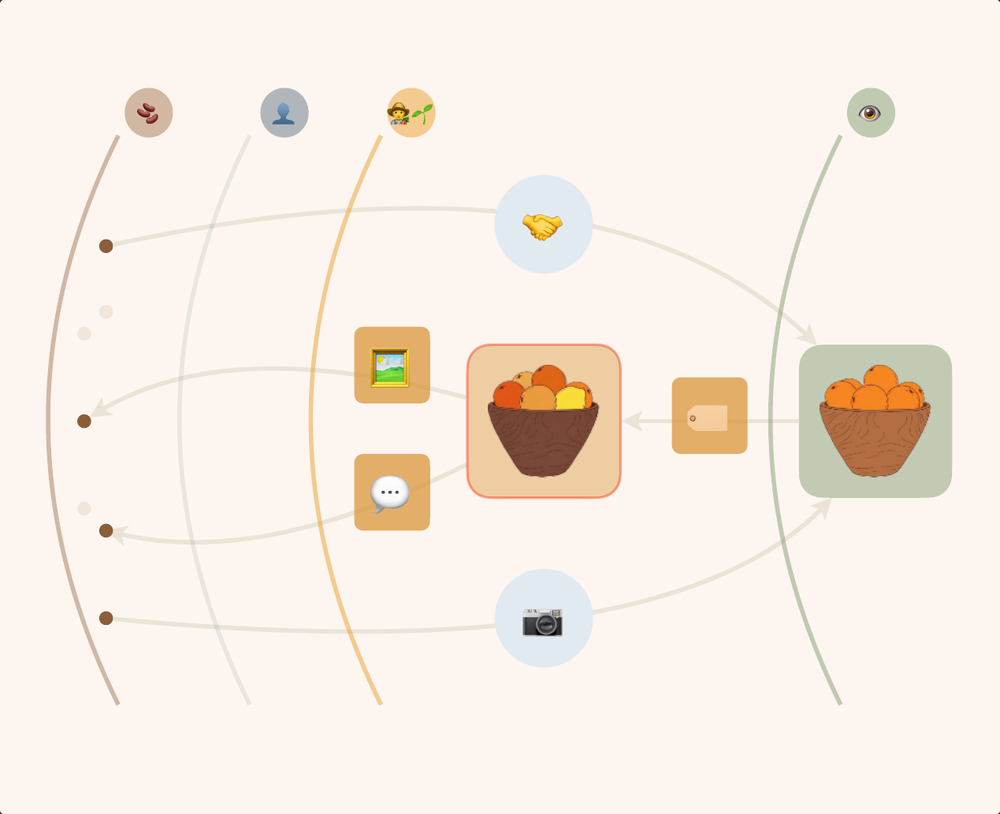
The figure reads left to right and back again. The four curves are the four parts of the mind this project draws: the store, manas, mind consciousness, and the senses. Contact and perception come out of the store and reach across to the bowl. Perception makes its sign off the bowl, and the sign’s two forms go back into the store on two separate lines, because the book counts them as two seeds and not one. (Going Deeper gives Thầy’s own account of sign, image and name, and what follows from their being two.)
So what the mind rests on is never the thing. It is a sign the mind made. The book says this about ordinary perception in general, and says it strongly: “Our perceptions rarely reach the mode of things-in-themselves, however. We usually perceive things in the other two modes, as representations or mere images.” The bowl the mind works with is a picture of the bowl. Thầy’s image for it is “taking a photograph of a photograph.”
That is the machinery. Now take it up the four levels.
Where this comes from
The four levels and their names are the book’s. Thầy lists them in Chapter Nine as the sixth to ninth of the nine stages: the Realm of Limitless Space, the Realm of Limitless Consciousness, the Realm of No Object, and the Realm of No Perception and No Non-Perception. He gives each of them a name and a number and nothing else.
What perception has hold of at each level, and how it changes from one to the next, is not in this book. We took it from the Abhidharma, the early commentaries, because without it there is nothing to say about a level beyond its name. The argument at the seventh level, that the awareness you turn toward is not a self, is different. That one is the book’s own, and the reading quotes it where it is used.
The sixth level: limitless space
You stop resting on shapes and edges. You rest on open space instead, space with no edge to it.
Your eyes have nothing to do here. There is no form left to see. Chapter Three says that of the whole realm: “Life continues, but there is no perception of form.” But you are still perceiving. What you are perceiving is the space.
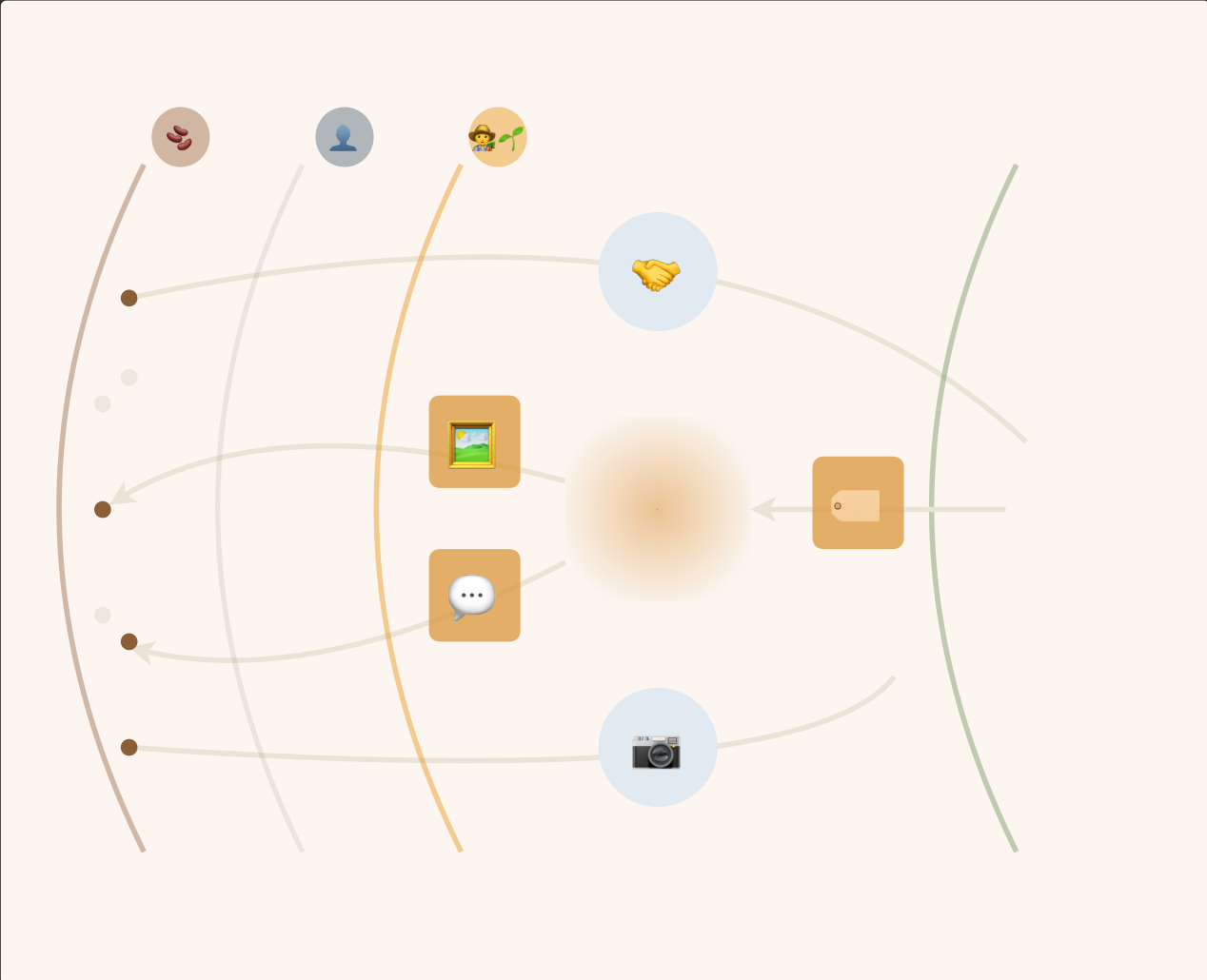
Put the two figures side by side. The bowl has gone, and everything else is where it was. Contact still reaches. Perception still makes a sign, and the sign is still stored. Only the sign has changed: it is now a sign of open space, which is fainter than a sign of a bowl of oranges.
You cannot perceive nothing. There is always something you are aware of. Here, it is space.
The seventh level: limitless consciousness
Then you notice the awareness that was holding that space.
To hold space with no edge, that awareness had to reach that far. So it has no edge either. You let the space go and rest on the awareness instead. The book’s name for the level says what its object is: the Realm of Limitless Consciousness. The level is not called limitless because it is grand. Its object was limitless, and an awareness that reaches boundless space is as wide as what it knows.
This is where people go wrong. It feels as though there is a self standing behind you, watching. There is not. Here is why, and the reason is the book’s.
Thầy writes, in his commentary on Verse 24:
“Knowing always includes the subject who knows and the object that is known. Before we can speak about awareness, we have to ask, ‘awareness of what?’ This is basic, but not easy to understand.”
Awareness is always awareness of something. So the moment you rest on the awareness, it has become the something. It is now the thing you are aware of, sitting in front of you, the same as the space was a moment ago. Anything that can be looked at is an object. And an object is not a self. The watcher you thought you had found is one more thing being watched.
The book puts the same point a second way, in its chapter on Verse 17, and borrows a philosopher to do it: “The German phenomenologist Edmund Husserl stated that consciousness must be consciousness of something. In the Manifestation Only teachings, the same point is made. To be angry means to be angry at someone or something… To think is to think something.” Consciousness has a perceiver side and a perceived side, and they come together, like the top and the bottom of a plate. There is no perceiver left over, standing outside the pair. (Going Deeper takes up why nothing turns around and sees itself, and where the book’s account differs from another tradition’s.)
If the sixth level’s figure were redrawn for this level, the blur would be gone. Contact and perception would still reach out, and what they reach would be a faint copy of the mind’s own curve. The object at this level is not a thing, and not a space. It is the mind’s own knowing, taken as a sign.
The eighth and the ninth
At the eighth level, which the book calls the Realm of No Object, you let go of that boundless awareness too. Now the only thing you are aware of is that there is nothing there. But that is still something. You are aware of the nothing.
The ninth level is finer again. Perception has not stopped, but you could not honestly call it perception either. The book’s name for the level says exactly that and nothing more: the Realm of No Perception and No Non-Perception. We have run out of language. That is not the words failing us. It is the end of the nine stages.
It cannot stop, because the book says perception and its object arrive together or not at all: “There cannot be a perceiver if there is no object to be perceived. Consciousness is possible only when subject and object manifest together. If there is no object of perception, there will be no perception.” Take away the last object and you do not get a perceiver with nothing in front of it. You get no perceiving. And the book puts the ninth level inside the nine stages, inside samsara, where perceiving is still going on. So there is something there. It is just too faint for the word.
There is nothing finer left to rest on. And you are still aware of something.
Nothing stopped
There were four levels, and at every one of them you were still perceiving.
The object got fainter each time. The perceiving did not. There was never a moment with nothing in it, and there was never anyone standing behind it, watching. That is what the mind is doing at the top of the nine stages.
This does not show that the four levels are worthless, and it does not show that anyone should avoid them. It shows what they are made of. From the outside they look like a mind letting go of more and more until nothing is left. From the inside they are a mind doing the one thing a mind always does, perceiving, on an object it has made fainter and fainter. Chapter Three says why that leaves us where we started: “In the realm of non-form, suffering still exists because all wrong perceptions have not yet been removed and many desires are still dormant in the depth of our consciousness.” The sign got fainter. It did not get seen through.
That leaves one question, and the next two readings take it up. Does any of this set us free?
Contemplation Questions
When you turn toward your own awareness, what do you find?
Have you ever caught yourself assuming there is someone behind your experience, watching?
What happens when you look for them?
Carry whichever of these stays with you — into your own quiet reflection, or into conversation with others.
Going Deeper
A few notes for anyone who wants to follow a thread further.
Sign, image and name — what perception makes
This reading depends on the word sign, and the book defines it in one place, at Verse 2, where the verse itself lists seeds of perceptions, names, and words:
“When we perceive an object, we see its ‘sign’ (lakshana). The Sanskrit word ‘lakshana’ also means ‘mark,’ ‘designation,’ or ‘appearance.’ The sign of a thing is the image that is created by our perception (samjña) of it. Suppose we see a wooden platform supported by four legs. That image becomes a seed within our consciousness. The name we assign to this image, ‘table,’ is another seed.”
So the three words nest. A sign is what perception makes of a thing and then meets in its place — perception does not hand the mind the bowl, it hands it a mark that stands for the bowl. The sign comes in two forms. The image is the sign as a picture: the bowl-shape that perceiving makes when the senses meet the bowl. The name is the sign as a word: the label attached to that image. The store keeps each of them as a seed of its own — two seeds, not one — which is why the first figure in the teaching sends the image and the name back to the store on two separate lines.
Once stored, they call each other up. Thầy: “every time we perceive the object we have named as a ‘table,’ or even when we simply hear the word ‘table,’ our image of a table manifests in our mind consciousness.” Hear the word and the picture comes; see the shape and the word comes. So from then on it is the sign the mind meets, not the thing — which is why the loop in the figure closes back into the store rather than ending at the bowl.
Two things follow for the four levels. First, what the mind rests on at any level is a sign it made, and the levels differ only in how faint that sign is: open space, then the awareness that held it, then the absence itself, then something too faint to call a sign, which is what the ninth level’s name says. Second, making the sign fainter is not the same as seeing through it. The book gives the second act its own name, at Verse 49: “If you see a flower only as a flower and don’t see the sunshine, clouds, earth, time, and space in it, you are caught in the sign of the flower… This is called signlessness.” A later reading, Still Not Free, takes that up.
Why nothing turns around and sees itself
The reading says that the awareness you turn toward at the seventh level is an object, not a self, and rests that on Verse 24’s “awareness of what?” A careful reader will want the mechanism. What, exactly, is the mind taking as its object when it rests on its own awareness?
The book’s answer is in its chapter on Verse 17, where Thầy sets out the three aspects of any moment of consciousness: “a subject (the perceiver, darshana-bhaga), an object (the perceived, nimitta-bhaga), and the basis that makes both subject and object possible, which is the thing-in-itself (svabhava-bhaga).” He then says these three “are together called ‘the self-revealing aspects’ and they depend upon each other,” and gives the sutras’ image of three reeds leaning on one another, none of which stands alone. A perceiver is never found on its own. It arrives with its object, as the top of a plate arrives with the bottom.
He also names the part of the mind that makes this move all day long. “The object of manas is the perceiver aspect of store consciousness. Just as the perceiver naturally embraces the perceived, manas embraces and clings to this aspect of store consciousness, makes it into an object, and that object becomes an idea of self.” That is the seventh level’s error in its everyday form. Manas takes the knowing side of the store as its object and calls it me. The book says of what manas gets hold of that way: “This perceived object of manas belongs to the field of representations and to the mode of false perception.” A perceiver made into an object is a representation of a perceiver, and not a self.
There is one account we did not use. The Theravāda commentaries explain the same experience with a rule about time: a mind cannot know itself in the same moment, so what it takes as its object is always the mind-moment just gone, and the practitioner is always a step behind. It is a tidy explanation, and an earlier draft of this reading leaned on it. We cut it, because it is another tradition’s machinery and because this book leans the other way. Thầy has one consciousness taking a perceiver-aspect as its object now, not a moment ago, and in Breathe, You Are Alive!, on the eleventh exercise, he writes: “Using the mind to observe the mind… Mind is the oneness of the subject that illumines and the object that is illuminated.” The no-watcher point does not need a mechanism about time. It needs only the book’s own question, which is why the reading stands on that.
Using the mind to observe the mind
The seventh level is a state a mind arrives at by concentration. The move at its centre, turning toward the awareness itself and finding that it is an object, is also something a person can do sitting in a chair, and Thầy gives it as a practice.
In Breathe, You Are Alive! the ninth exercise of mindful breathing is “Breathing in, I am aware of my mind,” and the eleventh is “Breathing in, I concentrate my mind.” Of the eleventh he writes: “Using the mind to observe the mind, the eleventh exercise brings us to deep concentration.” And in his commentary on the ninth, he says what the word mind covers there, and what it does not: the term citta “includes all psychological phenomena, such as feelings, perceptions, thoughts, reasoning, and so forth, along with their objects. It does not refer to a single, unchangeable psychological subject. Mind is a river of psychological phenomena that is always flowing.”
That last sentence is the seventh level’s finding, said plainly and from the other direction. Look for the one who is looking, and what you find is one more thing in the river: a feeling, a place behind the eyes, a sense of me. Each is something you are aware of. Each is in front of you, not behind you. Nothing found that way is a self, and nothing found that way is unreal either. Even a blank, empty feeling is something you are aware of, so it is an object too.
So the practice is not to find nobody and feel empty. It is to look, find an object, notice that it is an object, and come back to the breath and the body. The sutra’s exercises are the safe form of the seventh level’s move, because they never ask the mind to hold a boundless object. They ask it to look at what is already there.
09.27Resting on Space
The sixth of the nine stages, tried instead of described. Eckhart Tolle explains how to rest your attention on space, a short practice lets you try it, and then Thầy’s books say what happened.
The Reading
Verse 9 reads:
All manifestations bear the marks of both the individual and the collective. The maturation of store consciousness functions in the same way in its participation in the different stages and realms of being.
The two readings before this one described the sixth of the nine stages, the Realm of Limitless Space. The first described it from outside, as the first of four levels where the mind has less and less to rest on. The second described it from inside, where perception is still making a sign and the sign is of open space.
This reading does not add a level. It goes back to the sixth stage and tries it. The practice further down the page takes five or six minutes, and it is the centre of the reading. The sections before it explain where the practice comes from and how Thầy’s books read what happens in it.
The Teaching
What we can try, and what we can’t
The two earlier readings made two claims about the sixth stage. The mind goes very quiet there, and perception is still working. You can agree with both claims from an armchair, and you cannot check either of them there. You can check both in a few minutes of sitting.
You will not be trying the sixth stage itself. The book lists the Realm of Limitless Space directly after the fourth dhyāna, which is the stillest level of the realm of form. A few minutes of noticing the space in your living room is not that. It is the same move on a scale anyone can try: you take your attention off things and rest it on the space they are in. The reading on the last four stages offered three everyday tastes of these levels, which were floating in a lake, being lost in music, and the minute before sleep. This is a fourth taste, and unlike the other three you can do it on purpose.
Tolle’s instructions
In this book Thầy gives the sixth stage a name and a number. In The Heart of the Buddha’s Teaching he also names what the mind rests on there, which is limitless space. Neither book tells you how to begin or what it feels like. The best instructions we found are not Buddhist. They are in chapter seven of Eckhart Tolle’s The Power of Now, in two short sections called Silence and Space.
Tolle is not writing about the nine stages, and he never mentions them. We put his instructions next to the sixth stage because the move is the same. Where he and Thầy disagree, this guide follows Thầy.
Tolle starts with sound. He asks you to listen to a dog barking in the distance, and then to pay more attention to the silence around the bark than to the bark. Then he does the same thing with a room. The furniture is inside the room, and the walls and floor mark its edges, but none of them is the room. The room is the space. “Everybody pays attention to the things in space, but who pays attention to space itself?” His instruction is to become aware of the space all around you, and to feel it and not think about it.
Then he says what happens next: “You cannot think and be aware of space”. His reason is that thoughts are objects too, so when your attention comes off objects it comes off your thoughts as well. You can test this in the practice below. The mind goes quiet, and it goes quiet fast.
The last thing he gives is his reading of that quiet: “By becoming aware of the empty space around you, you simultaneously become aware of the space of no-mind, of pure consciousness: the Unmanifested.” He calls the contemplation of space a portal into it. A few paragraphs later he says what the portal frees you from, and the next reading starts there.
Thầy’s reading of the same quiet
Thầy’s school does not dispute the quiet. It gives a different account of it, and the account starts with a question the school asks about every state of mind. In his commentary on Verse 24, Thầy writes: “Before we can speak about awareness, we have to ask, ‘awareness of what?’”
At the sixth stage that question has an answer. You are aware of space. So perception is still working, and it is working on a sign of open space. That sign is much fainter than the sign of a chair or a worry, which is why thinking finds so little in it to get hold of. The mind-only school’s explanation of the quiet is that perception has a very fine object. Perception has not stopped, and you have not stepped outside the mind.
The second part of Thầy’s account is that the quiet does not reach the seeds. Chapter Three says of the whole realm of non-form that “many desires are still dormant in the depth of our consciousness.” The depth of our consciousness is the store consciousness, and the seeds in it were not touched by your quiet minutes. They were not watered either, and that is a large part of why resting on space feels good. But whatever was waiting for you before you sat down is still waiting when you get up.
Thầy’s word for a quiet state used this way is refuge. At the 2013–14 Winter Retreat he said of people who can stay in deep concentration for days that “they only take refuge in the dhyana… the fourth dhyana and the fourth [formless absorption].” A refuge is real, and it helps. It is not the way out. The next reading gives his reasons in full.
What Thầy does with space
Thầy does not tell anyone to stop resting on space. In The Heart of the Buddha’s Teaching he says what to do once you are there:
“When we begin to practice this concentration, everything seems to be space. But as we practice more deeply, we see that space is composed of and exists only in ‘non-space elements,’ like earth, water, air, fire, and consciousness.”
(He calls it the fifth level in that book, because he counts the levels differently there. It is this book’s sixth.)
In that passage the resting comes first, and then he looks into the thing he is resting on. He finds that space depends on everything that is not space. His list is earth, water, air, fire and consciousness. In a room, that means the walls that give the room its shape, the air, the body sitting in it, and the mind that notices the space. He concludes: “So space and everything else inter-are.”
Tolle tells his reader not to try to understand space, because for him there is nothing in it to understand. Thầy looks into it, and he sees that space cannot exist by itself. That looking is a different practice from the resting, and the next reading is about it.
The Practice
Five or six minutes, on your own, in any room. Read one line, then stay with it for about nine breaths before you read the next.
Sit, and let the breath settle.
Now let go of the things in this room. Notice the space around them. The space between you and the wall. The space the sounds travel through. Space with no edge.
Rest in that space. There is nothing to hold on to.
Stay with it. Notice how quickly the mind goes quiet here.
Now, gently, ask one question. What are you aware of?
You are aware of space. So you are still aware of something. Perception is still working. It is working on something very fine.
Come back to the breath. Feel the body on the chair or the cushion. Open your eyes.
If it felt good, let it. Nothing in Thầy’s account says the quiet is a mistake.
Contemplation Questions
When you took your attention off the things around you, what happened to your thinking?
When the mind went quiet, what were you still aware of?
Tolle would say you had touched something beyond the mind. Thầy would say the mind was resting on a very fine object. Which description fits what you found?
Carry whichever of these stays with you — into your own quiet reflection, or into conversation with others.
Going Deeper
Two notes for anyone who wants to follow a thread further.
Tolle says space cannot become an object. Does that answer Thầy?
In the Space section a questioner asks Tolle what this “nothing” is, and he refuses the question: “Your mind is trying to make nothing into something. The moment you make it into something, you have missed it.” A few lines later he says of space, “It cannot become an object of knowledge.” A reader could take that as a reply to Thầy in advance. If space cannot be an object, then a mind resting on space is not resting on an object, and perception has nothing to work on.
The two writers use the word object for different things. Tolle means an object of thought. His examples are a scientific theory of space and a Ph.D. on “nothing”, and his advice is to feel the space and not think about it. The mind-only school means something wider. In the chapter on Verse 17 Thầy writes, “A consciousness is always consciousness of something,” and the something is the object whether or not any thinking is going on. A sound you hear before you have named it is already the object of ear consciousness. By that definition Tolle’s own instruction, “become aware of the space that is all around you,” gives the mind an object. The object is space, and the awareness of it has no words in it. Both of those are true of the sixth stage as the previous reading describes it.
So the two of them do not disagree about the experience. They disagree about what the wordless awareness is. Tolle says it is no longer the mind. Thầy’s school says it is mind consciousness with a very fine object, and that the seeds underneath it have not changed.
Did Tolle describe the seventh stage too?
Near the end of the Space section Tolle makes a second move. He says the inner equivalent of space is “the consciousness that enables your mind objects to be,” and that when you become aware of space you become aware of that consciousness at the same moment.
The nine stages separate those two moves. At the sixth stage the mind rests on limitless space. At the seventh it lets the space go and rests on the awareness that was holding it, which is why the book calls that level the Realm of Limitless Consciousness. Tolle treats the two as one event, and he treats the consciousness he arrives at as what you really are.
The previous reading explains why Thầy’s school does not. The awareness you turn toward has become the thing you are aware of, so it is an object like any other, and an object is not a self. The practice on this page stays at the sixth stage on purpose. If you notice your attention turning from the space to whatever is aware of the space, you have found the door to the seventh stage, and the previous reading describes that level.
09.28Still Not Free
The close of the nine stages: why the ninth is still samsara, what actually frees, and why none of it is made alone.
The Reading
Verse 9 reads:
All manifestations bear the marks of both the individual and the collective. The maturation of store consciousness functions in the same way in its participation in the different stages and realms of being.
Earlier readings walked through all nine stages, from the realm of desire up to the ninth stage, and finished with a question. Does any of this set us free? The reading before this one went back to the sixth stage, tried it, and found two answers. Eckhart Tolle calls resting on space a portal. Thầy calls it a refuge.
This reading gives Thầy’s answer, and it is not the answer the stages lead you to expect. It has three parts. The first is the book’s own reason why the ninth stage is still samsara. The second is the practice that does free us, which the earlier readings have already used. The third is where the nine stages actually are, which is much closer than the word realm suggests.
The Teaching
Still not free
Tolle makes his claim a few paragraphs after the instructions the previous reading used. In chapter seven of The Power of Now he says that once you know space and time from the inside, “The world, too, continues to exist for you, but it will not bind you anymore.” That is a claim about liberation, and he rests it on a state of very quiet attention.
Thầy never wrote about Tolle. The book answers the claim anyway, because some schools make the same claim for the ninth stage: a mind that is quiet enough is free. The book says it is not.
There are nine stages in three realms, and all nine are samsara. In Chapter Three, Thầy calls the realms “the three realms of samsaric existence.”
He explains why in the same chapter, and the reason has nothing to do with how still the mind is:
“In the realm of non-form, suffering still exists because all wrong perceptions have not yet been removed and many desires are still dormant in the depth of our consciousness.”
The seeds are untouched. The depth of our consciousness is the store consciousness, which is what this whole verse has been teaching. Deep concentration stops watering those seeds for a while, but it never reaches them.
At the Winter Retreat, teaching Vasubandhu’s Thirty Verses, he explains the same point with a rabbit. A rabbit goes into its hole to be safe, but it cannot stay there. Sooner or later it has to come out and find food. Then he says:
“So there are those who have capacity to enter into dhyana… They can be there for several days, but they only take refuge in the dhyana… the fourth dhyana and the fourth [formless absorption]. But that is not the solution, because when they get out of the dhyana, they suffer again.”
He names the fourth formless level there, and he calls it a refuge. (Going Deeper gives the whole passage, which starts with workaholism and the internet, not with meditation.) In The Heart of the Buddha’s Teaching he has a name for using concentration this way: “When you use concentration to run away from yourself or your situation, it is wrong concentration.” He does not blame anyone for it. His next sentence is “Sometimes we need to escape our problems for relief, but at some time we have to return to face them.”
The book’s own image for this is in the same chapter. Early Buddhist texts describe the three realms as a “house on fire,” and Thầy says who lit it: “The three realms are burning, and it is we who light the fire through the false perceptions of our consciousness.” The cause is false perceptions again, not restlessness and not a lack of depth. The wrong perceptions are still there at the ninth stage, and that is why the ninth stage is still burning.
The sutra turns
The reading on crossing into the realm of form used the sixteen exercises of mindful breathing, from Thầy’s Breathe, You Are Alive! The first twelve settle the body, then the feelings, then the mind. The eleventh is “Breathing in, I concentrate my mind.” Up to this point the sutra is doing the same thing the nine stages do.
Then the sutra stops concentrating further and starts looking, which the stages never do. The last four exercises, in Thầy’s translation, are:
13. “Breathing in, I observe the impermanent nature of all dharmas.” 14. “Breathing in, I observe the disappearance of desire.” 15. “Breathing in, I observe cessation.” 16. “Breathing in, I observe letting go.”
Plum Village’s current translation gives the fifteenth line as the no-birth, no-death nature of all phenomena. Both translations are his.
None of these four is a finer object to rest on. Impermanence is not a subtler object. You can see it in a cup of tea. (An earlier Going Deeper entry on the nine stages and the sixteen exercises sets the two schemes side by side.)
Thầy himself connects the thirteenth exercise to the second of the Three Doors of Liberation. In his commentary on it he writes: “Impermanence also means ‘signlessness’ (alakshana)… The categories of perception and thought are ‘signs.’” The reading on what perception is doing followed the sign up through the four formless levels. It got fainter at each level, but it was never seen through. This is the practice that sees through it.
The nine stages give the mind less and less to hold. Looking deeply keeps hold of one thing and finds everything else inside it. The stages shrink what you are aware of. Looking deeply opens it.
This does not mean concentration is thrown away. Thầy’s own commentary on the eleventh exercise says so: “Only if there is concentration can the work of looking deeply take place.” The book says the same thing twice more. At Verse 27: “we focus our mind consciousness on one point in order to get a breakthrough.” And at Verse 48: “Concentration is the battery; the flashlight is mindfulness.” Concentration is the condition for insight. It is not the answer on its own. (Going Deeper asks whether insight is simply the missing formation. The book’s answer comes with a warning about the word insight.)
Where the stages came from
There is one more thing to say about this sutra. The four dhyānas and the four formless levels, which is everything above the realm of desire on the list of nine, are not in it. They are not in the Sutra on the Four Establishments of Mindfulness either. Thầy says so in an appendix to Breathe, You Are Alive!, and goes further: they “were not introduced into Buddhism as Buddhist practices until one hundred years after the Buddha’s passing.” Before his enlightenment the Buddha learned the four formless concentrations from two teachers, Arada Kalama and Udraka Ramaputra, “practiced the Four Formless Concentrations with great success,” said plainly that the practice “did not lead to final liberation from suffering,” and left it.
He is not telling anyone to drop them: “We need not criticize them for being later teachings, certainly not before we have practiced them and seen for ourselves if they work well.” (Going Deeper has what he says in another book, where the number is different and the verdict is harder.)
Being fair to the stages
One thing has to be said in the stages’ favour, because the book says it. In Chapter Three, looking deeply is what carries a mind from one realm to the next:
“If we practice looking deeply at the nature of craving, we will become emancipated from the realm of desire and begin to dwell in the realm of form, which is a higher realm. Looking even more deeply, we can lessen our attachment to form and begin to dwell in the realm of non-form.”
So in this book the stages are not a rival practice. They are where the mind settles after it has seen through something. The reading on the last four stages quoted the second of those sentences as the move that opened every level, and nothing above contradicts it. The stages cannot finish the job, and Chapter Three’s next sentence says why: the wrong perceptions are still there.
The vocabulary of refining the object against seeing through it is ours. We took it from the Abhidharma, and it is a way of saying what the book says in its own terms: the levels are named by what the mind rests on, and freedom is named by what the mind has understood.
This is what the chapter on our verse means by emancipation. Emancipation is not a tenth stage:
“Emancipation — participation in the realm of joy and peace — is a matter of touching and transforming the seeds, of helping the positive seeds grow. We don’t need to die in order to be reborn and have a new being.”
We walked through the stages because they show something real about the mind. But they were never the destination.
All nine are in us
So the stages are not a place we go to. They are here. Chapter Three says: “It is possible to touch all three realms in the present moment, around us and within us.” And in the chapter on this verse:
“When we participate in one of the nine stages of being, it does not mean that we are not also participating in the other eight stages, only that our participation in them is more diluted… All nine stages exist within us. When one manifests, the others are less distinct but they are nonetheless present.”
We have spent eight readings on a picture of the whole of existence, and it turns out to describe an ordinary week: a morning of wanting things, an hour of quiet after a walk, a minute so still there was almost nothing in it. All of that is the nine stages, and all of it is us.
We do not make any of it on our own either. The verse says every manifestation carries both an individual and a collective mark, and Chapter Three spells that out for the realms: “Each realm of being is a result of the collective consciousness of those dwelling there. If our world is a peaceful, happy place, it is because of our collective consciousness. If it is on fire, we are co-responsible for that.”
Collective does not mean external. A realm made by many minds is still made of mind. But it does mean that what a few people practise together is not private, and Thầy finishes the passage by saying what it can build: “If five or six people practice and attain the fruits of joy, peace, and happiness, and if these people then go out and establish a practice center, manifesting their happiness in a setting in which others can participate, then they have established a small ‘pure land.’”
That is what a sangha is for. It is not a place to hide from the fire, and it is not a ladder out of it. It is a few people watering the same seeds in the same room, until the room becomes a realm worth living in.
Contemplation Questions
Where do you go to be quiet in a way that soothes you but changes nothing? What happens when you come out?
Thầy says all nine stages are in us. Which one has been most active in you over the last few days?
He says a few people practising together can make a small pure land. When you practise with others, what are you making together?
Carry whichever of these stays with you — into your own quiet reflection, or into conversation with others.
Going Deeper
A few notes for anyone who wants to follow a thread further.
The second door — why the ninth stage is still samsara, in the book’s vocabulary
The reading says the ninth stage is still samsara because the wrong perceptions are still there, and that the practice which frees is signlessness. A careful reader will ask whether the book itself connects those two things. It does, in three sentences that sit in three different chapters, and the join between them is ours.
First, the book says what a sign is. From the chapter on Verse 2: “The sign of a thing is the image that is created by our perception (samjña) of it.” A sign is not a thing in the world. It is what perception makes.
Second, it says what signlessness is. From the chapter on Verse 49: “If you see a flower only as a flower and don’t see the sunshine, clouds, earth, time, and space in it, you are caught in the sign of the flower… When you can see that person deeply, you touch the whole cosmos and you will not be fooled by appearances. This is called signlessness.”
Third, it says why the formless realm is not freedom. From Chapter Three: “In the realm of non-form, suffering still exists because all wrong perceptions have not yet been removed.”
Put the three together. Perception is the faculty that makes signs. The book’s stated reason the ninth stage is still samsara is that the perceptions there are still wrong, which is to say the signs are still believed. The second door is what is missing at the ninth stage. The stages have no rung for it, because signlessness is not a rung. The ninth level is named No Perception and No Non-Perception. At that level the sign-making is so fine that you can no longer honestly call it sign-making, and it is still not signlessness. Reducing a sign and seeing through it are two different acts.
The join is ours, and we should say so. The book never puts signlessness and non-form in the same passage. We searched the whole text: the word signless occurs exactly twice in Understanding Our Mind, both inside the Three Doors passage. The bridge between the two is the word perception, which is his in both places. So the materials are his and the connection is ours.
And another of his books says something close to the opposite. In The Heart of the Buddha’s Teaching he puts signlessness inside these levels and names it. Of the level he calls Nothingness, this book’s eighth: “we see that the fruit is in the flower, and that the flower, the cloud, and the earth are in the fruit. We go beyond outward appearances or signs and come to ‘signlessness.’” And of the level above it, this book’s ninth: “Since we no longer believe in the reality of signs, our perception becomes wisdom. We go beyond signs (‘no perception’), but we do not become perceptionless (‘no non-perception’).” That is the second door opening at the level this note says has no rung for it.
We follow Understanding Our Mind, because it is the book we are reading, and Chapter Three is unambiguous. But the difference is not only which book ranks higher. Read the two passages side by side and they are not describing the same act. What he calls signlessness at those levels is interbeing applied to a formless object: space seen as made of non-space elements, nothingness seen as the fruit already in the flower. That is looking deeply, done on a very fine object. It is the second practice reaching into the levels of the first, not the levels producing it on their own. So the claim narrows to what it should have been all along. Refining the object never reaches the second door. Someone standing at these levels can still look deeply, and when they do, that is what happens.
This note does not say the formless levels are worthless; the body’s Verse 48 line stands. Freedom is not measured by how deep the concentration goes.
The rabbit and its everyday holes
The rabbit is from the first talk of the 2013–14 Winter Retreat, Rebuilding Our Health, given at Plum Village on 17 November 2013, and Thầy reaches it through three paragraphs that have nothing to do with meditation.
He starts with restlessness, and the moments when we feel empty inside and do not know what to do with the loneliness. We look for something to cover it. We work, and we become workaholics, because “working helps us to take refuge in order to calm down a little bit.” We turn on the television, pick up a newspaper with nothing interesting in it, or even study. Then he comes to the internet, where we take refuge “in order for us to forget for some time the loneliness, the restlessness in us.” Only then does he reach the rabbit: “…we do like rabbits, we use a sitting meditation as a place for refuge, in order not to suffer too much from our restlessness… Because after sitting meditation, we can go out and then we suffer again.”
Then he says what the alternative is: “And that is why we should need the vipashyana and not only samatha.” Looking deeply brings insight, and only insight, he says, “can liberate you from afflictions like restlessness.” Meditation, he says, “is not… a temporary refuge for you to stop suffering for a while. Meditation should have the power to help you to transform the suffering in you.”
The first contemplation question comes straight from this passage. The hole does not have to be a formless absorption. For most of us the hole is a screen.
Two numbers and a harder sentence
The reading gives the history of the dhyānas and the formless levels from Breathe, You Are Alive!, where Thầy says they entered Buddhism “one hundred years after the Buddha’s passing.” He tells the same history in Awakening of the Heart, with a different number and a harder verdict:
“These states of concentration probably found their way back into the sutras around two hundred years after the Buddha passed into mahaparinirvana. The results of these concentrations are to hide reality from the practitioner, so we can assume that they shouldn’t be considered Right Concentration.”
We kept that sentence out of the body, and not because it is inconvenient. Understanding Our Mind, the book we are reading, walks all nine stages as real states of mind and says nothing of the kind about them. Where his books disagree, that book governs, and a harder line from another is a note, not a correction. The gentler sentence from Breathe, that we need not criticise them before we have practised them, is also his, and it fits a reader who has just walked them.
Both numbers are approximate in his own telling. He is not dating a text. He is saying the Buddha learned these states before his awakening and set them aside, and that the tradition brought them back later. On that the two books agree.
Is insight the missing formation?
A reader who has followed the fifty-one formations will ask a sharper version of this reading’s question. The nine stages run on concentration, one of the five particular formations. Its neighbour on the list is insight. Is insight the missing piece, and is that all that “looking deeply” means?
The answer is yes, with a catch the book itself adds.
First the yes. Thầy’s three powers of meditation are mindfulness, concentration and insight, and each one waters the next. The stages have the first two in full. They never turn on the third. At Verse 27 he says what concentration is for: “we focus our mind consciousness on one point in order to get a breakthrough.” The breakthrough is the insight. The stages are all focus and no breakthrough, and that is the rabbit’s problem.
Now the catch. In the chapter on Verse 20, Thầy warns that the prajñā counted among the five particulars is not the prajñā of the Perfection of Wisdom. As a formation it is only “a kind of understanding or conviction that is only an idea, an assertion,” and it is often wrong: “you believe you are right, but you are wrong. You think you have seen a snake, but it was only a rope.” It is the one particular that runs with manas, which is how manas can be so sure of a self that is not there. He proposes a second word for that lesser kind: “Let us reserve the word ‘prajna’ for true understanding, true insight, and instead use for this particular mental formation the word mati, which means an understanding that might be false.”
So the formation on the list is not, by itself, the thing that frees. It was present at every one of the nine stages, quietly certain that it understood. What frees us is that same faculty turned on the sign until it sees through the sign: to impermanence, non-self and interbeing, the Three Doors. Insight is something the mind does to a perception. It is not a formation that was missing.
One sentence in the book seems to say the opposite. At Verse 48, right after the battery and the flashlight, Thầy writes: “In fact, concentration and looking deeply cannot be separated. As soon as there is concentration, looking deeply is already there.” If that is so, how can the ninth stage have concentration and lack insight?
We read the two passages side by side, and they are about two different uses of the same power. Verse 48 is describing stopping in order to look: “When we stop and look deeply into a flower, we can see its interdependent co-arising nature, the sun, rain, and soil in the flower.” The concentration there is pointed at a flower, and the looking follows because a flower has something in it to see. The stages point the same concentration at less and less, and at the top, at the absence of an object. There is nothing in that object to see through, so nothing gets seen through. The rabbit passage is Thầy saying, in his own words, that śamatha without vipaśyanā is possible and that people do it. Chapter Three says why it does not free: the wrong perceptions are still there. Both sentences are his. Verse 48 tells you what concentration is for. Chapter Three tells you what happens when it is used for something else.
That is why this reading’s answer is looking deeply and not “more insight”. The mind at the sixth stage is not short of the faculty. It is resting on space instead of looking into anything, and a sign survives resting. It does not survive being looked into.
09.29The Law of Affinity
The close of the chapter: a realm is made by the people in it, the seeds in the store take us to the people and the stage of being that match them, and transformation is possible.
The Reading
Verse 9 reads:
All manifestations bear the marks of both the individual and the collective. The maturation of store consciousness functions in the same way in its participation in the different stages and realms of being.
The earlier readings on this verse walked all nine stages of being and closed them. This reading returns to the chapter itself, to the pages that follow the list of the nine stages and close it. They answer a question the list leaves open. If the stages are states of mind, what puts a mind in one stage rather than another? Thầy’s answer is a law, and he gives it a name: the Law of Affinity, the attraction of like to like. And then he says what can be done about it.
The reading follows the chapter in order. First he says that a realm is made by the people in it. Then he states the law and gives four illustrations of it, ending with the book in the reader’s hands. Then he explains karma, which is where the law gets its material. Last, he says that transformation is possible.
The Teaching
A realm is made together
Thầy begins with where he lives. Plum Village, he says, is “the collective manifestation of the consciousnesses of the teacher, the disciples, the friends on the path, and the community of practice that has been established there.” A teacher and his students wanted the same thing, and together they made the place. Then he widens it to every realm at once: “Whether you live in the desire realm, the form realm, or the formless realm, that realm is the creation of the collective consciousness of all those who inhabit it.”
Here he applies the verse’s first clause to a whole realm. Earlier in the chapter he gave the image of two candles: light the second, and there is no patch of light left that comes from one candle alone. A realm is like that light: nobody is in the desire realm on their own.
He is honest about what that means for a practice centre. Western society is a consumer society, and the people at Plum Village are still in the desire realm, “which is a manifestation of collective consciousness.” They have not left it. They have done something smaller, which a person can actually do. “Television advertising is cleverly designed to water the seeds of desire in us. In Plum Village we do not watch television, so our seeds of desire cannot be watered through that particular medium.” He calls this “an individual manifestation within the collective manifestation of the consumer society.”
Two things follow from that sentence. We cannot step out of a realm by ourselves, because a realm is collective. We can choose what waters our seeds, because the watering is individual.
Like draws like
Then he states the law. “The maturation of store consciousness also follows the Law of Affinity, the attraction of like to like. We do this, and we do not do that. The reasons why we do one thing and not another are already determined in the ‘maturation-as-cause’ that leads to the ‘maturation-as-fruit.’”
Two things are packed in here. The first is that the law belongs to maturation, the verse’s own word. The reading on ripening used the orange: a blossom needs time and conditions to become a fruit you can eat. The Law of Affinity says what the fruit is in this case. The seeds we sowed are the cause. Where we find ourselves, and who we find ourselves with, is the fruit.
The second is the example. “One example of maturation-as-fruit is the presence of Plum Village and the community of practice there. Maturation-as-cause are the seeds we sowed in the past that have drawn us to that place.” He calls the pull “the force of action.” Seeds of the Dharma, watered over years, “give us the energy to come and participate in a community of practice.” Seeds of drug addiction would carry the same person somewhere else. So he says that Plum Village is “in this sense, predetermined.” (Going Deeper asks what that word leaves room for, because the next page of the chapter is about changing direction.)
The store consciousness is doing the drawing here, not any one mental formation. Nothing on the list of fifty-one is called affinity. The pull is what ripening seeds feel like from the inside.
The Jeta Grove
Thầy’s first illustration is the Buddha’s own. “One day, sitting in the Jeta Grove, the Buddha observed, ‘Monks, do you see that the monks who enjoy Dharma discussion are sitting close to the Venerable Shariputra and those who are interested in the precepts are sitting with the Venerable Upali? The monks who like to give Dharma talks are gathered around the Venerable Purna.’”
Nobody arranged the seating. The monks sorted themselves, each toward the elder who was good at what he loved. Thầy draws the conclusion for the whole verse: “Our aspirations, our needs, and the energy of our actions determine whether we participate in one realm or stage of being or another.” (Going Deeper says where this story comes from in the early texts.)
The seed of affinity
The second illustration is a friend. “When we find a friend we enjoy spending time with, there is the law of attraction of like to like. We feel we have an affinity with this person, and this information is recorded as a seed in our consciousness. When the seed of affinity ripens, we find ourselves drawn to a particular person or situation.”
This is the smallest and most useful version of the law. Enjoying someone’s company is not only a feeling in the moment. It is recorded, it becomes a seed, and the seed ripens on its own schedule. Months later we find ourselves drawn back to that person, or to a room like the one we shared, without having decided to. The reading on ripening said a seed always needs the right amount of time and the right conditions. A friendship is one of the seeds it was talking about.
Where the sum of our actions takes us
The third illustration is Plum Village again, but now inside Europe. “Plum Village is a small area and Europe is a large area. We belong to the large area, and we come and participate in the small area. Yet when we are in Plum Village, we are also in Europe.” The reading that closed the nine stages quoted what follows: taking part in one stage of being does not mean leaving the other eight, only that “our participation in them is more diluted.”
Then he says where the law takes us. “At the time of maturation, our consciousness seeks to dwell in the stage that is closest to the sum of our actions.” The reading on the sum of our actions taught that we are the sum of action A plus action B. Here he says where that sum takes us: to the stage of being, and the company, that match it. His example is hard on purpose: someone with an action in the store “associated with addiction to cocaine” is led “to associate with others who like drugs.” The law does not comfort anyone. It describes how a life gets its shape, in either direction.
This book, this sangha
The last illustration is the book itself. “Let us look deeply into this book. This book is a manifestation of our collective consciousness, because each of you has planted in your store consciousness the seed of the practice.” Perhaps a reader heard about mindfulness years ago, or read another book, or wanted to understand healing and transformation better. “This may have happened some time ago. Now conditions are sufficient for me to offer this book and for you to read it.” Then he asks: “Why aren’t others reading about these Fifty Verses? Because they do not share the same interest.”
He first said this at a retreat in 1997, about the retreat his listeners were sitting in. In the book he says it about the book. It works for any group that has gathered around this text, including a sangha meeting on a weeknight to read it. Nobody was made to come. Each person was drawn there by a seed that someone once watered.
He closes the passage with a second name for the law: “This is the Law of Affinity, or participation.” Participation is the verse’s own word. The maturation of store consciousness participates in the stages and realms of being. The Law of Affinity is how it participates.
Karma means action
The law gets its material from what we do, which is what the book means by karma. “Whether we go in the direction of gods, humans, ashuras, hungry ghosts, hell, or animals is already established within our store consciousness. Karma means action, the actions of body, speech, and mind. Every act, word, and thought in our daily life has the power to bring forth a fruit.”
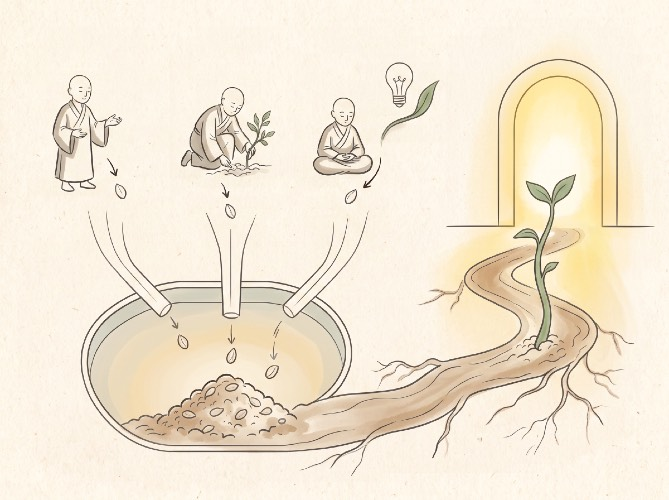
Karma is not fate, then. It is the ordinary record of what we have done, said and thought, kept as seeds. “When our actions of body, speech, and mind come together and have time to ripen, store consciousness undergoes maturation and brings forth another stage of being.” After years of actions, the store brings forth the realm we live in. Nobody assigns it to us. It ripens.
Between the six realms and the law, Thầy pauses on two of them. “We all have been in hell. Hell is not very far away. Hell is right here.” And the hungry ghosts, whom the readings on that destination described: he says our society “creates thousands of hungry ghosts every day,” people without roots who “are hungry for understanding and love” and cannot yet take either, because their throats are so narrow. Then he states the law again, in its unkindest form: “because of the Law of Affinity, hungry ghosts also like to come together with other hungry ghosts. If we water the seed of the hungry ghost in ourself, we will become a hungry ghost.”
Transformation is possible
Then he changes direction. His example is a man “caught in a cycle of drug-taking,” drawn to that environment wherever he goes, by exactly the law this reading has described. “But if he meets someone who is capable of loving and helping him, the positive seeds in him are watered and he might get some insight.” With that person’s help he may leave the environment, and “slowly, the maturation of other seeds will help him move toward and participate in another realm of being.”
Then he says: “The seeds in us lead us to share the life of others who are like us— whether that life is wholesome or unwholesome. Transformation, however, is possible.”
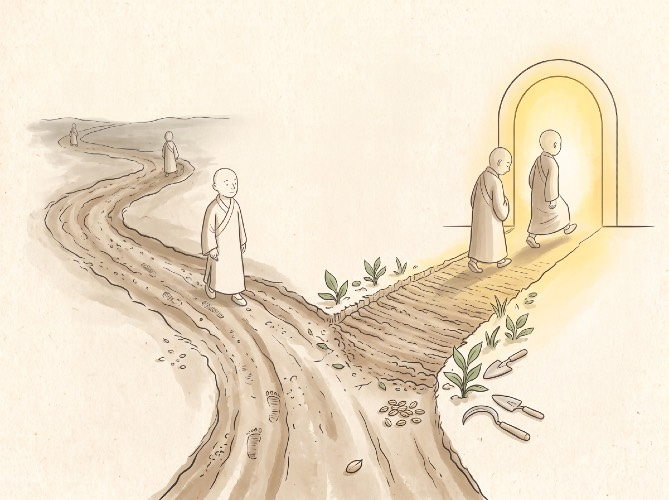
He gives it three steps, and they are small. “First, we have to determine in what direction we wish to go. Second, we have to wish to embark on a journey of transformation and healing. Third, we discover that there is a path that we can embrace and we look for a way to practice with others who also want to live more mindfully.” And then the law returns, working for us this time: “Then we discover that we share the same karma, the karma of practicing healing and transforming.”
The same law makes every kind of gathering. “Those who are interested only in eating, sleeping, and having sex will come together in the realm of desire. Those who are concerned about the suffering people in the world will find ways to come together in order to serve. This is the Law of Affinity.” The law works the same way in both cases. A sangha is the same law at work among people who want to live more mindfully.
A new being
The chapter ends with a sentence that the reading on the close of the nine stages already quoted: emancipation is “a matter of touching and transforming the seeds, of helping the positive seeds grow. We don’t need to die in order to be reborn and have a new being.” He adds a timescale, and it is not a lifetime. “A few weeks or months of practicing in order to transform can help ripen the wholesome seeds in us and bring about a new life here and now.” He has seen people come out as new beings “after only three or four days of practice,” go home and reconcile with their families.
His last sentence is the plainest in the chapter: “We too are capable of producing a new being from the seeds in our consciousness, of living in a more positive and happy way. There is no reason to think we cannot.”
Contemplation Questions
How did you come to this practice? Looking back, which seeds were watered, and by whom?
Who are you drawn to spend time with these days, and what does that time water in you?
Thầy says transformation begins with deciding which direction you want to go. Which direction is that, for you, this season?
Carry whichever of these stays with you, into your own quiet reflection or into conversation with others.
Going Deeper
A few notes for anyone who wants to follow a thread further.
“Predetermined”: what the word leaves room for
Thầy writes that Plum Village is “in this sense, predetermined,” and that the reasons we do one thing and not another “are already determined” in the maturation of our seeds. A careful reader will ask whether that leaves any room to choose.
The book answers on the very next page, and the reading’s last two sections are built on that answer. Thầy describes a man caught in a cycle of drug-taking, drawn to that environment wherever he goes, and then says: “But if he meets someone who is capable of loving and helping him, the positive seeds in him are watered and he might get some insight.” Then: “Transformation, however, is possible.”
So the word predetermined means less than it seems to. It says that where we are now is the fruit of seeds already sown, and that nothing else could have produced it. It does not say the seeds are fixed. The verse’s own word is maturation, and the reading on ripening was clear that a seed needs time and conditions. Conditions can be changed, by us and by the people who love us. The law describes the pull. It says nothing about whether we keep watering the seed that pulls.
The passage does rule out one idea: that we could leave a realm by an act of will while we go on watering its seeds. The television sentence is his example. Nobody at Plum Village decided to stop being in the desire realm. They stopped watering one of its seeds through one channel, and the rest followed the law.
Where the Jeta Grove story comes from
The scene of the monks sorting themselves around Shariputra, Upali and Purna is told in Thầy’s words in the chapter, without a citation. The early text behind it is a short discourse in the Saṃyutta Nikāya (14.15, the Caṅkama Sutta, “Walking Together” in Bhikkhu Sujato’s translation). We opened it on 2026-09-23. The Buddha points out eight elders, each walking with a group of monks, and names what the group shares: the monks with Sāriputta have great wisdom, the monks with Puṇṇa are Dhamma speakers, the monks with Upāli are experts in the monastic law, and so on through Moggallāna, Kassapa, Anuruddha, Ānanda and Devadatta, whose monks “have corrupt wishes.” Then the Buddha gives the general rule: “Sentient beings join together and converge because of an element. Those who have inferior convictions join together and converge with those who have inferior convictions. Those who have good convictions join together and converge with those who have good convictions.” The sutta says this holds in the past, the future and the present.
Thầy’s three elders are three of the eight, and their specialities are the sutta’s. Two details are his telling: the sutta has the Buddha at Vulture Peak near Rājagaha, not in the Jeta Grove, and the monks are walking, not sitting. Neither changes the point. The word the sutta uses for what draws like to like is dhātu, element, and that is not far from what this book calls a seed.
For the verse, what matters is how Thầy uses the story. He uses the Buddha’s observation as an example of a law of maturation. That is his reading, and it is the one this book teaches: the monks sorted themselves because of their seeds.