10.03
Associated and Universal
The third reading on Verse 10: how the five universals work together, and how they work differently in each consciousness, followed through one sound of the bell.
This page is our current understanding, written as we work through the book together — it changes as our understanding changes.
The Reading
Verse 10 reads:
Unobstructed and indeterminate, store consciousness is continuously flowing and changing. At the same time, it is endowed with all five universal mental formations.
Once the chapter has named the five universal mental formations, it says how they work, in two short passages:
“These five mental formations are ‘associated’ (samprayukta), which means they are engaged with each other. They are called universal because they are active in all eight consciousnesses.”
“The five universal mental formations (sarvatraga) function with the eighth consciousness in terms of receiving, accepting, holding, maintaining, preserving, and storing the seeds, which are the functions of store consciousness. Store consciousness operates in the form of these five universal mental formations. However, the five universals are different in each of the other consciousnesses, because the mode of perception (pramana, ‘way of measuring’) of store consciousness is different from the mode of perception of other consciousnesses.”
Thầy says three things here. The five work together. They are active in every consciousness, and in the store they are how the store does its work. And they are not the same in each consciousness. This reading takes the first point, then follows one sound of the bell through the consciousnesses to see the other two. The book does not follow a sound in this way. We built the walk from what the book says about each consciousness. The book’s reason for the difference, the mode of perception, is the subject of the next reading on this verse.
The Teaching
Engaged with each other
The book’s whole explanation of associated is that the five are “engaged with each other.” At the Winter Retreat Thầy said what that means for their order: they “take place almost simultaneously. Sometimes mental attention takes place before contact, sometimes feelings come first” (28 November 2013). The list of contact, attention, feeling, perception and volition is a way of telling a very short moment slowly, and any of the five can come first.
Two examples of ours show the order changing. When we are waiting for the bell we are already listening, so attention arises before the sound arrives (how that can be). When a message arrives, we see who it is from and then feel glad or uneasy, so perception comes before feeling. In each moment all five are at work, and each supports the others.
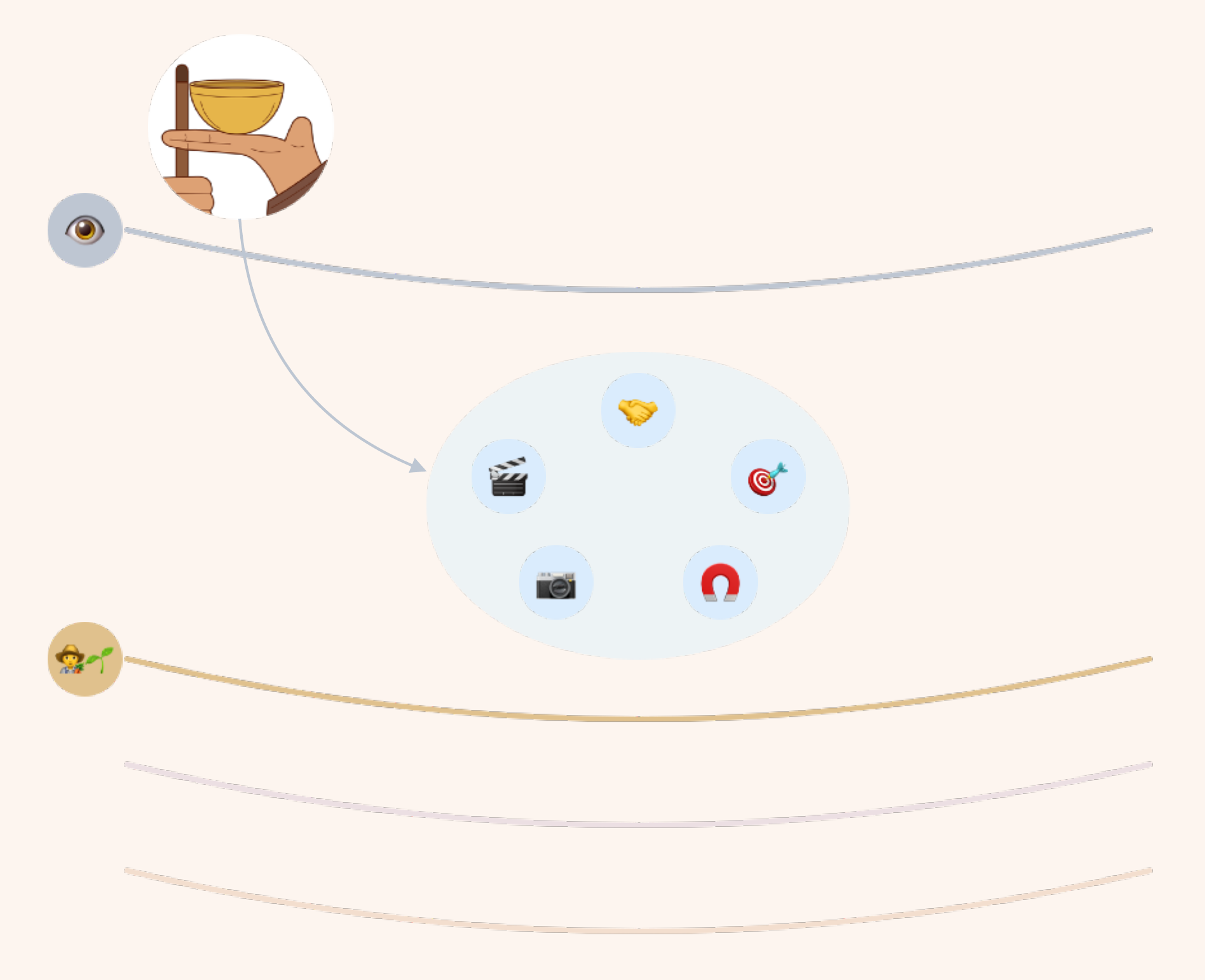
One bell, eight consciousnesses
The book calls the five universal “because they are active in all eight consciousnesses.” To see what that means, we follow one sound of the bell through them: the ear, standing for all five senses, then mind consciousness, manas and the store. These four are at work at the same moment, each with its own five. We take them one at a time only so that we can see each.
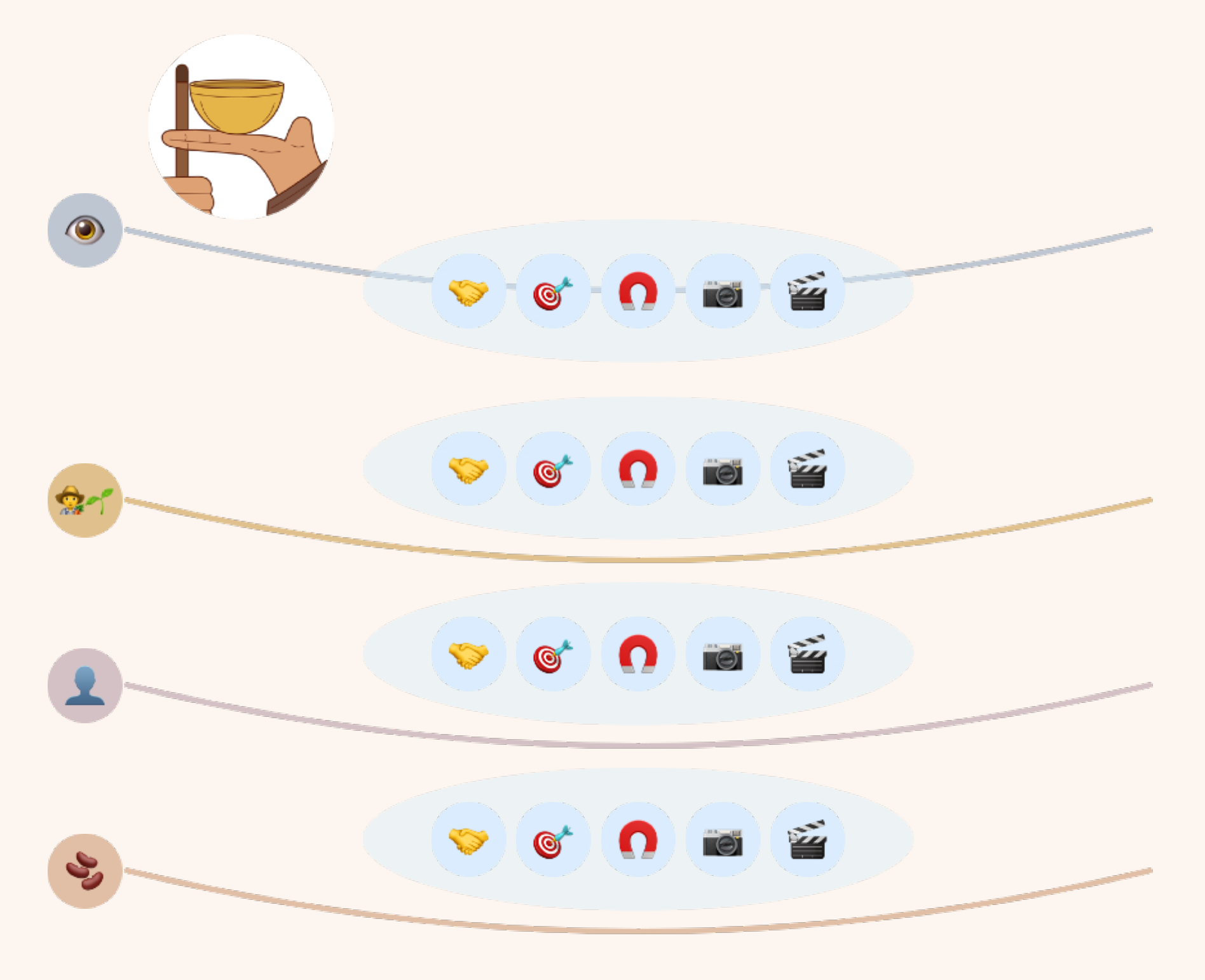
In ear consciousness
The sound meets the ear and hearing begins. The chapter has already said why contact matters here: “Only through contact with its object does a sense base give rise to a sense consciousness.” All five arise with that contact. The ear turns to the sound, and the sound feels pleasant or unpleasant. Perception hears the sound itself, its tone and its fading, before there is any name for it. Volition is the pull to keep listening. That last example is ours, because the book says the five are active in the senses but gives no example of volition there.
The book’s picture of this way of perceiving is a baby with a toy, in the chapter on Verse 29. There is “no comparison, remembering, or judging,” and she “simply enjoys the form of the toy.”
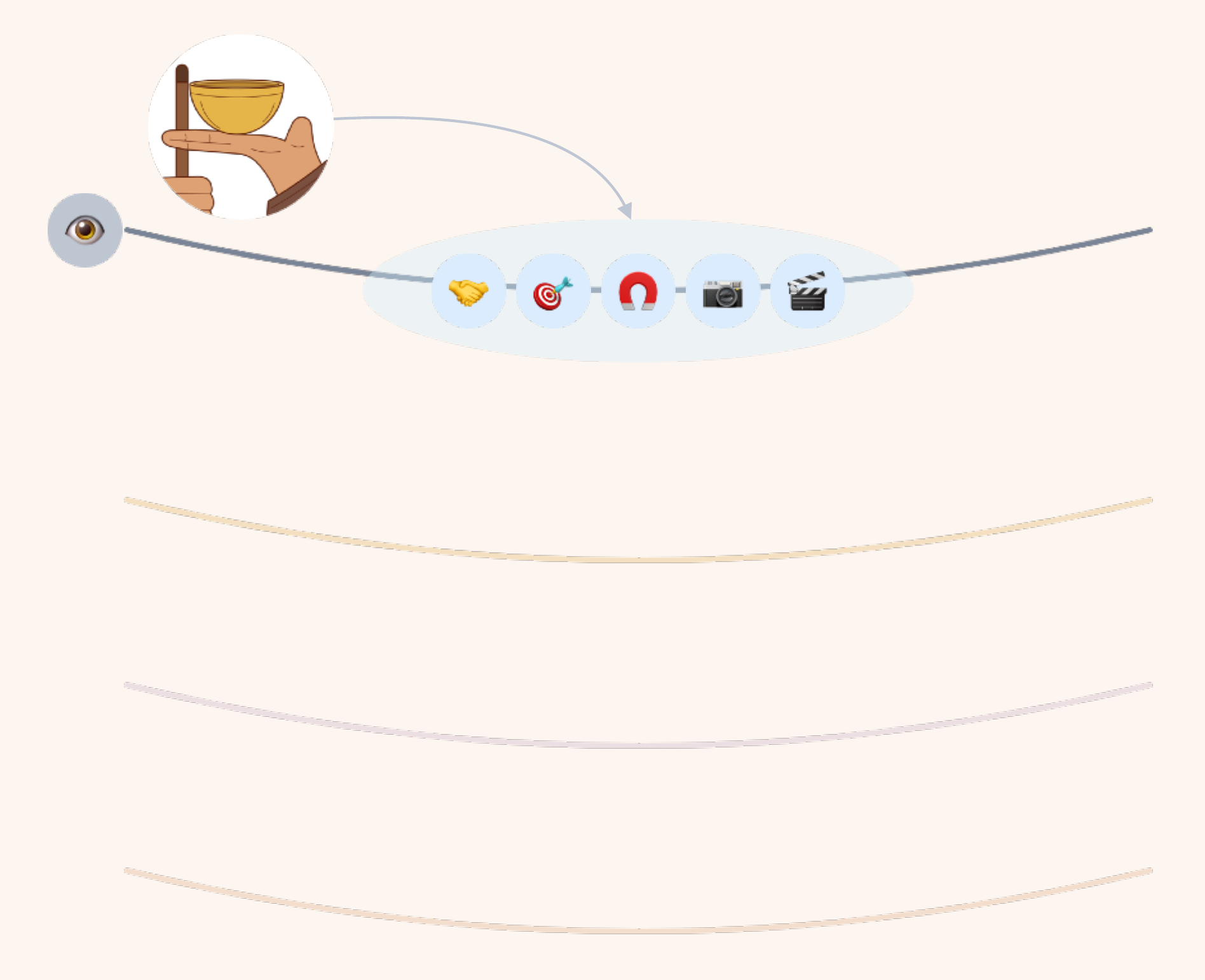
In mind consciousness
Mind consciousness names the sound: “the bell.” To do that it draws on every bell we have heard before. The chapter on Verse 29 says that it “tends to discriminate between things, name them, or compare them,” and that once it enters, “it brings the seeds of memories, experiences of joy and sadness, and comparison into play.” So mind consciousness perceives a bell of its own, which is no longer quite the sound that reached the ear. The book’s example is sadness: “When we are sad, it is difficult for us to be joyful even when we are looking at beautiful scenery. The landscape has been stained by our sadness.”
Mind consciousness’s five work on that bell. It may like the sound, or it may feel interrupted. Then it decides what to do, and perhaps we stop and breathe. This is where appropriate attention comes in, because mind consciousness can choose to turn to the bell.
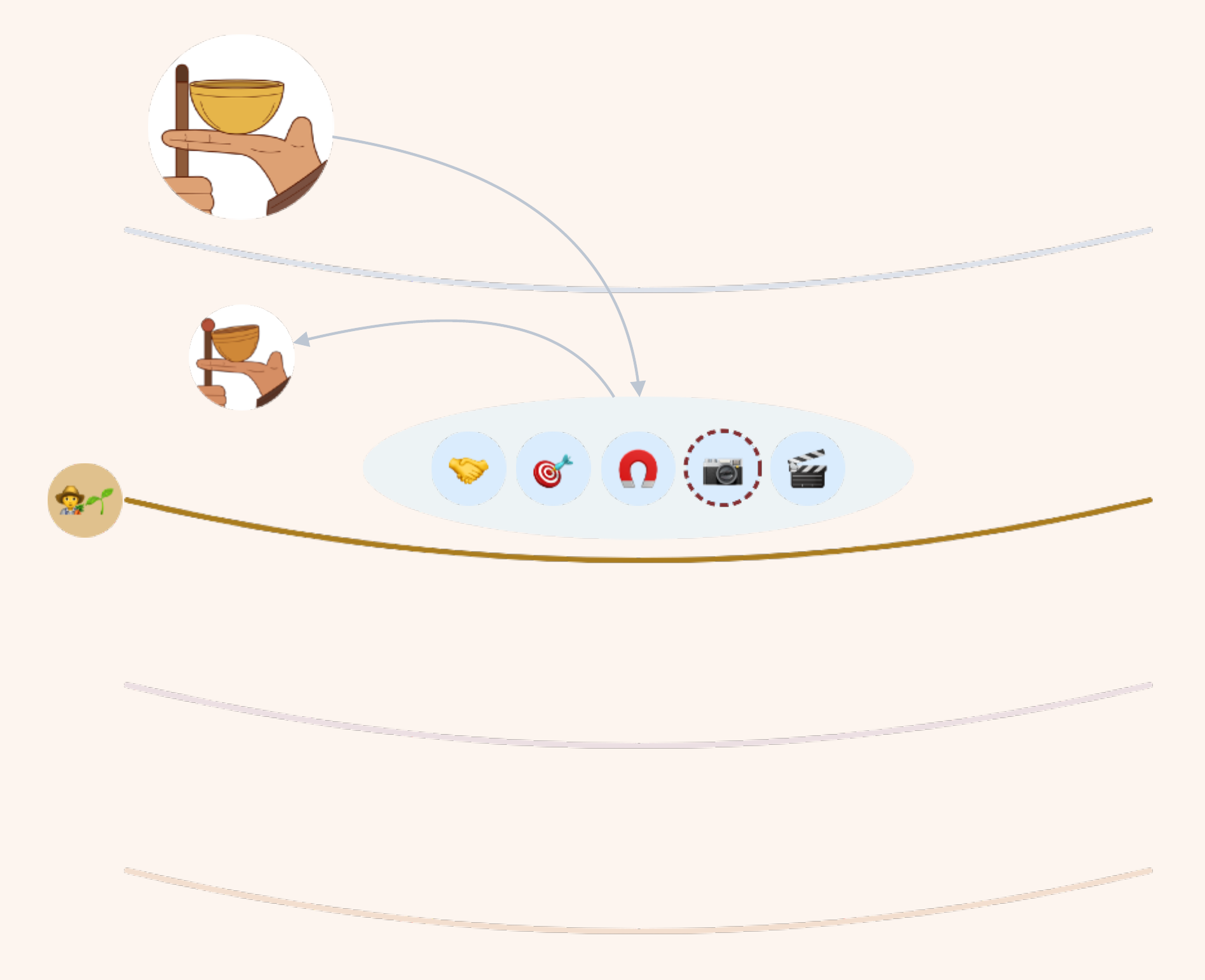
In manas
Manas does not hear the bell. The chapter on Verse 17 gives it a different object: “The object of manas is the perceiver aspect of store consciousness.” Manas turns toward the store and takes that part of it for a self. “All manas does is to think and calculate: ‘This is me.’”
So when mind consciousness names the sound, manas makes it personal: “my sitting,” “I’m doing well,” “who interrupted me?” Those three thoughts are our examples.
If the bell makes us jump, that is manas as well. The book says the same of a startle in our sleep: “When we are sleeping and something startles us, that reaction is due to manas.” Mind consciousness “has not had enough time to consider the situation,” while manas “behaves automatically, instinctively.” The book does not say how a sound reaches manas.
Manas has its five like every other consciousness. The chapter on Verse 20 says, “Manas is always in contact, being attentive, feeling, perceiving, and intending,” and then says what they do: “Through the activity of these five universal mental formations, manas grasps the store consciousness and regards it as a self.” Their object is the store, not the bell.
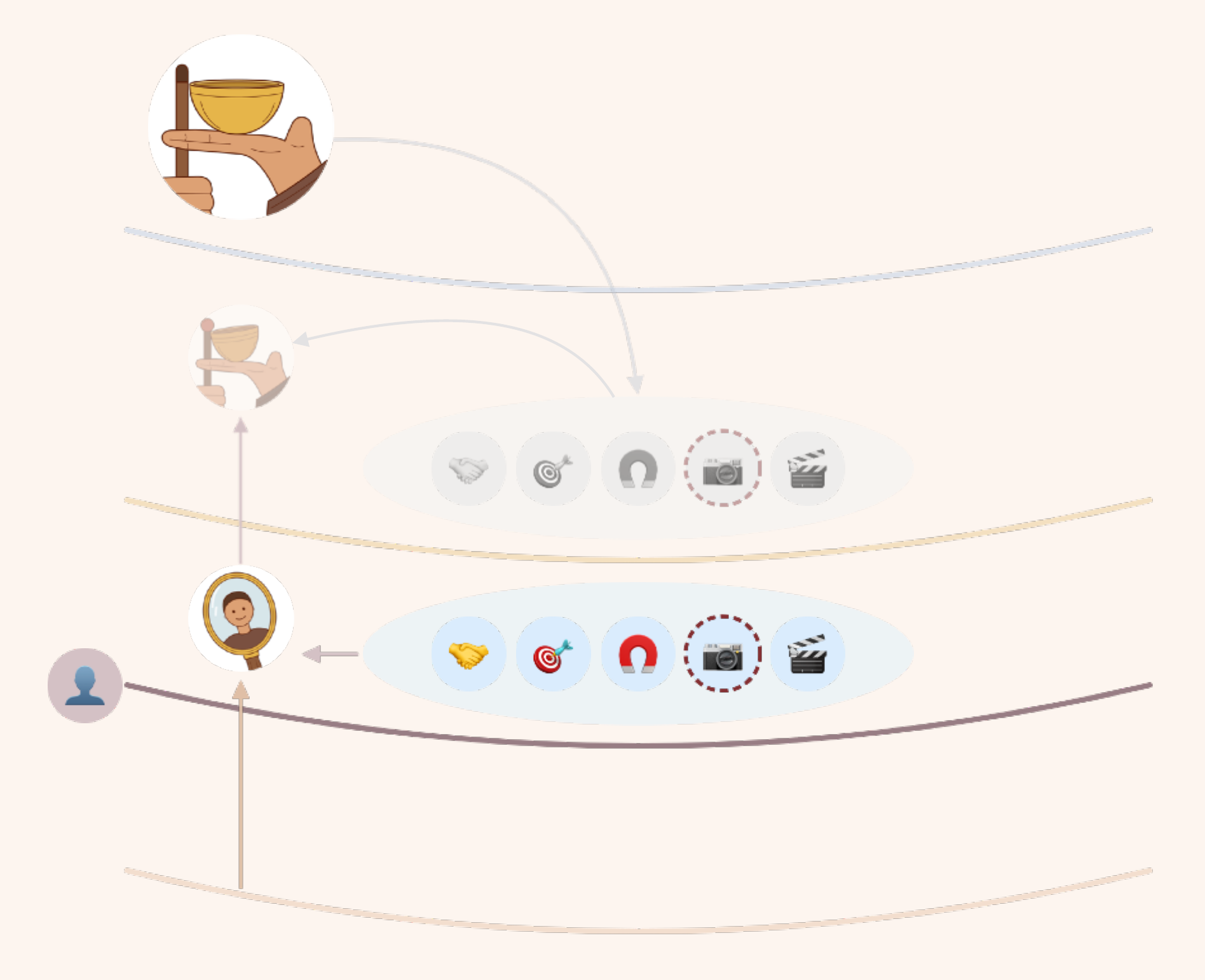
In the store
The store receives the sound and keeps it as a seed, as it keeps everything we see and hear. The chapter on Verse 3 says that consciousness “receives and is impregnated with all the experiences and perceptions that come to us through seeing, hearing, smelling, tasting, and touching,” and that these “then become seeds in our store consciousness.” Verse 10 adds that the five do this work: “Store consciousness operates in the form of these five universal mental formations.” Contact, attention, feeling, perception and volition are how the store receives and keeps. The book says something similar of manas, whose thinking “manifests as these five universals.”
How we meet the sound goes into the store too. Each bell we stop for waters the seed of mindfulness. The book does not say this of the bell. We took it from its teaching on watering.
The store has a volition of its own. At the Winter Retreat Thầy said, “Alaya doesn’t want to die. Alaya wants to live,” and he called that wish its volition (19 December 2013). Alaya is the Sanskrit name for the store. Manas wants to live too, but as “me,” and the book sets the two apart: the store is “continuous but does not discriminate.” In the same talk he said that the store’s “feelings are neutral.” The earlier reading on the five says more about what volition is, and why he calls it a food.
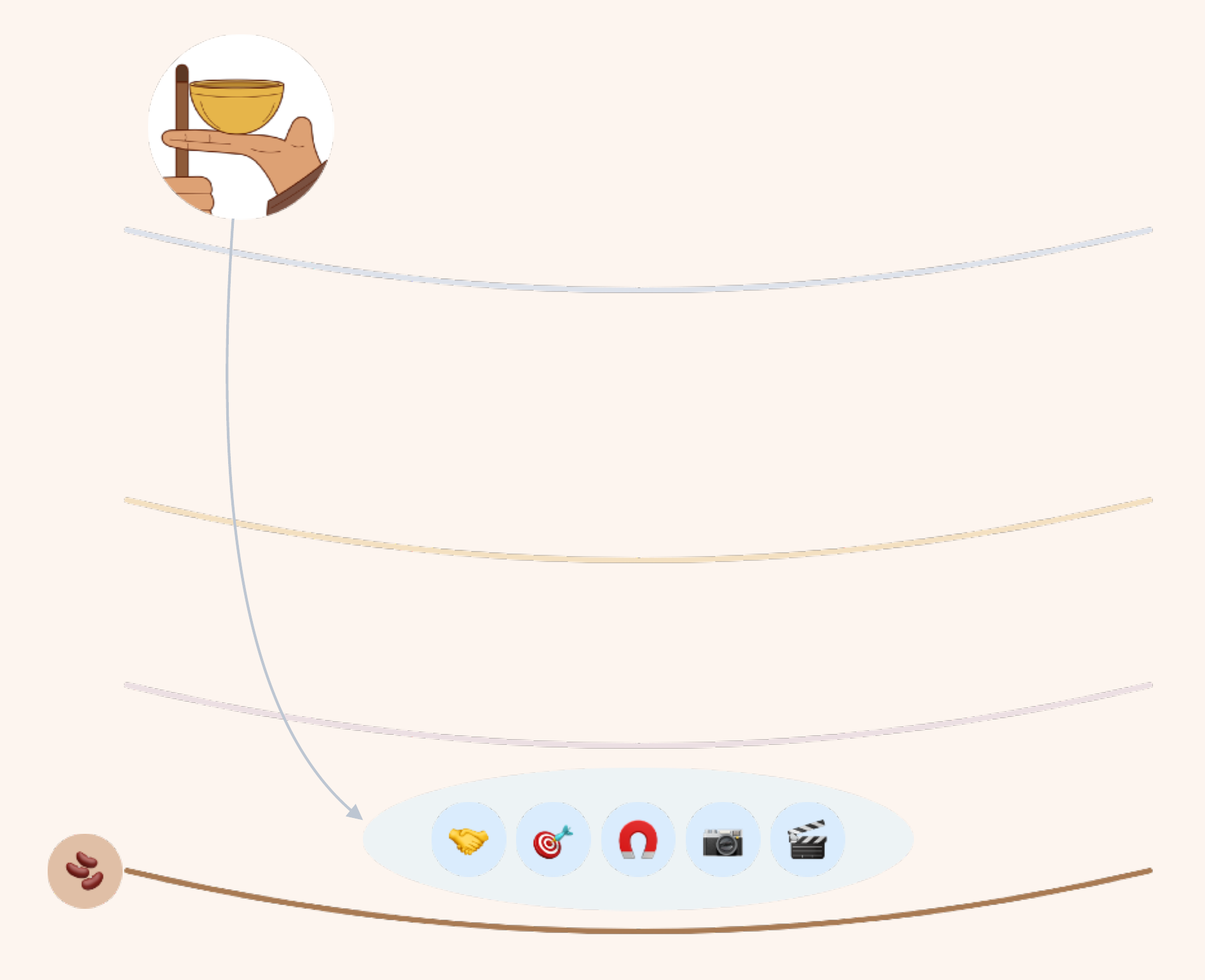
Each in its own way
So the five are in every consciousness, and they are not the same in each. The ear hears a sound. Mind consciousness hears “the bell.” Manas hears nothing, and still takes the moment personally. The store keeps it all.
One moment for each consciousness shows the difference, three from the book and one from the Winter Retreat. Thầy’s example for the store is driving. Once we have learned to drive, mind consciousness can think about other things and we carry on driving the car: “And that is alaya consciousness who is driving the car, not the mind consciousness” (19 December 2013). The same talk says the store reacts quickly when something unexpected happens, a quickness the book gives to manas, so we use the example only for the skill.
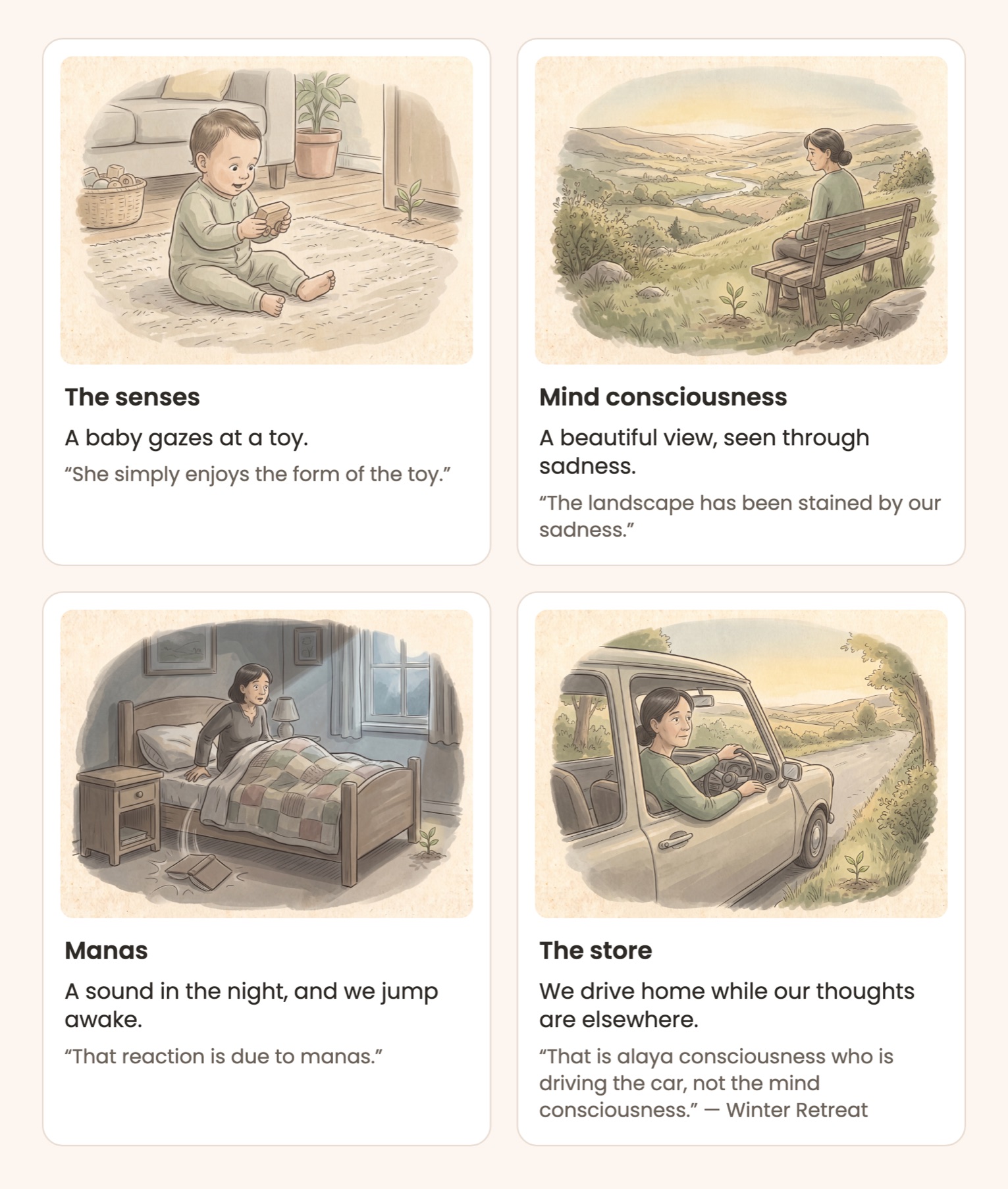
The book gives one reason for these differences: the store’s mode of perception is not the same as the others’. The next reading on this verse takes up the three modes.
None of this has to be pulled apart while we sit. Contact, attention, feeling, perception and volition are all here in one breath, working together. What we can do is notice what we take in, because the store receives all of it: a conversation, a screen, a meal. Breathing in, I know my store keeps what I take in. Breathing out, I choose to take in what nourishes me. Each mindful breath is received by the store too, as a seed of mindfulness. In the film Looking Deeply into Your Five Skandhas, Thầy asks us to stop running and make time to go home to our own body, feelings, perceptions, mental formations and consciousness: “My body, I am here for you.”
Contemplation Questions
The universals work together in every moment. When did you last notice a sound, a feeling and a reaction arrive all at once?
The store receives and keeps what we take in. What have you taken in lately that you would like to keep, and what would you rather not have taken in?
Thầy says the store drives the car while the mind is elsewhere. What else does your store do for you without being asked?
Carry whichever of these stays with you — into your own quiet reflection, or into conversation with others.
Going Deeper
8 notes ·A few notes for anyone who wants to follow a thread further.
How can attention come before contact?
At the Winter Retreat Thầy said that the five “take place almost simultaneously. Sometimes mental attention takes place before contact” (28 November 2013). That can sound backwards. Contact is where a sense organ, an object and consciousness meet, so it seems the mind would have to meet something before it could attend to it.
The answer is in what attention does. At the 1997 retreat Thầy glossed it as “turning the mind to the object.” His thesis of 1963 lists it first of the five and gives it two jobs: “this is the cause for the occurence of any kind of cognition. If the cognitive element has not yet occured, it causes it to occur; if it has occured already, it causes it to direct itself to the object.” The thesis calls it mental excitation, meaning the mind is roused. Contact needs consciousness to be there, and the first of those two jobs is to bring it. So attention can come first: the mind is roused and turned toward something, and contact happens when the object arrives.
Thầy gave no example of this in the talk, so the three here are ours. When the bell is about to be invited, we are already listening. Attention has turned toward a sound that has not happened yet, and when the bell sounds, contact lands in a mind that is ready for it. When we look for a friend’s face at an airport, attention goes out first, and contact comes when the eye finds them. Habit can do it too. Later in the same talk Thầy describes someone who is “afraid of going to a meeting because she knows that whenever she goes to a meeting, she would come in contact with this object.” Her attention is on that object before anyone has spoken, and that is part of why her reaction comes so fast.
Neither order is the true one. The book lists contact first and the thesis lists attention first. The five are associated, engaged with each other, so any list of them is a way of telling one very short moment slowly.
Do the five work in every consciousness at once?
Yes. They work in every consciousness that is active at that moment, and each consciousness has its own five. Following one sound of the bell through the consciousnesses one at a time is a way of seeing each. In life they run together.
Two of them never stop. The chapter on Verse 10 says that store consciousness “operates continuously, day and night, without stopping,” and that “Like store consciousness, manas never ceases in its activity.” Their five are at work whenever anything else is, the bell included.
The others come and go. In the same passage, “The six sense consciousnesses of eye, ear, nose, tongue, body, and mind are sometimes active and sometimes at rest.” When they are active, they can work together. The chapter on Verse 28 says the senses manifest “either separately or together with mind consciousness like waves rising up from the ocean,” and gives an ordinary example: “When we watch television, we use both our eyes and ears. In this case, two sense consciousnesses are manifesting together.” They can also narrow to one. Absorbed in a painting, “Without even knowing that we have done so, we have closed off our other four sense consciousnesses.”
So at one sound of the bell, four sets of five can be at work at the same moment: the ear’s, mind consciousness’s, manas’s and the store’s.
The five are simultaneous in two ways, then. Within one consciousness they are associated, arising together, so that none of them has to come first (how attention can come before contact). Across the consciousnesses, several are active at once, each with its own five.
If manas doesn’t hear the bell, how does it make the moment personal?
It works through mind consciousness, which rests on it. The chapter on Verse 17 says, “Manas is a sense base for mind consciousness in the same way that the eyes are a sense base for eye consciousness,” and that the objects of mind “come from the working of manas with the seeds in our store consciousness.” Verse 23 compares manas to wiring: “Manas is like an electrical conduit between the store consciousness and the mind consciousness, but because its nature is obscured, it distorts the electrical signal.”
So manas has already touched the bell that mind consciousness perceives. The chapter on Verse 24 says, “So often when we perceive something we’re merely perceiving an old seed in our store consciousness,” and “Due to manas, even when the truth is new and fresh, we cannot touch it.” Verse 29 draws the conclusion for mind consciousness: “because it is based on and influenced by manas, its mode of perception is usually erroneous as well.” The book gives no example with a bell. “My sitting” and “who interrupted me?” are our own.
Then how can the bell make us jump?
Manas takes the store as its object, so a careful reader may ask how a sound can startle it. The book states the fact and does not give the route. We looked in the book, both retreats and the 1963 thesis and did not find one.
Three passages point in a direction. At the Winter Retreat Thầy said, “Without manas, we cannot hear” (6 February 2014). At the 1997 retreat he called manas the base of the other six consciousnesses (8 November 1997). The chapter on Verse 26 says that in two deep states of concentration, manas and the store “no longer receive impressions and representations.” We infer from that sentence that at other times they do.
The Winter Retreat also credits the store with a quick reaction. Of driving, Thầy said, “if something unexpected happens, Alaya will react very quickly” (19 December 2013). The book gives the quick reaction to manas: “that rapid self-protective response belongs to manas.” The two may be different things, since the store’s reaction in that talk is a learned skill and the book’s is an instinct to survive. We follow the book on the startle, and we use the driving only for the skill.
What do manas’s five touch, if not the bell?
They touch the store. For contact and attention the chapter on Verse 17 says, “Day and night, manas is always thinking, believing, grasping, and considering store consciousness as its object.” Perception is the thought “This is me,” and Verse 29 says, “The mode of perception of manas is always false.” Volition is in Verse 21 itself: “a misguided attempt to survive, craving for continuation and blind satisfaction.”
Feeling is the gap. No passage in the book, the retreats or the thesis says what manas feels. The classical commentaries give it neutral feeling, and we mention that as theirs. Thầy gives neutral feeling to the store.
All five share manas’s nature: “all the mental formations that go along with it have the same nature: obscured and indeterminate.” The mistake itself is the perception “This is me,” which is why the figure rings perception alone.
Which part of the store manas grasps is a longer question. The book says the perceiver aspect, and Thầy’s 1963 thesis says the same. At the Winter Retreat he said that manas grasps “the body part of the store consciousness” (6 February 2014), and also that “the teachers of manifestation only do not agree with one another” about it (16 January 2014).
Would the bell still be unpleasant without manas?
We think so, if “without manas” means without its “me.” Nothing else in us works without manas, as the note above on the startle shows.
Feeling comes from contact, earlier than craving. The chapter on Verse 15 gives the links: “Contact conditions feeling (vedana). Feeling conditions craving (trishna). Craving conditions grasping.” Manas comes in after feeling: “Manas seeks to satisfy craving.” A harsh sound can be unpleasant to the ear by itself. “Who interrupted me?” is what manas adds.
In The Heart of the Buddha’s Teaching Thầy gives the Buddha’s image for what is added: “The Buddha said that if one arrow strikes you, you’ll suffer. But if a second arrow hits you in the same spot, you’ll suffer one hundred times more.” He goes on, “Fear or hatred, born of ignorance, amplifies your pain.” The Buddha had the first arrow too: “when he had a wound in his leg and people tried to help him, he said it was only a small wound.”
This answer is ours, put together from Verses 15 and 21 and that book. No passage says it in these terms.
How do the five receive and keep the seeds?
The book says the store “operates in the form of these five” and goes no further. It does not say which of the five receives and which keeps. We looked in the book, both retreats and the 1963 thesis, and found no passage that does.
The verse in Vasubandhu’s Thirty Verses that Verse 10 draws on gives a reason. In the English used at the Winter Retreat, it says that the store’s appropriation “cannot be known intellectually,” and then that the store “is always associated with contact, mental attention, feeling, perception, and volition.” Teaching the verse, Thầy explained appropriation as the store’s work: “it receives and it maintains.” Then he said, “This receiving the seeds is beyond our knowing.” His example was small children in France, who speak French well before they go to school because they hear grown-ups speaking it, so that “the language goes in a way that is beyond our knowing” (1 December 2013).
So the verse itself says we cannot work out by thinking how the store receives and keeps. The sources say only three things about the five in the store. The book says the store’s mode of perception is “always direct.” At the Winter Retreat Thầy added the two in the section on the store: its feeling is neutral, and its volition is the wish to live.
We can see the results, though. The chapter on Verse 15 gives an example. We meet someone whose name we cannot remember, try all the way home, give up and go to sleep. “The next morning, while we are brushing our teeth, the name leaps into our mind.” The book explains, “During sleep, our mind consciousness stops working on the problem, but the store consciousness continues its work.” The drive home is the same work: a skill the store received, kept and now uses on its own. The chapter draws the lesson for practice: “We have to trust our store consciousness. It isn’t the intellect that does all the work.”
Isn’t wanting to live manas’s job?
In the book it is. The chapter on Verse 17 says that “one of the functions of manas is the instinct to survive, to protect the self,” and the book never says what the store’s volition wants. The Winter Retreat gives the wish to live to both. Of the store Thầy said, “Alaya wants to live” (19 December 2013). Of manas he said that it is “a mechanism for survival,” and “It comes from store consciousness” (19 January 2014).
We read the two together this way. The store has, in his words, “the capacity to maintain life or sustain life,” and it does this without picking anyone out, because it “does not discriminate.” Manas takes part of the store to be “me,” and what it wants to continue is that “me.” The line between them is ours, drawn from the difference the chapter on Verse 19 gives: the store is continuous, and manas is “both continuous and discriminating.”