10.04
Three Modes of Perception
The fourth reading on Verse 10: the three things the book looks at in every consciousness, and a close look at one of them, the mode of perception, which can be direct, by inference or erroneous.
This page is our current understanding, written as we work through the book together — it changes as our understanding changes.
The Reading
Verse 10 reads:
Unobstructed and indeterminate, store consciousness is continuously flowing and changing. At the same time, it is endowed with all five universal mental formations.
The chapter has just said that the five universals are different in each consciousness “because the mode of perception (pramana, ‘way of measuring’) of store consciousness is different from the mode of perception of other consciousnesses.” Its next passage says what a mode of perception is:
“To understand how the consciousnesses operate, we have to consider the nature, mode, and object of perception of each. In Chapter Eight we discussed the three fields of perception—the realms of things-in-themselves, the realm of representations, and the realm of mere images. The mode of perception that leads to the realm of things-in-themselves is direct (pratyaksha pramana). A direct perception does not involve thought or imagination; it is not the result of comparison or reasoning. In the store consciousness, the mode of perception is always direct. When we see a fire, we know that it is a fire. This is a direct perception.”
“But suppose we see smoke rising from behind a wall and from that we surmise that there must be a fire there. This is a deduced perception, perception by inference (anumana pramana), and it may be either correct or incorrect. If what we thought was smoke from a fire is actually mist, for example, and if on seeing the mist we say there is a fire, that is an erroneous perception (abhava pramana). The Buddha warned that most of our perceptions are false. When we look at a beautiful sunset, we believe that we perceive the sun of the present moment. But scientists tell us that the sun we are seeing is actually an image of the sun of eight minutes earlier. We go through our lives with many erroneous perceptions, yet we are certain they are all correct. False perception is the source of so much suffering.”
Thầy names three things to look at in any consciousness, and then takes one of them, the mode, through three examples built on a single fire. This reading follows the same order: the three things, then the three modes one at a time, then the mode each consciousness perceives in. It ends with the Buddha’s warning and the question the book gives us for it, “Am I sure?”
The Teaching
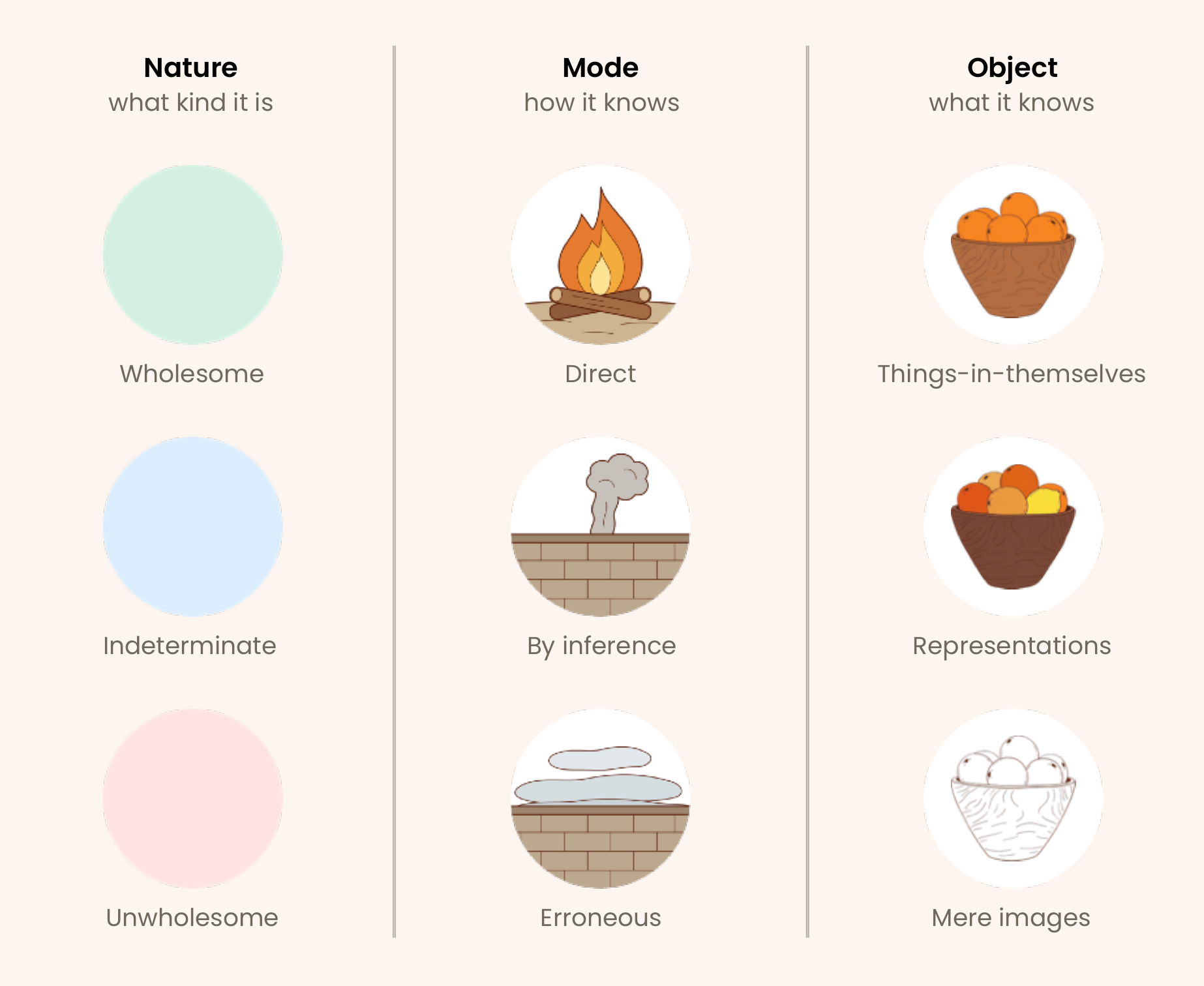
Nature, mode and object
The book asks three things of every consciousness. Its nature is whether it is wholesome, unwholesome or indeterminate; the chapter has already set out the three natures and called the store indeterminate. Its object lies in one of the three fields of perception from Verse 8: things-in-themselves, representations or mere images. Its mode is how it knows that object. The Sanskrit word is pramāṇa, which the book translates as “way of measuring.”
The fields and the modes are easy to confuse, and the book itself once uses the word modes for the fields. Describing the first field, the chapter on Verse 8 says, “This is the only one of the three modes of perception that is direct.” The two lists answer different questions. A field is what we perceive: the thing as it is, the picture the mind has made of it, or an image with nothing behind it. A mode is how we perceive it: straight away, by working it out, or wrongly. The passage joins the two lists at one point only: “The mode of perception that leads to the realm of things-in-themselves is direct.”
Thầy thought the two lists mattered a great deal. In his thesis of 1963 he wrote that “the notion of three aspects (pramāṇa, 量) and three spheres (viṣaya, 境) of cognition is the key for the understanding of the doctrine of Vijñānavāda,” the school whose teaching this book carries. His aspects are the book’s modes, and his spheres are its fields.
Direct perception
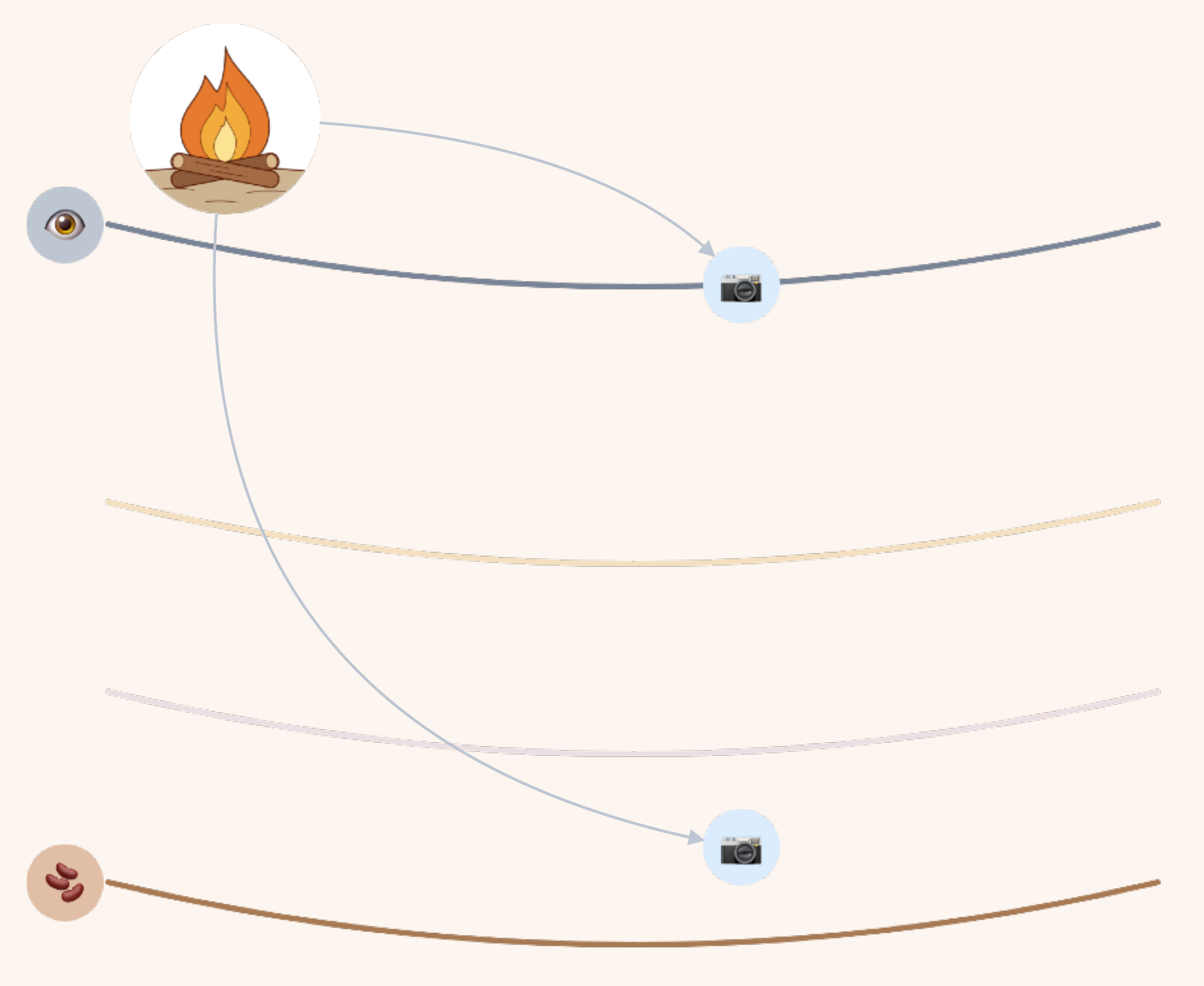
“A direct perception does not involve thought or imagination; it is not the result of comparison or reasoning.” The book’s example is a fire: we see it, and we know that it is a fire. Nothing is worked out on the way.
Thầy tells a story about this in The Heart of the Buddha’s Teaching. Walking in the woods with a group of children, he noticed a little girl thinking for a long time, and at last she asked him what colour a tree’s bark was. “It is the color that you see,” he told her. “I did not want to add another concept.”
Direct perception is the mode that reaches things-in-themselves. The chapter on Verse 29 gives it to the five sense consciousnesses, which “do not need to operate through the medium of thought,” and says that in this they are “like the eighth consciousness, store consciousness, which also has the direct mode of perception.” Its picture of the senses perceiving this way is a baby with a toy: there is “no comparison, remembering, or judging,” and she “simply enjoys the form of the toy.” The store perceives this way all the time. The paragraph after this reading’s passage says so again, and adds that the five universals in the store follow it: “In the eighth consciousness, contact is direct; mental attention is direct; and feeling, perception, and volition are also direct.”
Mind consciousness can perceive directly too, though not often. The book calls that intuition, and Thầy used the word for the whole mode.
Direct does not always mean correct. The rope in the section on erroneous perception shows why.
Perception by inference
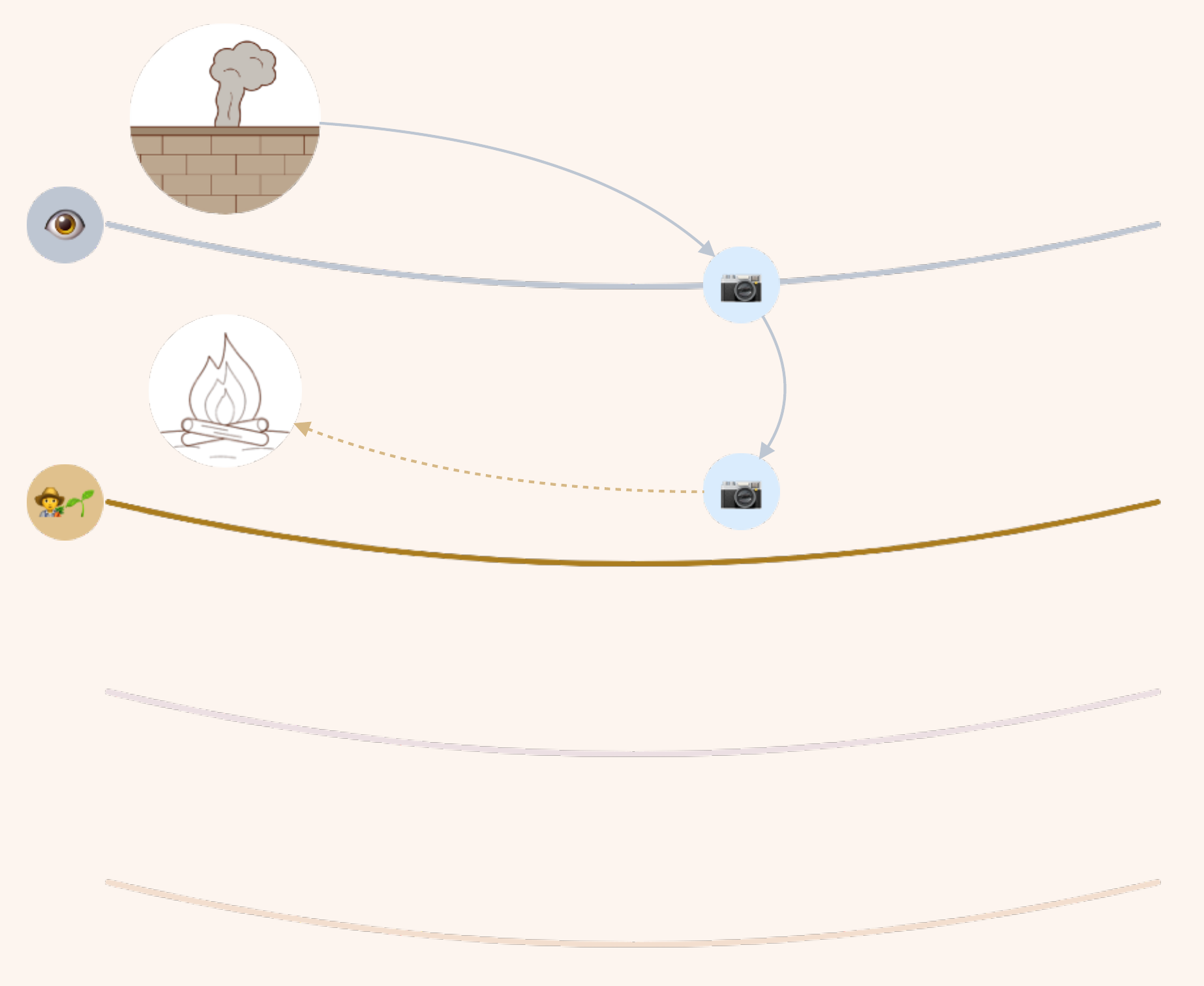
Inference knows something we cannot see from something we can. We see smoke rising behind a wall, and we work out that there must be a fire. At the 1997 retreat Thầy put it this way: “You do not see the fire. But because the fact is the smoke is there, you know the fire must be there.” An everyday example of ours: we see dark clouds and take an umbrella.
Inference compares and reasons, so among the eight consciousnesses only mind consciousness uses it. The book does not say this in one place. We put it together from what the book says of the others: the senses and the store always perceive directly, and “the mode of perception of manas is always false” (Verse 29). Thầy’s thesis says outright that inference belongs to the sixth consciousness alone, which is mind consciousness.
The chapter says inference “may be either correct or incorrect.” The clouds may blow over. The book comes back to the three modes in the chapter on Verse 24, with examples of its own for each.
Erroneous perception
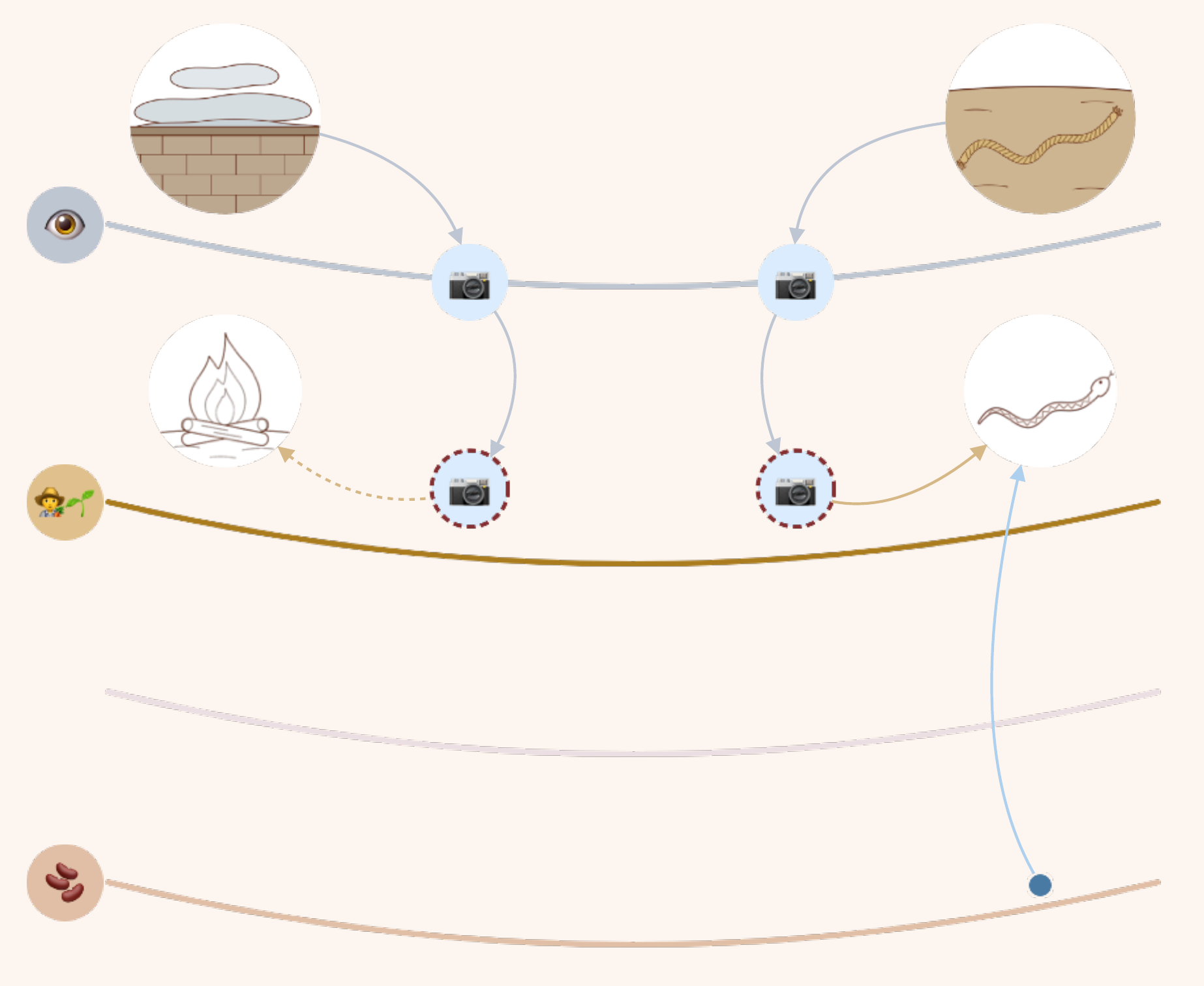
An erroneous perception takes something for what it is not. In the chapter’s example we see mist, take it for smoke, and say there is a fire. This is not a third way of knowing beside the other two. The chapter on Verse 24 calls it “the wrong perception that may be the result of either direct perception or inference.” A direct perception can go wrong, and so can an inference.
The rope from Verse 8 is a direct perception that went wrong. “Suppose you are walking in a field at dusk. In the path ahead you see a long, curving shape that you ‘recognize’ as a snake.” Nothing is reasoned out; we simply see a snake. The chapter on Verse 24 says so in as many words: “This is a direct perception that isn’t correct.” And Verse 8 says where the snake came from: “Seeing a piece of rope, you touched the image of a snake in your store consciousness.” The snake was a seed in our own store, not anything in the rope.
The mist is the other kind, an inference that went wrong: smoke would mean a fire, but this is not smoke. That is our reading of the example. The book calls the mist case erroneous and does not say which kind of error it is.
How each consciousness perceives
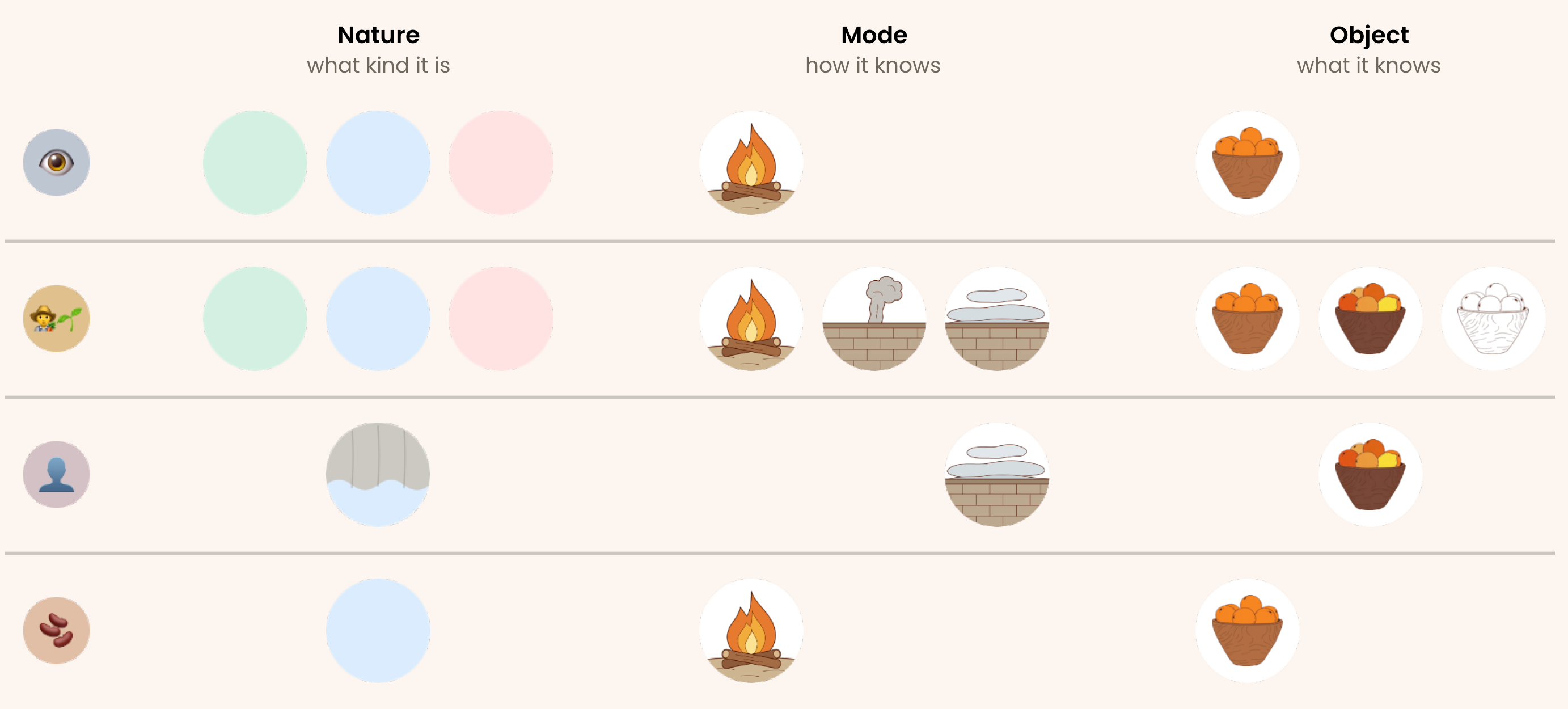
Now we can read the chapter’s earlier reason: the five universals differ in each consciousness because the store’s mode of perception differs from the others’. The book gives each consciousness its mode in a different chapter, and the answers fit in one table, with nature and object beside the mode.
The five senses perceive directly and, when they work on their own, reach things-in-themselves; their nature can be any of the three (Verse 29). Mind consciousness “has the capability of all three modes of perception” and can reach all three fields, though most of the time it reaches only representations and mere images (Verse 24). Because it rests on manas, its mode is “usually erroneous” (Verse 29), and its nature changes from moment to moment. Manas has one mode: “The mode of perception of manas is always false. Because of its obscuration, even when manas has a direct perception it is false” (Verse 29). “The object of manas is the mark of a self, found in the realm of representations” (Verse 18), and its nature is indeterminate and obscured. The store perceives directly, reaches things-in-themselves and is always indeterminate.
So the senses and the store share a mode, and mode cannot be the whole reason the five differ. In our reading the table shows the rest: the senses can take any of the three natures while the store is always indeterminate, and the two do different work. The senses take in a sight or a sound, and the store, the chapter says, works with its five “in terms of receiving, accepting, holding, maintaining, preserving, and storing the seeds.” Nor does “usually erroneous” put mind consciousness where manas is. The nature column raises questions of its own: why some consciousnesses have three natures and others one, and why manas, with its four afflictions always present, is not unwholesome.
Am I sure?
The passage ends with a warning: “The Buddha warned that most of our perceptions are false.” The chapter’s example is the sunset. We believe we are seeing the sun as it is now, but the light reaching us left it about eight minutes ago. Seeing the sun is not the mistake. The mistake is being sure that what we see is the sun as it is now. “We go through our lives with many erroneous perceptions, yet we are certain they are all correct.”
The chapter on Verse 24 says where much of the error comes from: “The Ekottara Agama says that most of our perceptions are the result of recalling things in the past. So often when we perceive something we’re merely perceiving an old seed in our store consciousness.” That is the snake again. We meet a rope, and what we see is a seed of our own.
The book gave a practice for this much earlier, in the chapter on Verse 2: “We should always ask ourselves, humbly, ‘Am I sure?’ and then allow space and time for our perceptions to grow deeper, clearer, and more stable.” In The Heart of the Buddha’s Teaching Thầy gives the same question as the first of four practices of Right Thinking, with the same rope: “If there is a rope in your path and you perceive it as a snake, fear-based thinking will follow.” He suggests writing “Are you sure?” on a large piece of paper, and hanging it “where you will see it often.” The question does not ask us to doubt everything. It gives a perception time to be looked at again. The chapter on Verse 24 adds that we need not do the looking alone, and gives the words to ask a friend: “Can you help me see whether what I have heard and seen is the truth?”
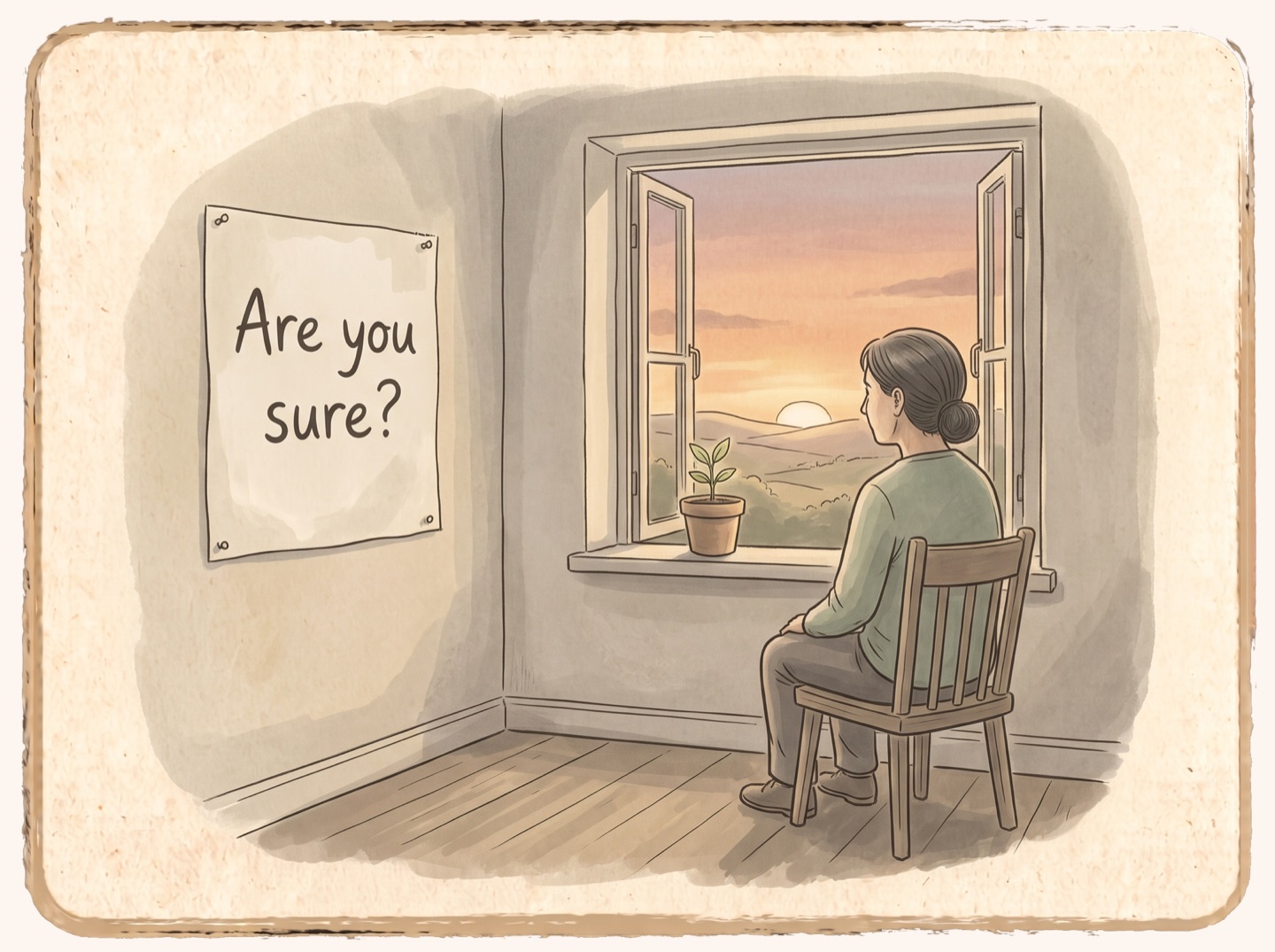
When a strong view of someone comes up, we can let it be there, ask it, “Are you sure?”, and hold it lightly. In the short film Right View, Thầy says that the Buddha named wrong view as the first cause of suffering.
Contemplation Questions
When did a perception of yours turn out to be wrong? How sure were you at the time?
Have you seen or heard anything directly lately, before a name or a judgement arrived? What was it like?
Where could you hang Thầy’s question, “Are you sure?”, so that you would see it often?
Carry whichever of these stays with you — into your own quiet reflection, or into conversation with others.
Going Deeper
5 notes ·A few notes for anyone who wants to follow a thread further.
What is a consciousness’s nature, and why does it change in some and not in others?
A consciousness’s nature is whether it is wholesome, unwholesome or indeterminate. The chapter on Verse 10 gives the test: “Wholesome means useful to ourselves and others. Unwholesome means harmful to ourselves and others.” Indeterminate is neither. The book applies the test to what a consciousness is doing, not to what it holds. The chapter on Verse 24 uses it on a single perception: “A perception is an act of cognition. If that act of cognition is wrong, it can create a lot of suffering and misunderstanding for the person who has it and the people around that person. That act has the mark, or nature, of unwholesomeness.”
That is why the nature of mind consciousness and the five senses changes. They are where seeds come up as mental formations, and where we think, speak and act, so each moment takes its nature from what has come up in it. The chapter on Verse 24 says, “When mindfulness is practiced, our mind consciousness has the capacity to be wholesome. In moments of forgetfulness, it has the capacity to be unwholesome. And it can also be indeterminate, neither wholesome nor unwholesome.” Verse 29 gives the senses the same three natures. The Cheng weishi lun, a Chinese commentary on the Thirty Verses from the seventh century, states this as a rule: a moment of the six consciousnesses is wholesome when faith and the other wholesome formations arise with it, unwholesome when the unwholesome ones do, and indeterminate when neither does.
The store consciousness does the same job all the time. It receives seeds of every kind and keeps them, and keeping a seed helps no one and harms no one. A seed does that later, when it comes up in another consciousness. Soil full of thorn seeds is not itself thorny. The store also has to stay neutral to do its job, and the reading on its three qualities gives Thầy’s reason, with his image of tea that takes the scent of jasmine.
Manas also does one thing all the time: it holds part of the store to be its self. So its nature does not change either. It is indeterminate, like the store, but obscured, and the next note asks why its four afflictions do not make it unwholesome.
A consciousness and its formations always share one nature. In the store and in manas, the consciousness sets the nature and what goes with it takes it on: Verse 10 says the seeds in the store “take on the nature of that consciousness,” and Verse 20 says the same of manas’s companions. In mind consciousness and the senses it runs the other way, and what comes up sets the nature of the moment. That way of putting it is ours, drawn from Verses 10, 20 and 24.
If manas always has its four afflictions, why isn’t it unwholesome?
The book calls the afflictions unwholesome, and it puts four of them in manas for good. The chapter on Verse 20 says, “Afflictions are unwholesome mental formations,” and of self-ignorance, self-view, self-pride and self-love, “These four major afflictions are always present in manas.” Yet the same chapter calls all of them indeterminate: “They are all indeterminate and obscured, exactly like manas. The ocean is salty, so all the drops of water in the ocean are also salty at the same time.”
So the afflictions in manas take on manas’s nature, as the seeds in the store take on the store’s. The book does not say why a belief in a self that never stops is not unwholesome in itself. The classical commentaries do, and we give their reasons as theirs, in our own translation. The Cheng weishi lun says that manas’s afflictions are indeterminate because what they rest on is subtle and they run by themselves, so no one chooses them, and that the self-view we are born with “does not set off harmful deeds.” Manas clings, quietly and all the time, but it does not speak or act. The chapter on Verse 25 gives that to mind consciousness, which “gives rise to actions leading to ripening.”
Indeterminate does not mean harmless, and obscured is the word that carries the harm. The chapter on Verse 19 says, “If manas loves in a blind and confused way, the other six consciousnesses will suffer.” The Cheng weishi lun says that ordinary people, whatever the nature of the moment, “outwardly do all kinds of deeds, but inwardly always cling to a self.”
The book finds hope in the same word: “And because they are indeterminate, they can be transformed” (Verse 20). The way to it runs through the store: “In order to transform manas, we have to transform our store consciousness, which holds all the seeds that are the base for manas” (Verse 19). When the change comes, the chapter on Verse 22 says, manas becomes “the wisdom of equality.”
Is mind consciousness always wrong, the way manas is?
No. The book gives manas no way out. Its mode “is always false. Because of its obscuration, even when manas has a direct perception it is false” (Verse 29). Mind consciousness is wrong only usually, and the book says why: it rests on manas. “When mind consciousness under the influence of manas gets involved, there is processing and distortion” (Verse 28).
But mind consciousness “has the capability of all three modes of perception” (Verse 24), and the chapter on Verse 23 says what happens when it uses the first: “When mind consciousness is able to touch the seeds in store consciousness directly, without the distortion of manas, it is capable of touching the realm of suchness.” Even its reasoning can help: “even the discursive, intellectual function of our mind can help us approach the ultimate dimension, if we use it to practice mindfulness” (Verse 24). That is why the practice is done in mind consciousness. The chapter on Verse 29 says, “By bringing the element of mindfulness into our mind consciousness we can begin to interrupt the process through which it ‘takes over’ the sense consciousnesses.”
Are mere images always unwholesome?
No. Whether an image is false and whether it is unwholesome are two separate questions: the first is about its field, and the second is about its nature. Every image is false in the sense of the fields: “All images, whether we perceive them in the mode of representations or the mode of mere images, are false” (Verse 8). But the book says that what we perceive has no nature of its own: “the Buddha said many times that dharmas (phenomena)—forms, sounds, smells, tastes, tactile objects, and objects of mind—are neither inherently wholesome nor unwholesome” (Verse 24).
The same chapter gives an example of a mere image doing good. “When we visualize a mountain during meditation, that visualization also belongs to the realm of mere images. But because this image is embraced by mindfulness, it begins to release the truth about itself… The realm of mere images can be the door to the truth.” Thầy’s breathing practices use images in just this way. In The Heart of the Buddha’s Teaching he offers “Breathing in, I see myself as a mountain. Breathing out, I feel solid.”
The chapter on Verse 24 also gives the other side: “Our suffering, our being tossed and turned in the realm of change, is not due to the realm of things-in-themselves but to the realm of mere images.” In our reading, what decides it is whether an image is held in mindfulness or taken for the real thing, the way the snake was taken for real on the path at dusk.
Does Thầy have other names for the three modes?
His thesis of 1963 calls them “intuitive cognition”, “discursive cognition” and “erroneous cognition,” and he used the same three words at the 1997 retreat (8 November). Both words are the book’s own. Of mind consciousness perceiving directly, the chapter on Verse 8 says, “When we have a strong intuition, our mind consciousness is in touch with the realm of suchness. Intuition is a form of knowing that is not based in thinking and imagining.” Of inference, the chapter on Verse 24 says, “It is discursive, speculative, and deductive.” The thesis says the same of the third mode as Verse 24 does: “This is not something that exists independently from those above. It consists simply of their erroneous sides.”