10.01
Three Qualities of Store
The first reading on Verse 10: what its three words for store consciousness — unobstructed, indeterminate and continuous — each mean, and why the chapter ends by saying that these are what make transformation possible.
This page is our current understanding, written as we work through the book together — it changes as our understanding changes.
The Reading
Verse 10 reads:
Unobstructed and indeterminate, store consciousness is continuously flowing and changing. At the same time, it is endowed with all five universal mental formations.
The first nine verses said what store consciousness does: it holds the seeds of everything we have lived through, it keeps every kind, it loses nothing, and its seeds ripen. Verse 10 says what the store is like. Thich Nhat Hanh, whom his students call Thầy, opens his commentary on it with one sentence: “This verse describes qualities of the store consciousness that differentiate it from the other consciousnesses.”
The verse has two halves. The first gives the store three qualities: it is unobstructed, it is indeterminate, and it is continuously flowing and changing. The second says it works with the five universal mental formations, and we come to those in the next reading. This reading takes the three qualities one at a time, and each one is clearest beside the consciousness it is being set against, which is usually manas. Then it reads the last paragraph of the chapter, where Thầy says why the three matter.
The Teaching
Unobstructed
Thầy’s first gloss in the book is short. “‘Unobstructed’ means exposed to the light, not hidden. Store consciousness is unobstructed because it has the capacity of attaining absolute clarity.” He says more when he comes back to it in the chapters on manas: “The nature of store consciousness is unobstructed, which means it can become true mind, Buddha nature. There is no obstacle standing in its way. There is the possibility of reaching the realm of things-in-themselves.”
The realm of things-in-themselves is the first of the three fields of perception from Verse 8: things met directly, before the mind has made a picture of them. The store can reach it because of the way it perceives. “The store consciousness does not engage in thinking, comparing, or imagining. Its mode of perception is always direct.” It does not stop to name a thing, compare it with something else, or decide what it means; it takes the thing as it is.
At the Winter Retreat on the Thirty Verses, in 2013 and 2014, Thầy used the Vietnamese term vô phú, which means “not covered”, and he gave the store’s direct perception as the reason for the name (12 January 2014). In another talk of that retreat he said what does not cover it: ideas and notions, such as the notion of a beginning and an end, of being and non-being, of good and evil (5 January 2014).
The word is clearest beside manas, which Verse 19 calls “indeterminate and obscured.” Thầy explains: “‘Obscured’ means to be ‘covered up.’ You cannot see the light if there is something covering it up.” The covering has a name: “The veil of ignorance that covers manas is the tendency to discriminate between self and nonself.” So manas “does not have the capacity to touch the realm of things-in-themselves. It can never touch the realm of suchness of store consciousness. Its object is an image of a self that exists only in the realm of representation.” At a retreat in 1997, teaching in English, he put it this way: “‘Obstructed’ means it is caught… There are obstacles on the way. That is why manas cannot touch the realm of suchness, the realm of things in themselves.”
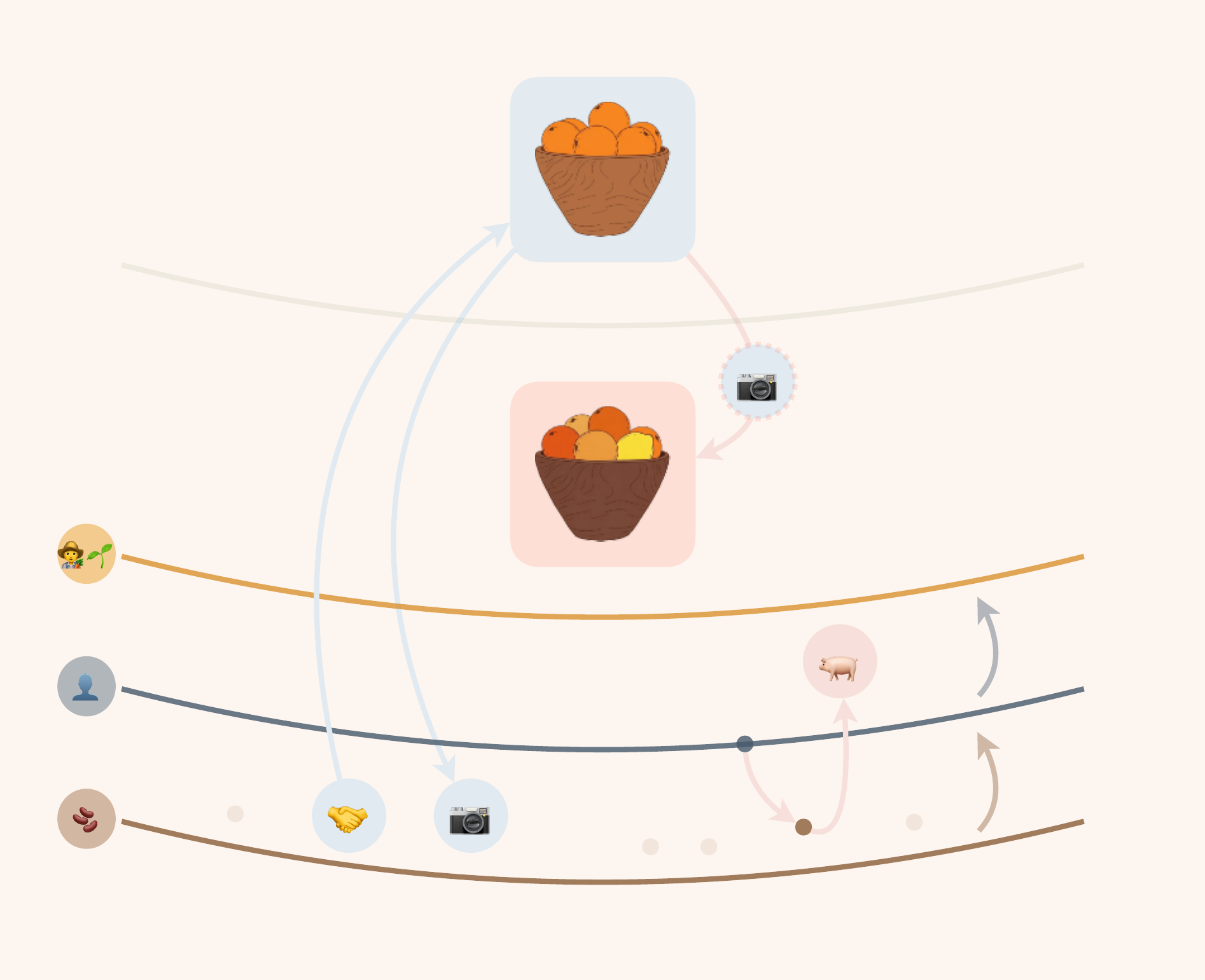
If the store is unobstructed, why don’t we see clearly? Thầy answers in the chapter on Verse 15: “There is so much ignorance and delusion in our usual way of perceiving and experiencing things that our store consciousness cannot reveal itself to us as a part of the ultimate dimension. But in fact the essential nature of store consciousness has always been free of afflictions.” The covering is in the consciousnesses we usually see with, manas and the mind consciousness that rests on it, and not in the store. When the seeds of delusion are transformed, Verse 15 says, the store becomes the Great Mirror Wisdom, “reflecting the cosmos in all directions.” The readings take that up when they reach Verse 15.
The book and the 1997 talk describe being unobstructed as a capacity: clarity can be reached. The Winter Retreat and Thầy’s 1963 thesis describe it as something already true: the store is not covered. These are two ways of saying it, and in his last talks on the subject Thầy went further than the book.
Indeterminate
The book names the second quality in its next sentence: “It is also indeterminate, meaning that store consciousness itself is neither wholesome nor unwholesome, though it contains all the seeds, both wholesome and unwholesome.” Then Thầy lays out the three natures that every action, word and thought belongs to: “Wholesome means useful to ourselves and others. Unwholesome means harmful to ourselves and others. Indeterminate means that an action, word, or thought is neither inherently wholesome nor unwholesome. It can be either, depending on the circumstances.”
So the store holds seeds of all three natures and has none of the three itself. His image for this is the earth. “Like the earth, store consciousness has the task of holding seeds. We know that store consciousness is itself neutral by nature.” At the Winter Retreat he named both kinds of seed: “Mother Earth has all the seeds, the seeds of Mara, the seeds of Buddha… and it’s up to us to decide what to choose” (8 December 2013). A week later he drew the consequence: because the store is indeterminate, “you have a choice to choose. You can choose one of the six paths, or you can choose nirvana” (15 December 2013).
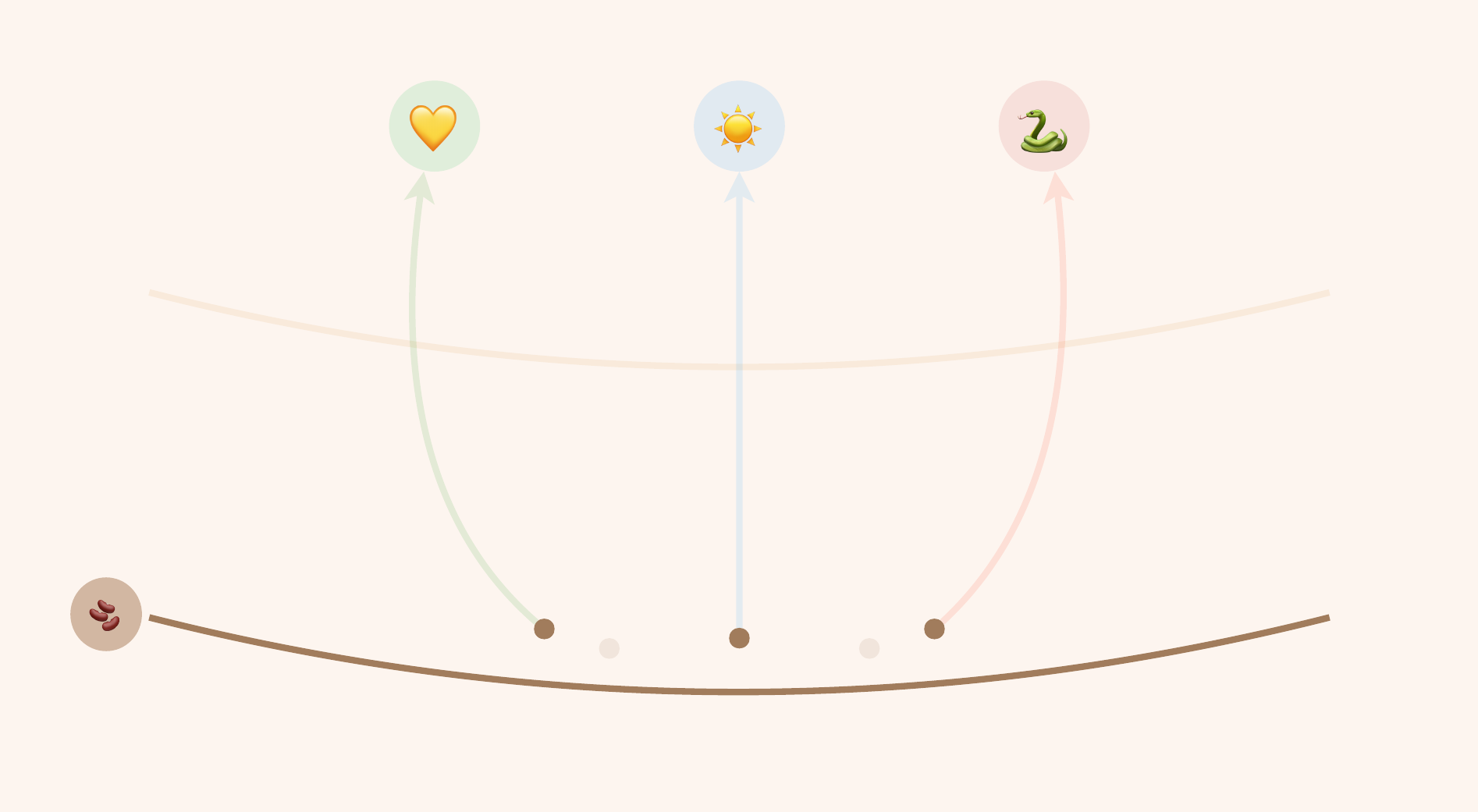
The formations in that figure are joy, insight and aversion, and the colours are the ones the Inner Landscape uses for the three natures.
Why does the store have to be neutral? Thầy’s answer at the Winter Retreat is that only something neutral can take on what is put into it (12 December 2013). His first image was tea: “Just like tea. It’s neutral.” That is why it can be scented with lotus flowers or jasmine. His second was cloth: a piece of white fabric can be dyed red or black or blue, but a cloth that is already red is hard to dye another colour. The jasmine tea is the same image the book uses for Verse 7, where Thầy explains habit energy: jasmine flowers shut in a box with the tea for several weeks, until the tea smells of them. Experience scents the store the same way, and it can only do so because the store has no scent of its own. In his thesis of 1963 Thầy put it in the older vocabulary: “the nature… of Alaya is neither good nor evil. It is neutral (avyākṛta 無記). So it admits the impregnation (vāsana) of both the good and the evil.”
Manas is indeterminate too. “The nature of manas is indeterminate, like store consciousness.” Thầy says this is why manas can change: “The transformation of manas can happen because it is indeterminate. The earth can give rise to thorns and brambles, but it can also give rise to fragrant fruits and flowers.” So being indeterminate is not what sets the store apart from manas; being unobstructed is. Manas is indeterminate and obscured, and the store is indeterminate and unobstructed, which is why the verse needs both words. (The book also uses indeterminate for something else entirely, and the word has two jobs. And a reader may fairly ask, if the store is neutral, whether our nature is good.)
Continuous, flowing and changing
“Store consciousness operates continuously, day and night, without stopping.” The other consciousnesses are not like that. A sense consciousness arises only when its sense organ is in contact with something: eye consciousness “operates during the day but not when we are asleep, because our eyes are closed and do not perceive any object.” Then the book says: “If we are asleep and not dreaming, mind consciousness stops also.” Verse 26 lists the other times mind consciousness stops: in states of non-perception, in two deep meditative attainments, in deep sleep, and in fainting or coma. Manas does not stop: “Like store consciousness, manas never ceases in its activity.”
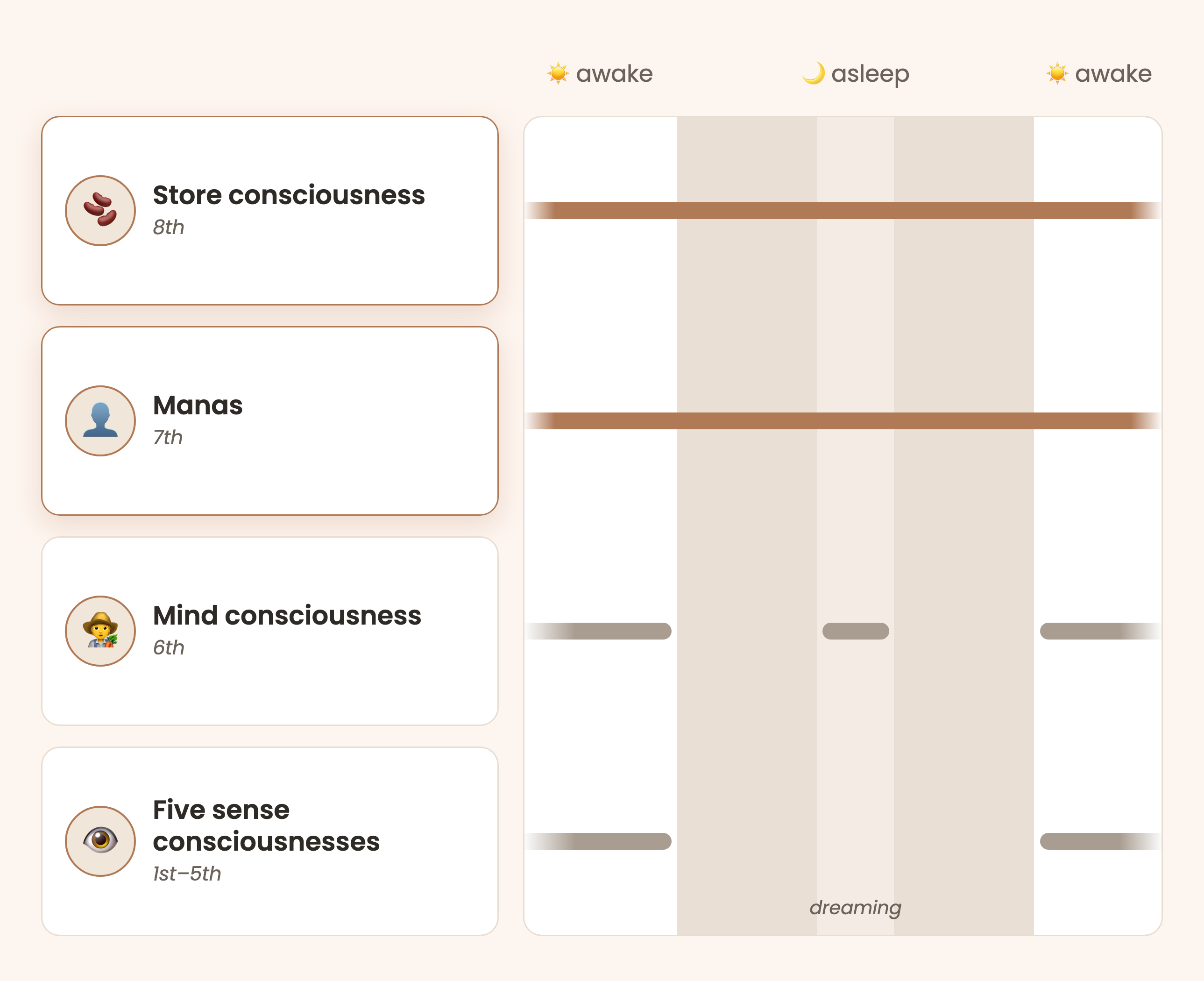
At the Winter Retreat Thầy said why this matters for the store in particular. The senses and mind consciousness can stop and we are still alive, “but store consciousness, if it stops, then we die” (28 November 2013). While we sleep, he said in another talk, the store goes on looking after the body: digestion, the heartbeat (16 January 2014).
Continuous does not mean unchanging, though, and the book says so at once: “Even though store consciousness never ceases, this doesn’t mean that it is always the same. It is continuously flowing and changing, like a river. A river is always the same river, but the water in it is always changing. Store consciousness is the same. It is the river, and the seeds it contains are like the water that is changing all the time.” In 1997, glossing this verse aloud, Thầy said: “It does not mean permanent. It is always changing.” The river is older than Thầy’s book. Vasubandhu’s Thirty Verses, which the Fifty Verses build on, say of the store: “It functions like the current of a river.” And in his thesis Thầy wrote: “Ālaya is not identical with itself in two consecutive moments.”
This matters because of what manas does with the store. Manas “embraces and clings to this aspect of store consciousness, makes it into an object, and that object becomes an idea of self.” It “continues to believe in the idea of a permanent, eternal self.” The store is the one thing in the mind that never stops, so it is the obvious place to look for a self that lasts. But what manas holds on to is a river. The next verse says this in its first line: “Although impermanent and without a separate self, store consciousness contains all phenomena in the cosmos…” So the store really is continuous, but the permanent self that manas builds on that continuity does not exist.
There is one more difference in the book, and it pairs with this one. “Unlike store consciousness, which is continuous but does not discriminate, the nature of manas is both continuous and discriminating.” Going Deeper sets all eight consciousnesses side by side on these points.
Why the three qualities matter
The chapter’s last paragraph ties the three together.
“The qualities of the store consciousness that make it unique are also the same qualities that allow for transformation of the seeds it contains. Because store consciousness is unobstructed and indeterminate, because its nature is neutral, and because it is always flowing and changing, it can be transformed. Every day is an opportunity for transformation. When we transform the seeds in our store consciousness, that is transformation at the base.”
If we read it with the rest of the chapter, each quality supplies one condition. Because the store is indeterminate, it can take on what we water, as the tea takes on the jasmine. Because it is always flowing and changing, nothing in it is fixed for good, so a seed watered today can change what the store is tomorrow. Because it is unobstructed, the clarity the practice is looking for is not somewhere else, but in the store, under the covering that manas and our usual perception add. That last step is our reading of how the three fit together; the book gives the three and the conclusion.
Thầy’s image for who does what is the gardener and the earth. “The other seven consciousnesses are the gardeners that till the earth.” We turn the soil, sow, water and weed. “But we cannot do the work of the earth.” And then: “What is most important is to have faith that the earth will germinate the seeds that have been sown.” The three qualities are why that faith is reasonable. The earth holds any seed, it never stops working, and nothing in it is fixed.
You can notice the difference between the store’s way of perceiving and ours in a small way. Listen to a sound, such as a bird, traffic or a fridge, without naming it or deciding whether it is pleasant. For a moment there is just the sound. Then the name arrives, and with it a judgement, and the moment of plain hearing is over. The book’s word for the first moment is direct.
Contemplation Questions
The store does its work silently, like the earth, even while we sleep. Have you ever woken up knowing something you did not know the night before? When you have an important decision, do you ever sleep on it, and why?
Manas holds on to the idea of a self that never changes. What is something about yourself that you thought would never change, but has?
Can you remember a moment when you saw something just as it was, before you started thinking about it?
Carry whichever of these stays with you — into your own quiet reflection, or into conversation with others.
Going Deeper
6 notes ·A few notes for anyone who wants to follow a thread further.
How the eight consciousnesses compare
The book makes these points in different chapters, and they are easier to hold side by side. Every cell below comes from the book.
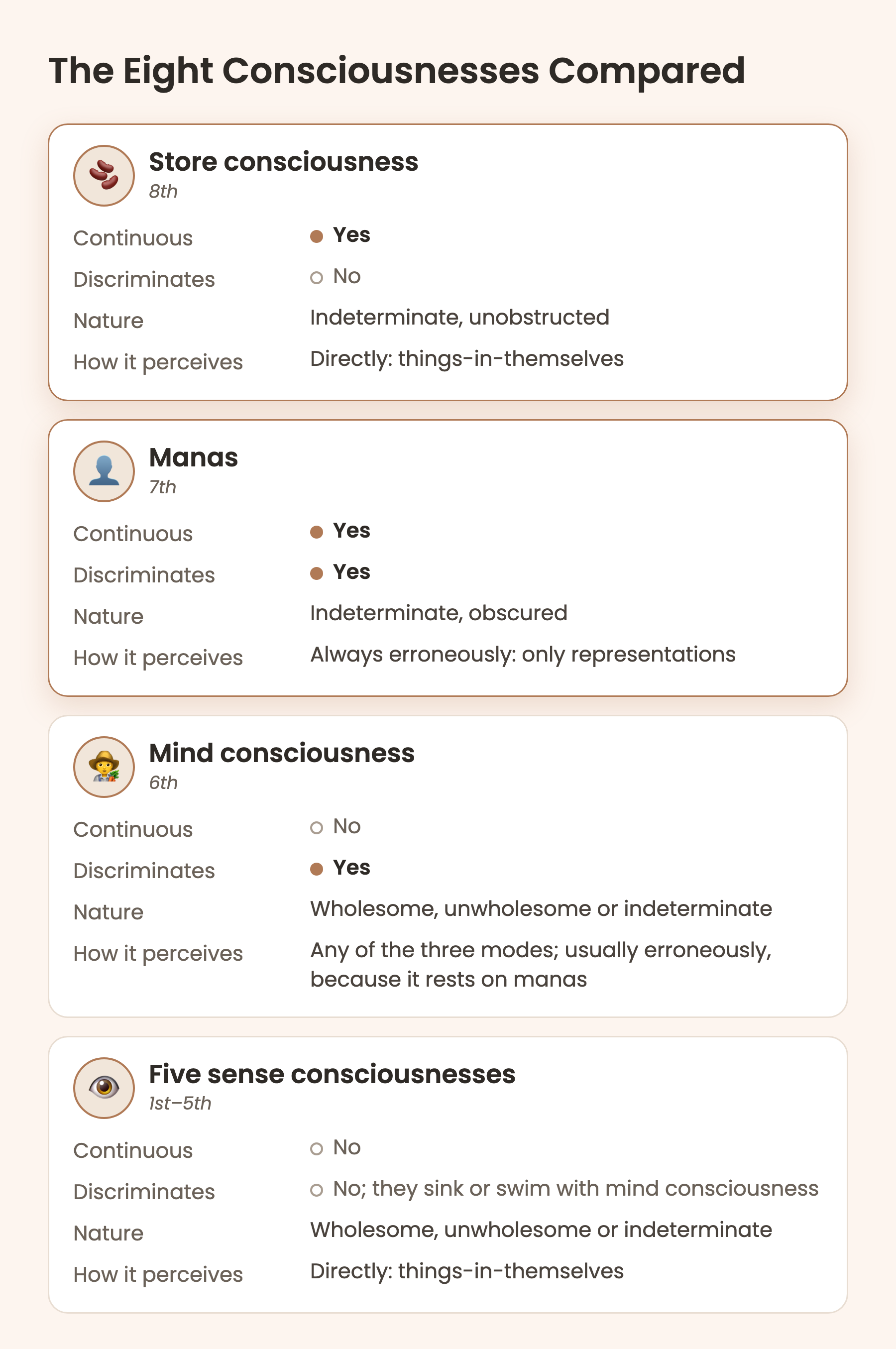
Continuous. The Verse 10 chapter gives store consciousness and manas (p. 47); the Verse 19 chapter repeats that manas, “like the store consciousness, is continuous”; the chapters on mind consciousness say that it and the five sense consciousnesses are not, and Verse 26 lists when mind consciousness stops.
Discriminates. “Unlike store consciousness, which is continuous but does not discriminate, the nature of manas is both continuous and discriminating.” For mind consciousness and the senses, the Verse 29 chapter says that the senses perceive directly until mind consciousness joins in: “Mind consciousness tends to discriminate between things, name them, or compare them, and when it does, the realm of things-in-themselves is no longer available.” The senses themselves do not discriminate, but when they work with mind consciousness, Verse 30 says, “they sink or swim with the mind consciousness.”
Nature. Verses 10, 19, 24 and 29. Verse 29 says the senses can be “wholesome, unwholesome, or neutral”, and Verse 24 gives mind consciousness the three natures; the table uses one word, since the book treats neutral and indeterminate as the same.
How it perceives. The Verse 29 chapter says the five senses are “like the eighth consciousness, store consciousness, which also has the direct mode of perception and whose field of perception is also the realm of things-in-themselves,” that “the mode of perception of manas is always false,” and that mind consciousness, “because it is based on and influenced by manas,” is usually erroneous as well.
At the Winter Retreat (28 November 2013) Thầy taught the first two columns as a pair, in Vietnamese hằng and thẩm: the store is continuous but does not deliberate; manas does both; mind consciousness deliberates but is not continuous; the five senses do neither. The interpreter’s English for thẩm was “cogitating”, where the book says “discriminating”.
Is the store clear already, or can it become clear?
The book describes the store’s clarity as a capacity: “it has the capacity of attaining absolute clarity,” and it “can become true mind, Buddha nature.” In 1997 Thầy said the same: “Unobstructed because [ālaya] has the capacity of being transformed.” The book also says the store perceives directly now, and that its “essential nature… has always been free of afflictions.” At the Winter Retreat the emphasis moved to the present. The store is vô phú, not covered. His thesis of 1963 had said so too: “The term covered (有覆) means to be veiled and conditioned by ignorance. The Ālayavijñāna is however non-covered (無覆)…”
In December 2013 he still taught it the book’s way. Of the store he said, “we cannot let it go, we can only transform it,” and that when we are not enlightened it is indeterminate, “but when we are enlightened, it becomes wholesome” (15 December 2013). In January 2014 he went further. In one talk, which we have in one transcription only, he says the store does not need to be transformed and calls this “something new” (12 January 2014). Two weeks later he said it plainly, and both transcriptions agree: “manas and mind consciousness are consciousnesses that need to be transformed. Whereas store consciousness is already perfect, it does not need to be transformed. This is our ground” (26 January 2014).
The book says the opposite in so many words: “Transformation occurs in the store consciousness,” and the chapter on this verse ends on “transformation at the base.” We follow the book, because it is the text these readings teach. The January view is Thầy’s own and later, and we give it here so that a reader who meets it in the retreat talks knows that it differs from the book and that the difference is his. Neither 1997 nor the thesis says already perfect.
If the store is neutral, is our nature good?
Thầy asked the question himself. The talk he gave on 12 December 2013 at the Winter Retreat is titled Is Our Nature Goodness, and his answer was that it is neither good nor bad: “So in Buddhism we say that the human nature is indeterminate.” In his thesis he named the view this school sets aside: “The theory of Mencius… that the human nature is good… is therefore not in accordance with the Vijñānavāda doctrine.” Mencius’s own explanation, he wrote, is that evil comes from contact with evil neighbours, which cannot explain how evil began if everyone was good to start with.
The book complicates this. It says the store’s essential nature “has always been free of afflictions,” and that the store “can become true mind, Buddha nature.” That sounds closer to good than neutral does.
Our reading is that the two answers are to different questions. Neutral is about the seeds. The store holds wholesome and unwholesome seeds without being either, as the earth holds thorns and flowers. Free of afflictions is about whether the afflictions belong to the store itself or only to what it holds, and Thầy says the store’s essential nature has always been free of them. In the same December talk he raised the hardest form of the problem himself: if some seeds were good or bad from the beginning, “then alaya cannot be called indeterminate.” His answer was that a seed’s nature is organic. A flower becomes compost and compost becomes a flower, so no seed is fixed as good or bad, and a neutral store can hold them all.
The word indeterminate has two jobs in this book
In the Verse 10 chapter, indeterminate (the book gives aniyata) is the third of the three natures: neither wholesome nor unwholesome, and the store’s own nature. The book uses the same word, aniyata, for four of the fifty-one mental formations: regret, sleepiness, initial thought and sustained thought. Those four are indeterminate in a narrower sense: each one can go either way depending on how it is used. Regret is wholesome when it moves us to make amends, and unwholesome when it sinks into brooding. Sleepiness is wholesome as needed rest, and unwholesome when it clouds the mind during practice.
The two uses are easy to run together, and the store is not a fifth member of that group. In the thesis and at the Winter Retreat Thầy uses a different word for the store’s nature, avyākṛta (vô ký in Vietnamese). The four formations keep aniyata.
Do the senses really stop when we sleep?
A careful reader will object that a loud noise wakes us, so something was listening. The book’s own wording allows for this. Its example is the eye, which stops “because our eyes are closed and do not perceive any object,” and its rule is that “only through contact with its object does a sense base give rise to a sense consciousness.” When a sound reaches us in the night, ear consciousness arises for as long as the contact lasts. The chart of which consciousnesses never stop draws the senses as off for the whole night because its subject is continuity, and the senses are not continuous.
Thầy on this verse, in his own words
On 6 November 1997, at a retreat on Buddhist psychology in Key West, Florida, Thầy read Verse 10 aloud and glossed it in English, in under three minutes: the recording on Vimeo, from 1:37:46 to about 1:40:30, and the transcript. He gives each quality a line. “Indeterminate means that it is neither wholesome or unwholesome… it depends on our way of life.” He contrasts the store with eye consciousness and ear consciousness, which stop when we sleep, and then says: “It does not mean permanent. It is always changing.” The recording is from 1997 and quiet in places, but it is the teacher of this book explaining this verse.