09.29
The Law of Affinity
The close of the chapter: a realm is made by the people in it, the seeds in the store take us to the people and the stage of being that match them, and transformation is possible.
This page is our current understanding, written as we work through the book together — it changes as our understanding changes.
The Reading
Verse 9 reads:
All manifestations bear the marks of both the individual and the collective. The maturation of store consciousness functions in the same way in its participation in the different stages and realms of being.
The earlier readings on this verse walked all nine stages of being and closed them. This reading returns to the chapter itself, to the pages that follow the list of the nine stages and close it. They answer a question the list leaves open. If the stages are states of mind, what puts a mind in one stage rather than another? Thầy’s answer is a law, and he gives it a name: the Law of Affinity, the attraction of like to like. And then he says what can be done about it.
The reading follows the chapter in order. First he says that a realm is made by the people in it. Then he states the law and gives four illustrations of it, ending with the book in the reader’s hands. Then he explains karma, which is where the law gets its material. Last, he says that transformation is possible.
The Teaching
A realm is made together
Thầy begins with where he lives. Plum Village, he says, is “the collective manifestation of the consciousnesses of the teacher, the disciples, the friends on the path, and the community of practice that has been established there.” A teacher and his students wanted the same thing, and together they made the place. Then he widens it to every realm at once: “Whether you live in the desire realm, the form realm, or the formless realm, that realm is the creation of the collective consciousness of all those who inhabit it.”
Here he applies the verse’s first clause to a whole realm. Earlier in the chapter he gave the image of two candles: light the second, and there is no patch of light left that comes from one candle alone. A realm is like that light: nobody is in the desire realm on their own.
He is honest about what that means for a practice centre. Western society is a consumer society, and the people at Plum Village are still in the desire realm, “which is a manifestation of collective consciousness.” They have not left it. They have done something smaller, which a person can actually do. “Television advertising is cleverly designed to water the seeds of desire in us. In Plum Village we do not watch television, so our seeds of desire cannot be watered through that particular medium.” He calls this “an individual manifestation within the collective manifestation of the consumer society.”
Two things follow from that sentence. We cannot step out of a realm by ourselves, because a realm is collective. We can choose what waters our seeds, because the watering is individual.
Like draws like
Then he states the law. “The maturation of store consciousness also follows the Law of Affinity, the attraction of like to like. We do this, and we do not do that. The reasons why we do one thing and not another are already determined in the ‘maturation-as-cause’ that leads to the ‘maturation-as-fruit.’”
Two things are packed in here. The first is that the law belongs to maturation, the verse’s own word. The reading on ripening used the orange: a blossom needs time and conditions to become a fruit you can eat. The Law of Affinity says what the fruit is in this case. The seeds we sowed are the cause. Where we find ourselves, and who we find ourselves with, is the fruit.
The second is the example. “One example of maturation-as-fruit is the presence of Plum Village and the community of practice there. Maturation-as-cause are the seeds we sowed in the past that have drawn us to that place.” He calls the pull “the force of action.” Seeds of the Dharma, watered over years, “give us the energy to come and participate in a community of practice.” Seeds of drug addiction would carry the same person somewhere else. So he says that Plum Village is “in this sense, predetermined.” (Going Deeper asks what that word leaves room for, because the next page of the chapter is about changing direction.)
The store consciousness is doing the drawing here, not any one mental formation. Nothing on the list of fifty-one is called affinity. The pull is what ripening seeds feel like from the inside.
The Jeta Grove
Thầy’s first illustration is the Buddha’s own. “One day, sitting in the Jeta Grove, the Buddha observed, ‘Monks, do you see that the monks who enjoy Dharma discussion are sitting close to the Venerable Shariputra and those who are interested in the precepts are sitting with the Venerable Upali? The monks who like to give Dharma talks are gathered around the Venerable Purna.’”
Nobody arranged the seating. The monks sorted themselves, each toward the elder who was good at what he loved. Thầy draws the conclusion for the whole verse: “Our aspirations, our needs, and the energy of our actions determine whether we participate in one realm or stage of being or another.” (Going Deeper says where this story comes from in the early texts.)
The seed of affinity
The second illustration is a friend. “When we find a friend we enjoy spending time with, there is the law of attraction of like to like. We feel we have an affinity with this person, and this information is recorded as a seed in our consciousness. When the seed of affinity ripens, we find ourselves drawn to a particular person or situation.”
This is the smallest and most useful version of the law. Enjoying someone’s company is not only a feeling in the moment. It is recorded, it becomes a seed, and the seed ripens on its own schedule. Months later we find ourselves drawn back to that person, or to a room like the one we shared, without having decided to. The reading on ripening said a seed always needs the right amount of time and the right conditions. A friendship is one of the seeds it was talking about.
Where the sum of our actions takes us
The third illustration is Plum Village again, but now inside Europe. “Plum Village is a small area and Europe is a large area. We belong to the large area, and we come and participate in the small area. Yet when we are in Plum Village, we are also in Europe.” The reading that closed the nine stages quoted what follows: taking part in one stage of being does not mean leaving the other eight, only that “our participation in them is more diluted.”
Then he says where the law takes us. “At the time of maturation, our consciousness seeks to dwell in the stage that is closest to the sum of our actions.” The reading on the sum of our actions taught that we are the sum of action A plus action B. Here he says where that sum takes us: to the stage of being, and the company, that match it. His example is hard on purpose: someone with an action in the store “associated with addiction to cocaine” is led “to associate with others who like drugs.” The law does not comfort anyone. It describes how a life gets its shape, in either direction.
This book, this sangha
The last illustration is the book itself. “Let us look deeply into this book. This book is a manifestation of our collective consciousness, because each of you has planted in your store consciousness the seed of the practice.” Perhaps a reader heard about mindfulness years ago, or read another book, or wanted to understand healing and transformation better. “This may have happened some time ago. Now conditions are sufficient for me to offer this book and for you to read it.” Then he asks: “Why aren’t others reading about these Fifty Verses? Because they do not share the same interest.”
He first said this at a retreat in 1997, about the retreat his listeners were sitting in. In the book he says it about the book. It works for any group that has gathered around this text, including a sangha meeting on a weeknight to read it. Nobody was made to come. Each person was drawn there by a seed that someone once watered.
He closes the passage with a second name for the law: “This is the Law of Affinity, or participation.” Participation is the verse’s own word. The maturation of store consciousness participates in the stages and realms of being. The Law of Affinity is how it participates.
Karma means action
The law gets its material from what we do, which is what the book means by karma. “Whether we go in the direction of gods, humans, ashuras, hungry ghosts, hell, or animals is already established within our store consciousness. Karma means action, the actions of body, speech, and mind. Every act, word, and thought in our daily life has the power to bring forth a fruit.”
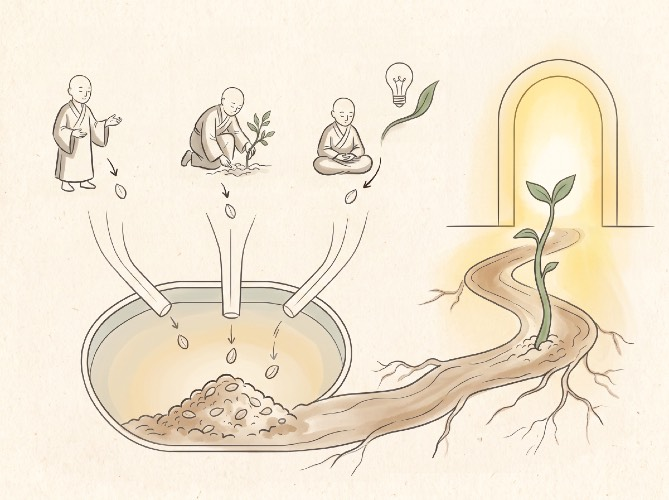
Karma is not fate, then. It is the ordinary record of what we have done, said and thought, kept as seeds. “When our actions of body, speech, and mind come together and have time to ripen, store consciousness undergoes maturation and brings forth another stage of being.” After years of actions, the store brings forth the realm we live in. Nobody assigns it to us. It ripens.
Between the six realms and the law, Thầy pauses on two of them. “We all have been in hell. Hell is not very far away. Hell is right here.” And the hungry ghosts, whom the readings on that destination described: he says our society “creates thousands of hungry ghosts every day,” people without roots who “are hungry for understanding and love” and cannot yet take either, because their throats are so narrow. Then he states the law again, in its unkindest form: “because of the Law of Affinity, hungry ghosts also like to come together with other hungry ghosts. If we water the seed of the hungry ghost in ourself, we will become a hungry ghost.”
Transformation is possible
Then he changes direction. His example is a man “caught in a cycle of drug-taking,” drawn to that environment wherever he goes, by exactly the law this reading has described. “But if he meets someone who is capable of loving and helping him, the positive seeds in him are watered and he might get some insight.” With that person’s help he may leave the environment, and “slowly, the maturation of other seeds will help him move toward and participate in another realm of being.”
Then he says: “The seeds in us lead us to share the life of others who are like us— whether that life is wholesome or unwholesome. Transformation, however, is possible.”
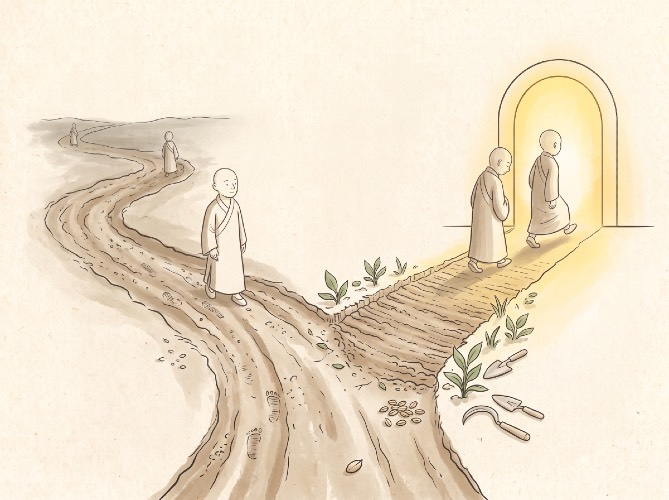
He gives it three steps, and they are small. “First, we have to determine in what direction we wish to go. Second, we have to wish to embark on a journey of transformation and healing. Third, we discover that there is a path that we can embrace and we look for a way to practice with others who also want to live more mindfully.” And then the law returns, working for us this time: “Then we discover that we share the same karma, the karma of practicing healing and transforming.”
The same law makes every kind of gathering. “Those who are interested only in eating, sleeping, and having sex will come together in the realm of desire. Those who are concerned about the suffering people in the world will find ways to come together in order to serve. This is the Law of Affinity.” The law works the same way in both cases. A sangha is the same law at work among people who want to live more mindfully.
A new being
The chapter ends with a sentence that the reading on the close of the nine stages already quoted: emancipation is “a matter of touching and transforming the seeds, of helping the positive seeds grow. We don’t need to die in order to be reborn and have a new being.” He adds a timescale, and it is not a lifetime. “A few weeks or months of practicing in order to transform can help ripen the wholesome seeds in us and bring about a new life here and now.” He has seen people come out as new beings “after only three or four days of practice,” go home and reconcile with their families.
His last sentence is the plainest in the chapter: “We too are capable of producing a new being from the seeds in our consciousness, of living in a more positive and happy way. There is no reason to think we cannot.”
Contemplation Questions
How did you come to this practice? Looking back, which seeds were watered, and by whom?
Who are you drawn to spend time with these days, and what does that time water in you?
Thầy says transformation begins with deciding which direction you want to go. Which direction is that, for you, this season?
Carry whichever of these stays with you, into your own quiet reflection or into conversation with others.
Going Deeper
2 notes ·A few notes for anyone who wants to follow a thread further.
“Predetermined”: what the word leaves room for
Thầy writes that Plum Village is “in this sense, predetermined,” and that the reasons we do one thing and not another “are already determined” in the maturation of our seeds. A careful reader will ask whether that leaves any room to choose.
The book answers on the very next page, and the reading’s last two sections are built on that answer. Thầy describes a man caught in a cycle of drug-taking, drawn to that environment wherever he goes, and then says: “But if he meets someone who is capable of loving and helping him, the positive seeds in him are watered and he might get some insight.” Then: “Transformation, however, is possible.”
So the word predetermined means less than it seems to. It says that where we are now is the fruit of seeds already sown, and that nothing else could have produced it. It does not say the seeds are fixed. The verse’s own word is maturation, and the reading on ripening was clear that a seed needs time and conditions. Conditions can be changed, by us and by the people who love us. The law describes the pull. It says nothing about whether we keep watering the seed that pulls.
The passage does rule out one idea: that we could leave a realm by an act of will while we go on watering its seeds. The television sentence is his example. Nobody at Plum Village decided to stop being in the desire realm. They stopped watering one of its seeds through one channel, and the rest followed the law.
Where the Jeta Grove story comes from
The scene of the monks sorting themselves around Shariputra, Upali and Purna is told in Thầy’s words in the chapter, without a citation. The early text behind it is a short discourse in the Saṃyutta Nikāya (14.15, the Caṅkama Sutta, “Walking Together” in Bhikkhu Sujato’s translation). We opened it on 2026-09-23. The Buddha points out eight elders, each walking with a group of monks, and names what the group shares: the monks with Sāriputta have great wisdom, the monks with Puṇṇa are Dhamma speakers, the monks with Upāli are experts in the monastic law, and so on through Moggallāna, Kassapa, Anuruddha, Ānanda and Devadatta, whose monks “have corrupt wishes.” Then the Buddha gives the general rule: “Sentient beings join together and converge because of an element. Those who have inferior convictions join together and converge with those who have inferior convictions. Those who have good convictions join together and converge with those who have good convictions.” The sutta says this holds in the past, the future and the present.
Thầy’s three elders are three of the eight, and their specialities are the sutta’s. Two details are his telling: the sutta has the Buddha at Vulture Peak near Rājagaha, not in the Jeta Grove, and the monks are walking, not sitting. Neither changes the point. The word the sutta uses for what draws like to like is dhātu, element, and that is not far from what this book calls a seed.
For the verse, what matters is how Thầy uses the story. He uses the Buddha’s observation as an example of a law of maturation. That is his reading, and it is the one this book teaches: the monks sorted themselves because of their seeds.