09.28
Still Not Free
The close of the nine stages: why the ninth is still samsara, what actually frees, and why none of it is made alone.
This page is our current understanding, written as we work through the book together — it changes as our understanding changes.
The Reading
Verse 9 reads:
All manifestations bear the marks of both the individual and the collective. The maturation of store consciousness functions in the same way in its participation in the different stages and realms of being.
Earlier readings walked through all nine stages, from the realm of desire up to the ninth stage, and finished with a question. Does any of this set us free? The reading before this one went back to the sixth stage, tried it, and found two answers. Eckhart Tolle calls resting on space a portal. Thầy calls it a refuge.
This reading gives Thầy’s answer, and it is not the answer the stages lead you to expect. It has three parts. The first is the book’s own reason why the ninth stage is still samsara. The second is the practice that does free us, which the earlier readings have already used. The third is where the nine stages actually are, which is much closer than the word realm suggests.
The Teaching
Still not free
Tolle makes his claim a few paragraphs after the instructions the previous reading used. In chapter seven of The Power of Now he says that once you know space and time from the inside, “The world, too, continues to exist for you, but it will not bind you anymore.” That is a claim about liberation, and he rests it on a state of very quiet attention.
Thầy never wrote about Tolle. The book answers the claim anyway, because some schools make the same claim for the ninth stage: a mind that is quiet enough is free. The book says it is not.
There are nine stages in three realms, and all nine are samsara. In Chapter Three, Thầy calls the realms “the three realms of samsaric existence.”
He explains why in the same chapter, and the reason has nothing to do with how still the mind is:
“In the realm of non-form, suffering still exists because all wrong perceptions have not yet been removed and many desires are still dormant in the depth of our consciousness.”
The seeds are untouched. The depth of our consciousness is the store consciousness, which is what this whole verse has been teaching. Deep concentration stops watering those seeds for a while, but it never reaches them.
At the Winter Retreat, teaching Vasubandhu’s Thirty Verses, he explains the same point with a rabbit. A rabbit goes into its hole to be safe, but it cannot stay there. Sooner or later it has to come out and find food. Then he says:
“So there are those who have capacity to enter into dhyana… They can be there for several days, but they only take refuge in the dhyana… the fourth dhyana and the fourth [formless absorption]. But that is not the solution, because when they get out of the dhyana, they suffer again.”
He names the fourth formless level there, and he calls it a refuge. (Going Deeper gives the whole passage, which starts with workaholism and the internet, not with meditation.) In The Heart of the Buddha’s Teaching he has a name for using concentration this way: “When you use concentration to run away from yourself or your situation, it is wrong concentration.” He does not blame anyone for it. His next sentence is “Sometimes we need to escape our problems for relief, but at some time we have to return to face them.”
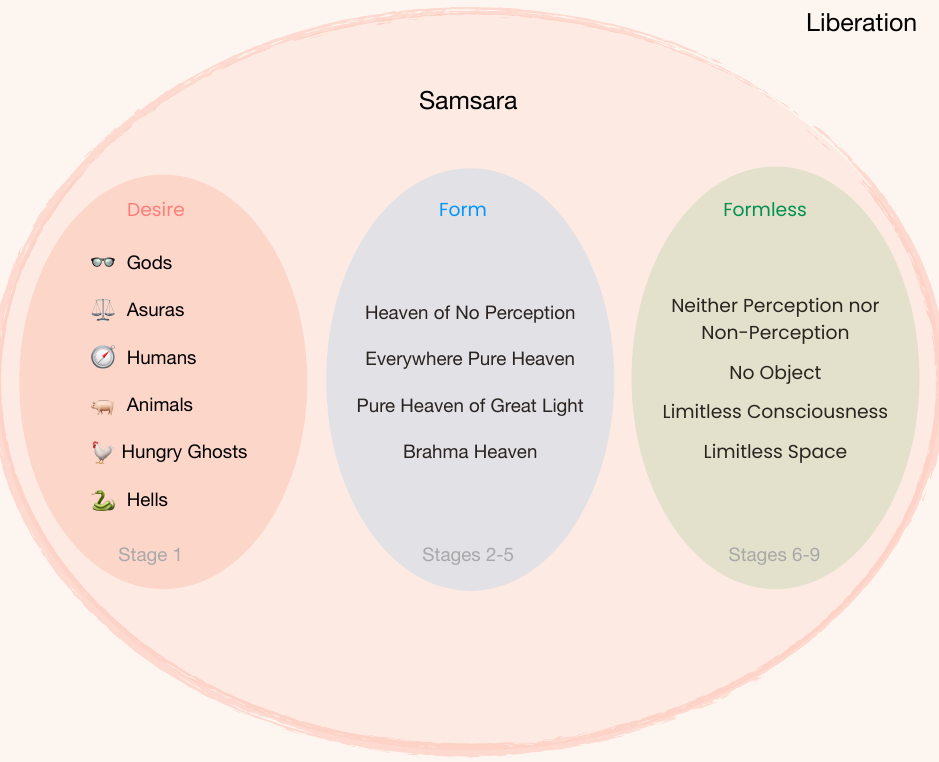
The book’s own image for this is in the same chapter. Early Buddhist texts describe the three realms as a “house on fire,” and Thầy says who lit it: “The three realms are burning, and it is we who light the fire through the false perceptions of our consciousness.” The cause is false perceptions again, not restlessness and not a lack of depth. The wrong perceptions are still there at the ninth stage, and that is why the ninth stage is still burning.
The sutra turns
The reading on crossing into the realm of form used the sixteen exercises of mindful breathing, from Thầy’s Breathe, You Are Alive! The first twelve settle the body, then the feelings, then the mind. The eleventh is “Breathing in, I concentrate my mind.” Up to this point the sutra is doing the same thing the nine stages do.
Then the sutra stops concentrating further and starts looking, which the stages never do. The last four exercises, in Thầy’s translation, are:
13. “Breathing in, I observe the impermanent nature of all dharmas.” 14. “Breathing in, I observe the disappearance of desire.” 15. “Breathing in, I observe cessation.” 16. “Breathing in, I observe letting go.”
Plum Village’s current translation gives the fifteenth line as the no-birth, no-death nature of all phenomena. Both translations are his.
None of these four is a finer object to rest on. Impermanence is not a subtler object. You can see it in a cup of tea. (An earlier Going Deeper entry on the nine stages and the sixteen exercises sets the two schemes side by side.)
Thầy himself connects the thirteenth exercise to the second of the Three Doors of Liberation. In his commentary on it he writes: “Impermanence also means ‘signlessness’ (alakshana)… The categories of perception and thought are ‘signs.’” The reading on what perception is doing followed the sign up through the four formless levels. It got fainter at each level, but it was never seen through. This is the practice that sees through it.
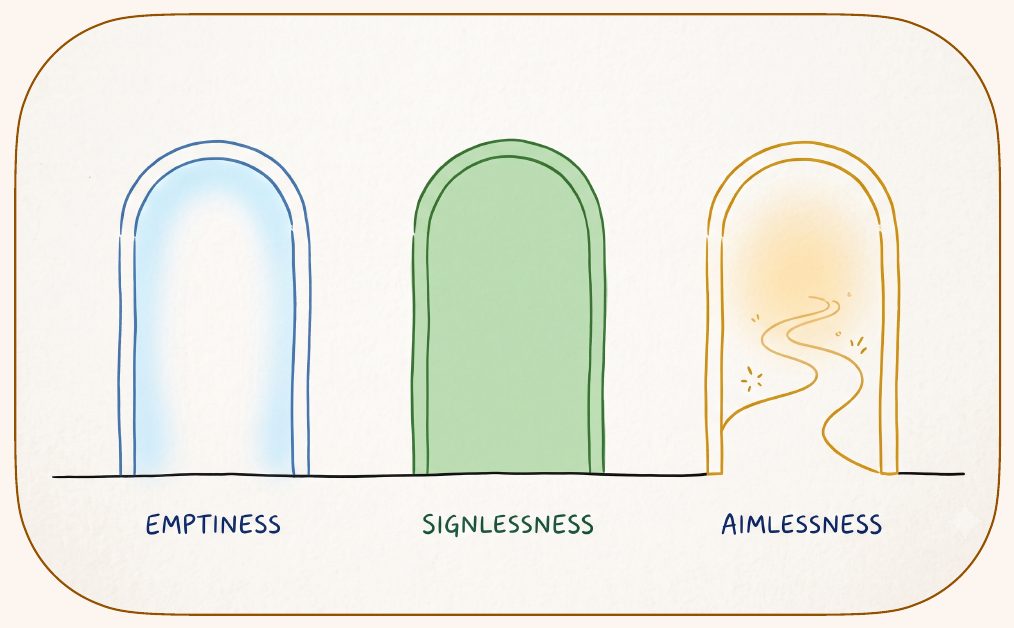
The nine stages give the mind less and less to hold. Looking deeply keeps hold of one thing and finds everything else inside it. The stages shrink what you are aware of. Looking deeply opens it.
This does not mean concentration is thrown away. Thầy’s own commentary on the eleventh exercise says so: “Only if there is concentration can the work of looking deeply take place.” The book says the same thing twice more. At Verse 27: “we focus our mind consciousness on one point in order to get a breakthrough.” And at Verse 48: “Concentration is the battery; the flashlight is mindfulness.” Concentration is the condition for insight. It is not the answer on its own. (Going Deeper asks whether insight is simply the missing formation. The book’s answer comes with a warning about the word insight.)
Where the stages came from
There is one more thing to say about this sutra. The four dhyānas and the four formless levels, which is everything above the realm of desire on the list of nine, are not in it. They are not in the Sutra on the Four Establishments of Mindfulness either. Thầy says so in an appendix to Breathe, You Are Alive!, and goes further: they “were not introduced into Buddhism as Buddhist practices until one hundred years after the Buddha’s passing.” Before his enlightenment the Buddha learned the four formless concentrations from two teachers, Arada Kalama and Udraka Ramaputra, “practiced the Four Formless Concentrations with great success,” said plainly that the practice “did not lead to final liberation from suffering,” and left it.
He is not telling anyone to drop them: “We need not criticize them for being later teachings, certainly not before we have practiced them and seen for ourselves if they work well.” (Going Deeper has what he says in another book, where the number is different and the verdict is harder.)
Being fair to the stages
One thing has to be said in the stages’ favour, because the book says it. In Chapter Three, looking deeply is what carries a mind from one realm to the next:
“If we practice looking deeply at the nature of craving, we will become emancipated from the realm of desire and begin to dwell in the realm of form, which is a higher realm. Looking even more deeply, we can lessen our attachment to form and begin to dwell in the realm of non-form.”
So in this book the stages are not a rival practice. They are where the mind settles after it has seen through something. The reading on the last four stages quoted the second of those sentences as the move that opened every level, and nothing above contradicts it. The stages cannot finish the job, and Chapter Three’s next sentence says why: the wrong perceptions are still there.
The vocabulary of refining the object against seeing through it is ours. We took it from the Abhidharma, and it is a way of saying what the book says in its own terms: the levels are named by what the mind rests on, and freedom is named by what the mind has understood.
This is what the chapter on our verse means by emancipation. Emancipation is not a tenth stage:
“Emancipation — participation in the realm of joy and peace — is a matter of touching and transforming the seeds, of helping the positive seeds grow. We don’t need to die in order to be reborn and have a new being.”
We walked through the stages because they show something real about the mind. But they were never the destination.
All nine are in us
So the stages are not a place we go to. They are here. Chapter Three says: “It is possible to touch all three realms in the present moment, around us and within us.” And in the chapter on this verse:
“When we participate in one of the nine stages of being, it does not mean that we are not also participating in the other eight stages, only that our participation in them is more diluted… All nine stages exist within us. When one manifests, the others are less distinct but they are nonetheless present.”
We have spent eight readings on a picture of the whole of existence, and it turns out to describe an ordinary week: a morning of wanting things, an hour of quiet after a walk, a minute so still there was almost nothing in it. All of that is the nine stages, and all of it is us.
We do not make any of it on our own either. The verse says every manifestation carries both an individual and a collective mark, and Chapter Three spells that out for the realms: “Each realm of being is a result of the collective consciousness of those dwelling there. If our world is a peaceful, happy place, it is because of our collective consciousness. If it is on fire, we are co-responsible for that.”
Collective does not mean external. A realm made by many minds is still made of mind. But it does mean that what a few people practise together is not private, and Thầy finishes the passage by saying what it can build: “If five or six people practice and attain the fruits of joy, peace, and happiness, and if these people then go out and establish a practice center, manifesting their happiness in a setting in which others can participate, then they have established a small ‘pure land.’”
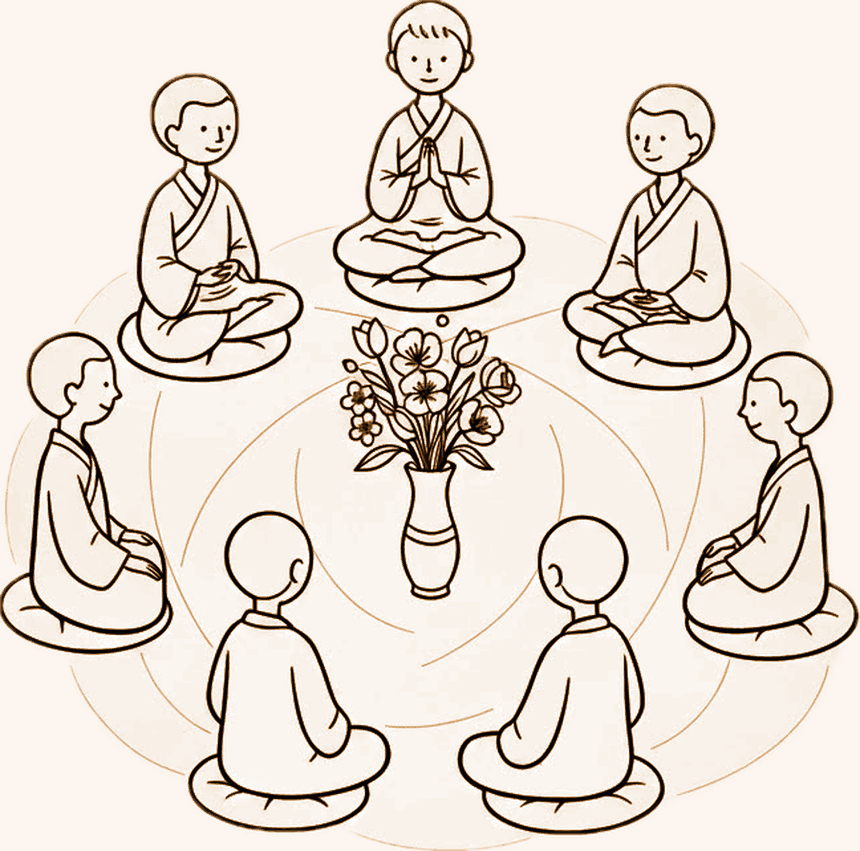
That is what a sangha is for. It is not a place to hide from the fire, and it is not a ladder out of it. It is a few people watering the same seeds in the same room, until the room becomes a realm worth living in.
Contemplation Questions
Where do you go to be quiet in a way that soothes you but changes nothing? What happens when you come out?
Thầy says all nine stages are in us. Which one has been most active in you over the last few days?
He says a few people practising together can make a small pure land. When you practise with others, what are you making together?
Carry whichever of these stays with you — into your own quiet reflection, or into conversation with others.
Going Deeper
4 notes ·A few notes for anyone who wants to follow a thread further.
The second door — why the ninth stage is still samsara, in the book’s vocabulary
The reading says the ninth stage is still samsara because the wrong perceptions are still there, and that the practice which frees is signlessness. A careful reader will ask whether the book itself connects those two things. It does, in three sentences that sit in three different chapters, and the join between them is ours.
First, the book says what a sign is. From the chapter on Verse 2: “The sign of a thing is the image that is created by our perception (samjña) of it.” A sign is not a thing in the world. It is what perception makes.
Second, it says what signlessness is. From the chapter on Verse 49: “If you see a flower only as a flower and don’t see the sunshine, clouds, earth, time, and space in it, you are caught in the sign of the flower… When you can see that person deeply, you touch the whole cosmos and you will not be fooled by appearances. This is called signlessness.”
Third, it says why the formless realm is not freedom. From Chapter Three: “In the realm of non-form, suffering still exists because all wrong perceptions have not yet been removed.”
Put the three together. Perception is the faculty that makes signs. The book’s stated reason the ninth stage is still samsara is that the perceptions there are still wrong, which is to say the signs are still believed. The second door is what is missing at the ninth stage. The stages have no rung for it, because signlessness is not a rung. The ninth level is named No Perception and No Non-Perception. At that level the sign-making is so fine that you can no longer honestly call it sign-making, and it is still not signlessness. Reducing a sign and seeing through it are two different acts.
The join is ours, and we should say so. The book never puts signlessness and non-form in the same passage. We searched the whole text: the word signless occurs exactly twice in Understanding Our Mind, both inside the Three Doors passage. The bridge between the two is the word perception, which is his in both places. So the materials are his and the connection is ours.
And another of his books says something close to the opposite. In The Heart of the Buddha’s Teaching he puts signlessness inside these levels and names it. Of the level he calls Nothingness, this book’s eighth: “we see that the fruit is in the flower, and that the flower, the cloud, and the earth are in the fruit. We go beyond outward appearances or signs and come to ‘signlessness.’” And of the level above it, this book’s ninth: “Since we no longer believe in the reality of signs, our perception becomes wisdom. We go beyond signs (‘no perception’), but we do not become perceptionless (‘no non-perception’).” That is the second door opening at the level this note says has no rung for it.
We follow Understanding Our Mind, because it is the book we are reading, and Chapter Three is unambiguous. But the difference is not only which book ranks higher. Read the two passages side by side and they are not describing the same act. What he calls signlessness at those levels is interbeing applied to a formless object: space seen as made of non-space elements, nothingness seen as the fruit already in the flower. That is looking deeply, done on a very fine object. It is the second practice reaching into the levels of the first, not the levels producing it on their own. So the claim narrows to what it should have been all along. Refining the object never reaches the second door. Someone standing at these levels can still look deeply, and when they do, that is what happens.
This note does not say the formless levels are worthless; the body’s Verse 48 line stands. Freedom is not measured by how deep the concentration goes.
The rabbit and its everyday holes
The rabbit is from the first talk of the 2013–14 Winter Retreat, Rebuilding Our Health, given at Plum Village on 17 November 2013, and Thầy reaches it through three paragraphs that have nothing to do with meditation.
He starts with restlessness, and the moments when we feel empty inside and do not know what to do with the loneliness. We look for something to cover it. We work, and we become workaholics, because “working helps us to take refuge in order to calm down a little bit.” We turn on the television, pick up a newspaper with nothing interesting in it, or even study. Then he comes to the internet, where we take refuge “in order for us to forget for some time the loneliness, the restlessness in us.” Only then does he reach the rabbit: “…we do like rabbits, we use a sitting meditation as a place for refuge, in order not to suffer too much from our restlessness… Because after sitting meditation, we can go out and then we suffer again.”
Then he says what the alternative is: “And that is why we should need the vipashyana and not only samatha.” Looking deeply brings insight, and only insight, he says, “can liberate you from afflictions like restlessness.” Meditation, he says, “is not… a temporary refuge for you to stop suffering for a while. Meditation should have the power to help you to transform the suffering in you.”
The first contemplation question comes straight from this passage. The hole does not have to be a formless absorption. For most of us the hole is a screen.
Two numbers and a harder sentence
The reading gives the history of the dhyānas and the formless levels from Breathe, You Are Alive!, where Thầy says they entered Buddhism “one hundred years after the Buddha’s passing.” He tells the same history in Awakening of the Heart, with a different number and a harder verdict:
“These states of concentration probably found their way back into the sutras around two hundred years after the Buddha passed into mahaparinirvana. The results of these concentrations are to hide reality from the practitioner, so we can assume that they shouldn’t be considered Right Concentration.”
We kept that sentence out of the body, and not because it is inconvenient. Understanding Our Mind, the book we are reading, walks all nine stages as real states of mind and says nothing of the kind about them. Where his books disagree, that book governs, and a harder line from another is a note, not a correction. The gentler sentence from Breathe, that we need not criticise them before we have practised them, is also his, and it fits a reader who has just walked them.
Both numbers are approximate in his own telling. He is not dating a text. He is saying the Buddha learned these states before his awakening and set them aside, and that the tradition brought them back later. On that the two books agree.
Is insight the missing formation?
A reader who has followed the fifty-one formations will ask a sharper version of this reading’s question. The nine stages run on concentration, one of the five particular formations. Its neighbour on the list is insight. Is insight the missing piece, and is that all that “looking deeply” means?
The answer is yes, with a catch the book itself adds.
First the yes. Thầy’s three powers of meditation are mindfulness, concentration and insight, and each one waters the next. The stages have the first two in full. They never turn on the third. At Verse 27 he says what concentration is for: “we focus our mind consciousness on one point in order to get a breakthrough.” The breakthrough is the insight. The stages are all focus and no breakthrough, and that is the rabbit’s problem.
Now the catch. In the chapter on Verse 20, Thầy warns that the prajñā counted among the five particulars is not the prajñā of the Perfection of Wisdom. As a formation it is only “a kind of understanding or conviction that is only an idea, an assertion,” and it is often wrong: “you believe you are right, but you are wrong. You think you have seen a snake, but it was only a rope.” It is the one particular that runs with manas, which is how manas can be so sure of a self that is not there. He proposes a second word for that lesser kind: “Let us reserve the word ‘prajna’ for true understanding, true insight, and instead use for this particular mental formation the word mati, which means an understanding that might be false.”
So the formation on the list is not, by itself, the thing that frees. It was present at every one of the nine stages, quietly certain that it understood. What frees us is that same faculty turned on the sign until it sees through the sign: to impermanence, non-self and interbeing, the Three Doors. Insight is something the mind does to a perception. It is not a formation that was missing.
One sentence in the book seems to say the opposite. At Verse 48, right after the battery and the flashlight, Thầy writes: “In fact, concentration and looking deeply cannot be separated. As soon as there is concentration, looking deeply is already there.” If that is so, how can the ninth stage have concentration and lack insight?
We read the two passages side by side, and they are about two different uses of the same power. Verse 48 is describing stopping in order to look: “When we stop and look deeply into a flower, we can see its interdependent co-arising nature, the sun, rain, and soil in the flower.” The concentration there is pointed at a flower, and the looking follows because a flower has something in it to see. The stages point the same concentration at less and less, and at the top, at the absence of an object. There is nothing in that object to see through, so nothing gets seen through. The rabbit passage is Thầy saying, in his own words, that śamatha without vipaśyanā is possible and that people do it. Chapter Three says why it does not free: the wrong perceptions are still there. Both sentences are his. Verse 48 tells you what concentration is for. Chapter Three tells you what happens when it is used for something else.
That is why this reading’s answer is looking deeply and not “more insight”. The mind at the sixth stage is not short of the faculty. It is resting on space instead of looking into anything, and a sign survives resting. It does not survive being looked into.