09.25
The Last Four Stages
The realm of no form — stages six to nine, and the end of the nine. The ninth stage is still samsara, and what frees us was never one more stage along.
This page is our current understanding, written as we work through the book together — it changes as our understanding changes.
The Reading
Verse 9 reads:
All manifestations bear the marks of both the individual and the collective. The maturation of store consciousness functions in the same way in its participation in the different stages and realms of being.
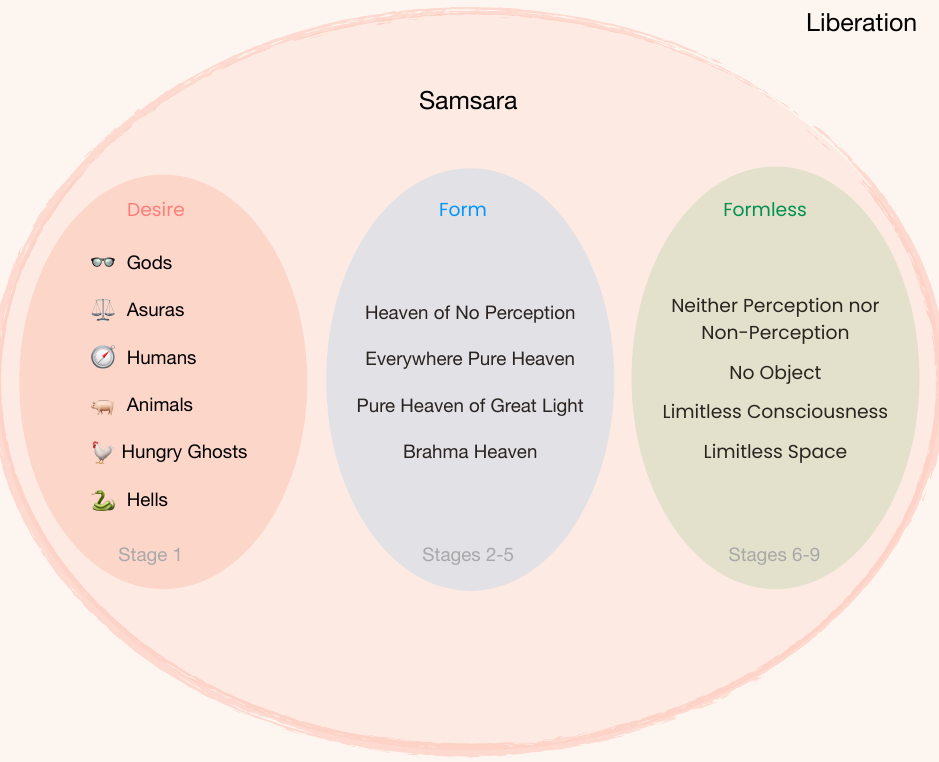
The words to hold onto are the different stages and realms of being. There are nine stages and three realms — the realm of desire and its six worlds, then the four levels of the realm of form, and then these last four, which complete the nine.
These four are the realm of non-form. At each one the mind rests on something finer than the level before, until at the fourth there is almost nothing left to rest on. Then the stages run out, and we are still inside them.
None of the nine is a place. They are states of mind, and Thầy says so in this same chapter: “All nine stages exist within us. When one manifests, the others are less distinct but they are nonetheless present.” When the reading says a mind dwells at a level, that is what it means.
The Teaching
Into the realm of non-form
The realm of form ends in stillness. At its fourth level the mind is steady: nothing lifts it up, and nothing drags it down. That stillness is not freedom, and the four stages above it do not change that.
Thầy describes the realm this way:
“In the third realm, the formless realm, materiality is absent. Only energy is present, and this energy manifests as our mind, our anger, our suffering, and so forth. Life continues, but there is no perception of form.”
He also says how we come into it: “Looking even more deeply, we can lessen our attachment to form and begin to dwell in the realm of non-form.”
It is the same move that opened every level below. Nothing is added. This time we put down form itself.
One phrase in that passage is easy to misread: only energy is present. It sounds like a claim about a subtle substance in some other place — a finer stuff the mind meets once matter is out of the way. He means something much more ordinary, and he says so in his own words at the Winter Retreat.
Where this comes from
In this book, Thầy gives each of these four levels a name and a place among the nine stages, and nothing else. The list shows it plainly. Levels two to five each get a sentence about the beings who live there — “bodies different from one another, but they think very much in the same way”, “much light”, “exactly alike in body and mind”. Levels six to nine get a name and a number: “The Realm of Limitless Space is the first level of the realm of non-form.” That is the whole entry.
He says far more elsewhere. In The Heart of the Buddha’s Teaching he names what the mind rests on at each of the four: limitless space, then limitless consciousness, then nothingness, then neither perception nor non-perception. He numbers them differently there — his fifth to eighth are this book’s sixth to ninth — but they are the same four in the same order. And he does not leave them as bare objects. He reads each one through interbeing: space is made of non-space elements, and nothingness is the fruit already in the flower. And his nine and this book’s nine are not the same nine: the two books put freedom in different places.
What he does not give is the movement between them — what falls away at each level, what changes, how one opens into the next. We looked for it in the five of his books this project holds and did not find it. That comes from the Abhidharma, the early commentaries, and we took it from there because without it there is nothing to say about a level beyond its name.
He also thinks the whole scheme arrived in Buddhism about a hundred years after the Buddha died, and that a practitioner can do without it. We come to that later, in his words.
Finer and finer
At each of these four levels the mind rests on something. Each time it is less than the time before.
First the mind rests on open space. Then on the awareness that held it. Then on the absence itself. Then on something so faint you could not say what it is.
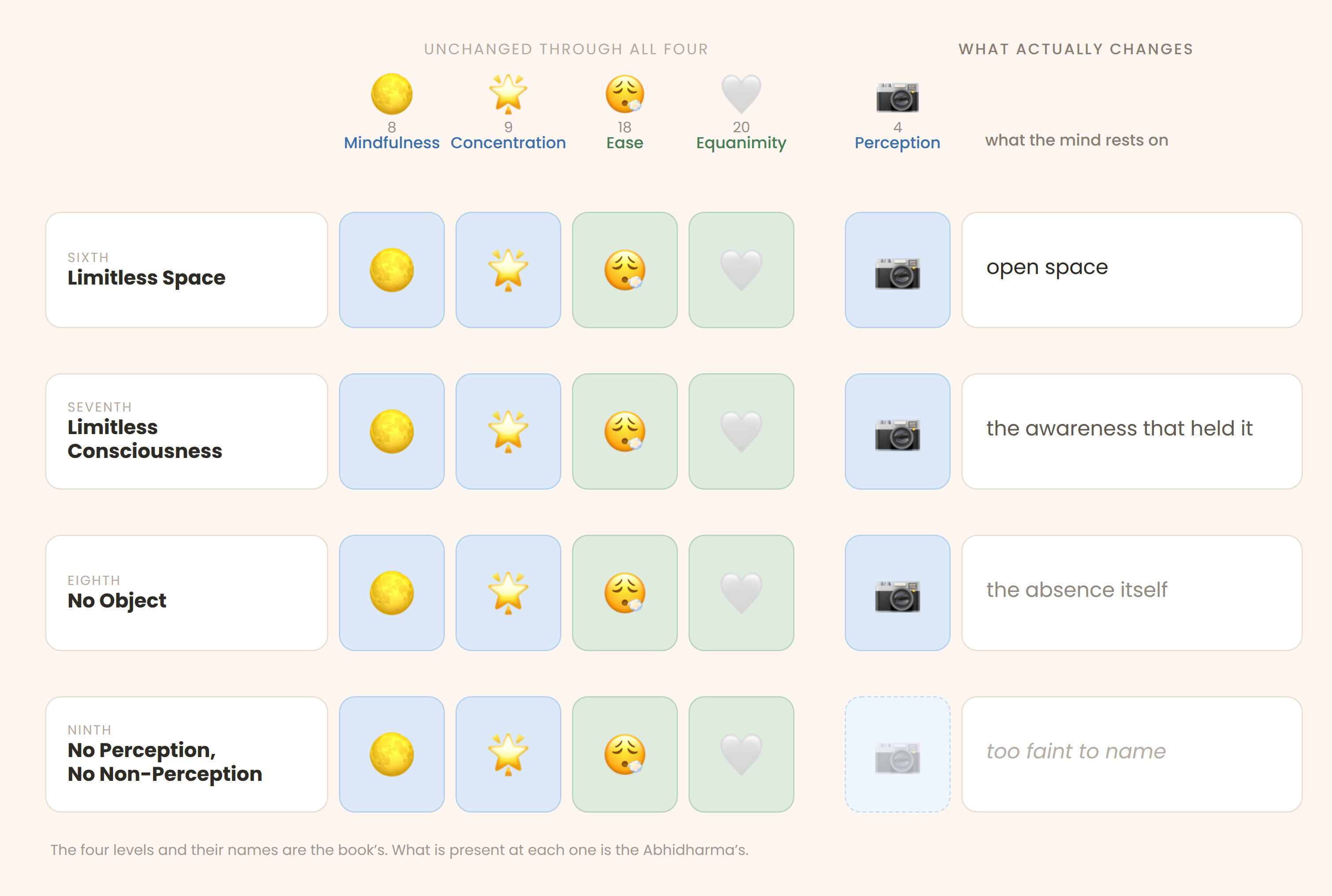
The book’s names for them say the same thing in order: the Realm of Limitless Space, the Realm of Limitless Consciousness, the Realm of No Object, and the Realm of No Perception and No Non-Perception.
You are aware of something the whole way through. That does not change. There is just less and less to be aware of.
Even at the eighth level, where what you are aware of is that there is nothing there, that absence is what you have hold of. The book says why this has to be so, in a passage about perception rather than about these levels: “If there is no object of perception, there will be no perception. There cannot be a perceiver if there is no object to be perceived. Consciousness is possible only when subject and object manifest together.” Subject and object arrive together or not at all. So the mind at the ninth level is doing what mind always does, on a very fine object. That is one reason the ninth stage is still samsara. The book gives its own, in Chapter Three, and it is about the seeds: “In the realm of non-form, suffering still exists because all wrong perceptions have not yet been removed and many desires are still dormant in the depth of our consciousness.” The stillness reaches the surface. It does not reach the store.
Nothing is set down here
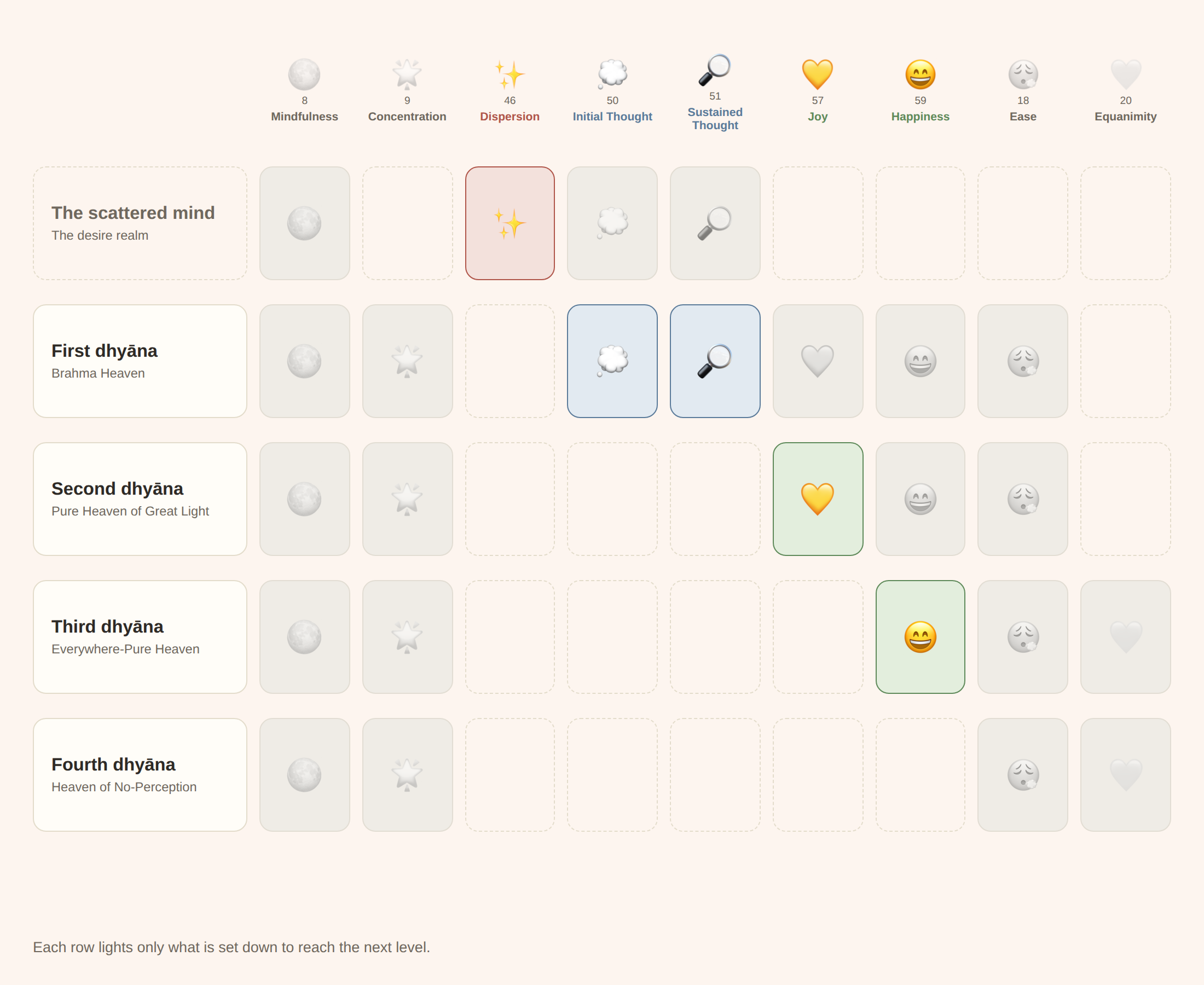
Look down the four left-hand columns of the table above. Mindfulness, concentration, ease and equanimity are exactly the same at the ninth level as at the sixth. There are four levels, and nothing is released at any of them. The only thing that changes is what the mind has to work on.
The four levels below these work the other way round. Each one of them opens because something was released:
A taste of it
Three ordinary moments come close.
You are floating on your back in water with your eyes closed, and you stop being able to feel where you end.
You are lost in a piece of music and the room disappears. Afterwards you realise you were awake the whole time, and you were not aware of anything in particular.
It is the last minute before you fall asleep. The thinking has thinned out. You are not thinking, and you are not not thinking.
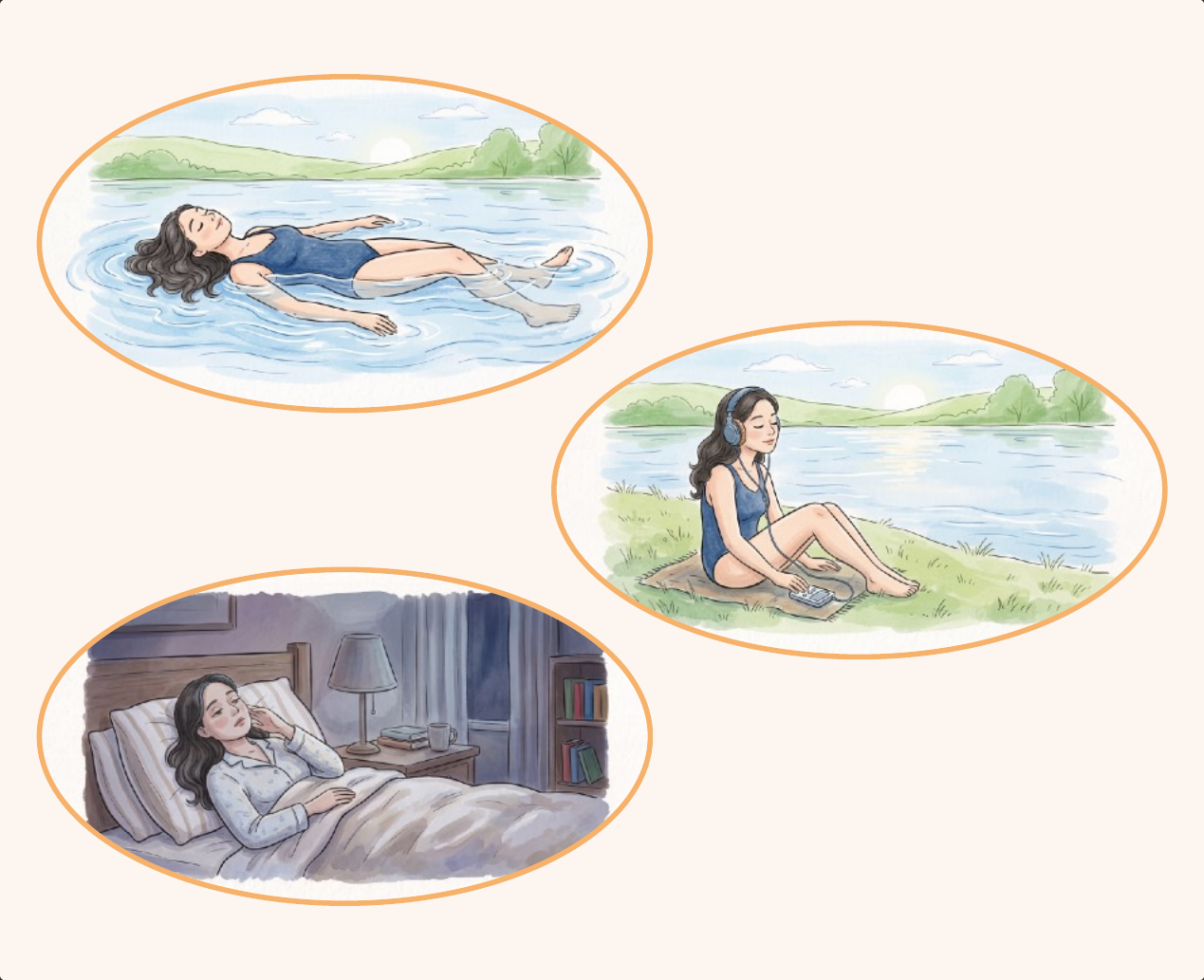
That last one is the closest everyday example, and it still is not the ninth level. As you fall asleep your awareness dims. At the ninth level it is bright, and that is the difference. The book keeps its own short list of the states where the thinking mind stops, and dreamless sleep is on it. These four levels are not.
These are hints. None of them is the thing itself. And none of them fixed anything — you got up the same person, with the same problems waiting for you.
Thầy says in The Heart of the Buddha’s Teaching: “Sometimes we need to escape our problems for relief, but at some time we have to return to face them.”
The end of the stages
That is all nine stages. The realm of desire, four levels of form, four levels of non-form.
There is nothing finer left to rest on. And you are still aware of something.
That leaves one question. Does any of it set us free?
The next reading comes back to these same four levels and looks at what the mind is actually doing at each one. Then it comes to the question.
Contemplation Questions
Have you ever come back from something deeply peaceful — a retreat, a long sit, a holiday — and found the same difficulty waiting for you, exactly as you left it?
When you sit, are you hoping to go deeper, or to see more clearly? Have you noticed a difference between the two?
We ran out of words at the ninth stage. Is there anything in your own practice you have never been able to describe to anyone?
Carry whichever of these stays with you — into your own quiet reflection, or into conversation with others.
Going Deeper
5 notes ·A few notes for anyone who wants to follow a thread further.
What Thầy means by “only energy is present”
Thầy’s description of the realm of non-form rests on one phrase: “materiality is absent. Only energy is present.” He is not reaching for anything mystical there, and we can say what he means because he says it elsewhere, about these same two realms.
At the Winter Retreat, teaching the seeds of store consciousness, he put it this way:
“Matter in Buddhism it’s called rupa… We have the realm of form and we have the realm of non-form. And in one of Thay’s poems, it said what happens when the form comes in touch with the non-form. And in science, it says that when matter comes in touch with… anti-matter, it destroys itself, and it becomes energy. So matter can become energy, and that energy can become matter again, and that nothing is lost and nothing is added to it.”
— What is the Purpose of this Human Life, 5 December 2013
The context matters. He had been asking whether the seeds in store consciousness are innate or newly planted, and answering that in Plum Village we take neither view: the seeds are neither new nor old, neither increasing nor decreasing. That, he says, is the teaching of emptiness — nothing added, nothing lost — and it is the same thing physics calls the conservation of energy. Matter and energy are not two substances, one solid and one subtle. They are one thing under two descriptions, and neither can be created or destroyed.
He returns to it in January with an image the sangha already knows: H₂O is the seed, and cloud and snow are the formation. “Matter is energy, and energy is matter… nothing is dying, nothing from being to non-being.” (What is Emptiness, 16 January 2014.)
So a realm described as having no materiality and only energy is not a subtle substance somewhere else. Nothing has been added to the world and nothing has left it. It is the same reality, without the perception of form.
Where the edge of sleep actually sits
The reading offers the last minute before sleep as the nearest everyday taste of the ninth level, and then pulls the comparison back: as you fall asleep your awareness dims, and at the ninth level it is bright. The book keeps a list that looks as though it settles the question. Read carefully, it does not.
Verse 26 names five conditions in which mind-consciousness stops. The Inner Landscape’s entry for mind consciousness, under Where it stops, sets them out: “Manas and the store never switch off, but mind-consciousness does. Verse 26 names five conditions in which it stops: the state of non-perception, the two attainments (the book’s ‘meditative states of no thinking and no perception’), deep sleep without dreams, and fainting or coma.”
None of the five is one of these four levels. The trap is the first one. The state of non-perception sounds like the ninth level, whose name is No Perception and No Non-Perception — but the book puts the Heaven of No-Perception at the fifth stage, the fourth dhyāna, the top of the realm of form. That is the level we crossed two readings ago, and it is the last row of the release table above. The two names sit three words apart and mean different things.
What is on the list is more interesting than what isn’t. The second and third of the five are the two attainments, and of the deeper one — the attainment of cessation — the book says something it says nowhere about these four levels: “At this stage, manas begins to let go of the store consciousness and the store consciousness is freed.” Manas is the self-grasping that holds the store. Where its grip lets go, something has actually changed.
And the book does not put that state anywhere on the nine stages. It places it “at the eighth stage in the career of a bodhisattva” — a different scale altogether. So the one state in this neighbourhood where the grip gives way is not a rung of the nine. That supports the reading’s argument from another direction: what frees us was never one more stage along.
His nine and this book’s nine are not the same nine
Understanding Our Mind counts nine stages of being: the realm of desire, then four levels of form, then four of non-form. The ninth is No Perception and No Non-Perception, and Chapter Three says suffering is still there.
The Heart of the Buddha’s Teaching counts to nine as well, and gets there another way: “There are nine levels of meditative concentration. The first four are the Four Dhyanas. The next five levels belong to the formless realm.” That is four plus five. So his fifth to eighth are the four levels this reading walks — and he has a ninth above them, which he calls cessation.
That ninth is where he puts the thing this reading says the stages never do: “when the meditator reaches the ninth level of concentration, the stage of arhat, manas is transformed and the internal formations in the store consciousness are purified.”
Breathe, You Are Alive! counts the same material a third way — four jhānas, four formless concentrations, and the cessation attainment making nine.
What to do with three counts. If you read the ninth in one of his other books, it is not the level this reading ends on. This book’s ninth is his eighth. What he calls the ninth is not on this book’s list of stages at all: Understanding Our Mind gives the name cessation to the deeper of the two attainments and places it on the bodhisattva’s eighth stage, not in the three realms — which is where the last note left it. He also reads the word itself differently in the two places. In Understanding Our Mind the attainment of cessation has no feelings and no cognition in it at all. In The Heart of the Buddha’s Teaching he says cessation means the cessation of ignorance in our feelings and perceptions, not of the feelings and perceptions themselves.
The two books are not describing different experiences. They are counting different things. Understanding Our Mind counts stages of being — where a mind can dwell. The Heart of the Buddha’s Teaching counts levels of concentration — what a practitioner can do. Freedom is off the end of the first list and at the top of the second, and neither book is wrong. We are following the first one, because it is the book we are reading.
The nine stages and the sixteen exercises — two different measures
How do these stages relate to the sixteen exercises of mindful breathing, the practice the earlier readings on this verse taught and sat with? They measure different things, and seeing how is worth more than either scheme on its own.
The nine stages measure depth. At every level the same thing is happening — something is being known — and what changes from one to the next is how refined the object is: shapes and edges, then boundless space, then the awareness that held it, then the absence, then something too faint to name. Going deeper does not change what you understand. That is precisely why the ninth stage is still samsara.
The sixteen exercises are not organised by depth at all. They move through four areas in turn — body, feelings, mind, and the objects of mind — and Thầy’s own translation runs:
Third tetrad (mind). 9. “Breathing in, I am aware of my mind.” · 10. “Breathing in, I make my mind happy.” · 11. “Breathing in, I concentrate my mind.” · 12. “Breathing in, I liberate my mind.”
Fourth tetrad (objects of mind). 13. “Breathing in, I observe the impermanent nature of all dharmas.” · 14. “Breathing in, I observe the disappearance of desire.” · 15. “Breathing in, I observe cessation.” · 16. “Breathing in, I observe letting go.”
Notice where concentration falls: the eleventh exercise of sixteen. Everything the nine stages measure sits at roughly one step out of sixteen. And then the sutra does what the nine stages never do. Having gathered the mind, the fourth tetrad does not go on to gather it further — it turns the gathered mind toward what is true of things.
That is the whole difference. The formless levels give the mind finer and finer objects. The fourth tetrad gives it a different way of seeing whatever object is already there — impermanence is not a subtler thing to rest on, it is something you can see in a cup of tea. One refines the object; the other changes how you look at whatever object is in front of you. That is Verse 48 again: “Concentration is the battery; the flashlight is mindfulness.” The nine stages measure how charged the battery is. The fourth tetrad is switching the light on.
There is one more detail, and it takes two translations to see it. The wording above is the one in Breathe, You Are Alive!, the book the sangha was given — the fifteenth exercise is “I observe cessation.” Plum Village’s current translation of the same sutra gives that line as “I observe the no-birth, no-death nature of all phenomena.” Both are his. The second one shows what the first is about: it is the same insight as the energy passage above, “matter and energy are no birth and no death.” The sutra’s fourth tetrad and his teaching on the seeds arrive at one place, and the later wording is where he says so out loud.
The other way of practising, in one sentence
The reading ends on a question, and this note does not answer it — the next reading does. But the shape of the answer is worth having in view, because it is what the nine stages are being measured against.
There are two different things a practice can do with what the mind is holding. It can make it finer, or it can look into it. The nine stages do the first — most plainly in the last four, where every level rests on something less than the level before, and by the ninth there is almost nothing left to rest on. (The four dhyānas below them work by subtraction instead: something is set down at each one.)
Thầy’s own practice does the second. Nothing has to get subtler; you keep hold of one ordinary thing and find everything else inside it — the cloud and the earth in the fruit, the fruit already in the flower. That is what he means by interbeing, and it can be done with a cup of tea in your hand.
The nine stages give the mind less and less to hold; looking deeply keeps hold of one thing and finds everything else inside it. Or, the same thing from the other side: the stages shrink what you are aware of, looking deeply opens it.
That is why the stillest of these stages is still samsara. Making the object finer is not the same as seeing through it, and only the second one frees us.