09.26
What Perception Is Doing
The same four formless levels, watched from inside the mind. Perception never stops, and the awareness you turn toward at the seventh is not a self standing behind you.
This page is our current understanding, written as we work through the book together — it changes as our understanding changes.
The Reading
Verse 9 reads:
All manifestations bear the marks of both the individual and the collective. The maturation of store consciousness functions in the same way in its participation in the different stages and realms of being.
The previous reading walked the last four of the nine stages from the outside: at each one the mind rests on something finer than the level before, and by the ninth there is almost nothing left to rest on. This reading takes the same four levels and watches them from inside. The question is a narrow one. What is perception doing at each level, and what does it have hold of?
To answer it we need one more piece of the mind than the earlier readings have used. The book calls it a sign, and it comes first.
The Teaching
What perception makes
Perception is the part of the mind that recognises and names. It is one of the five universal mental formations, contact, attention, feeling, perception and volition, which Thầy says “are called universal because they are active in all eight consciousnesses.” Wherever there is a moment of consciousness, perception is in it. Hold on to that fact. It does most of the work in this reading.
Here is what happens when the senses meet something. Our senses come into contact with a form: a bowl of oranges on a table. Perception makes a sign of it. The sign has two forms, an image of the bowl and a name for it, and the store keeps each of them as a seed. From then on, when we meet the bowl, it is the sign we meet.
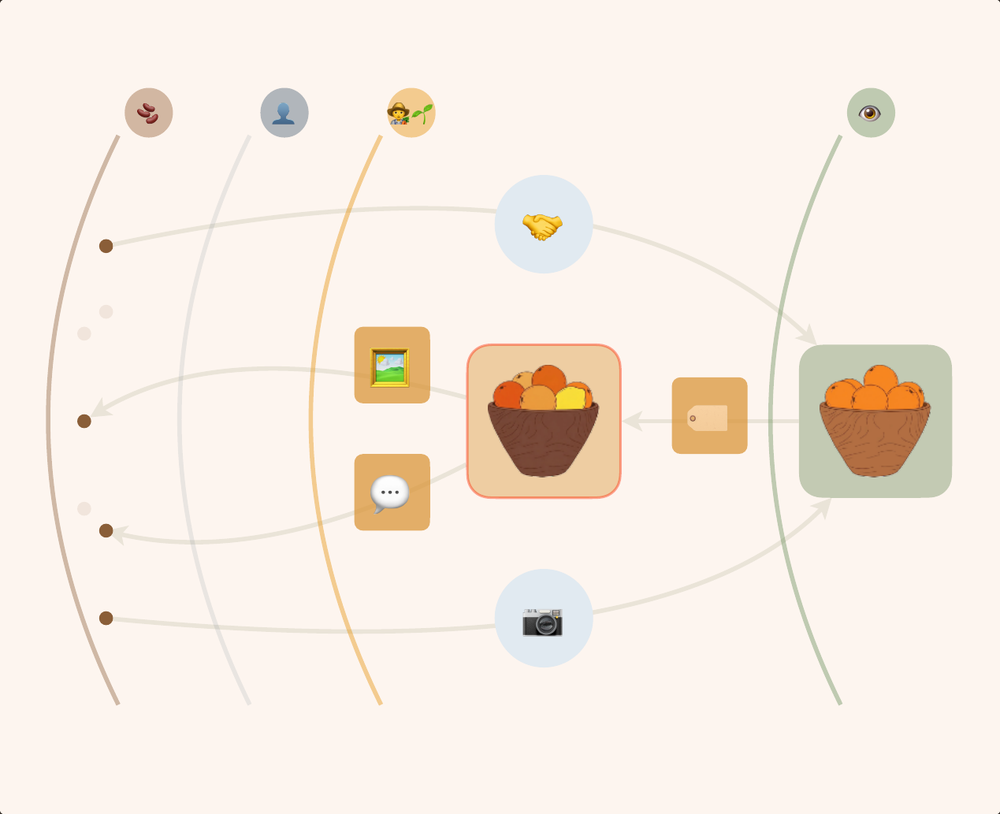
The figure reads left to right and back again. The four curves are the four parts of the mind this project draws: the store, manas, mind consciousness, and the senses. Contact and perception come out of the store and reach across to the bowl. Perception makes its sign off the bowl, and the sign’s two forms go back into the store on two separate lines, because the book counts them as two seeds and not one. (Going Deeper gives Thầy’s own account of sign, image and name, and what follows from their being two.)
So what the mind rests on is never the thing. It is a sign the mind made. The book says this about ordinary perception in general, and says it strongly: “Our perceptions rarely reach the mode of things-in-themselves, however. We usually perceive things in the other two modes, as representations or mere images.” The bowl the mind works with is a picture of the bowl. Thầy’s image for it is “taking a photograph of a photograph.”
That is the machinery. Now take it up the four levels.
Where this comes from
The four levels and their names are the book’s. Thầy lists them in Chapter Nine as the sixth to ninth of the nine stages: the Realm of Limitless Space, the Realm of Limitless Consciousness, the Realm of No Object, and the Realm of No Perception and No Non-Perception. He gives each of them a name and a number and nothing else.
What perception has hold of at each level, and how it changes from one to the next, is not in this book. We took it from the Abhidharma, the early commentaries, because without it there is nothing to say about a level beyond its name. The argument at the seventh level, that the awareness you turn toward is not a self, is different. That one is the book’s own, and the reading quotes it where it is used.
The sixth level: limitless space
You stop resting on shapes and edges. You rest on open space instead, space with no edge to it.
Your eyes have nothing to do here. There is no form left to see. Chapter Three says that of the whole realm: “Life continues, but there is no perception of form.” But you are still perceiving. What you are perceiving is the space.
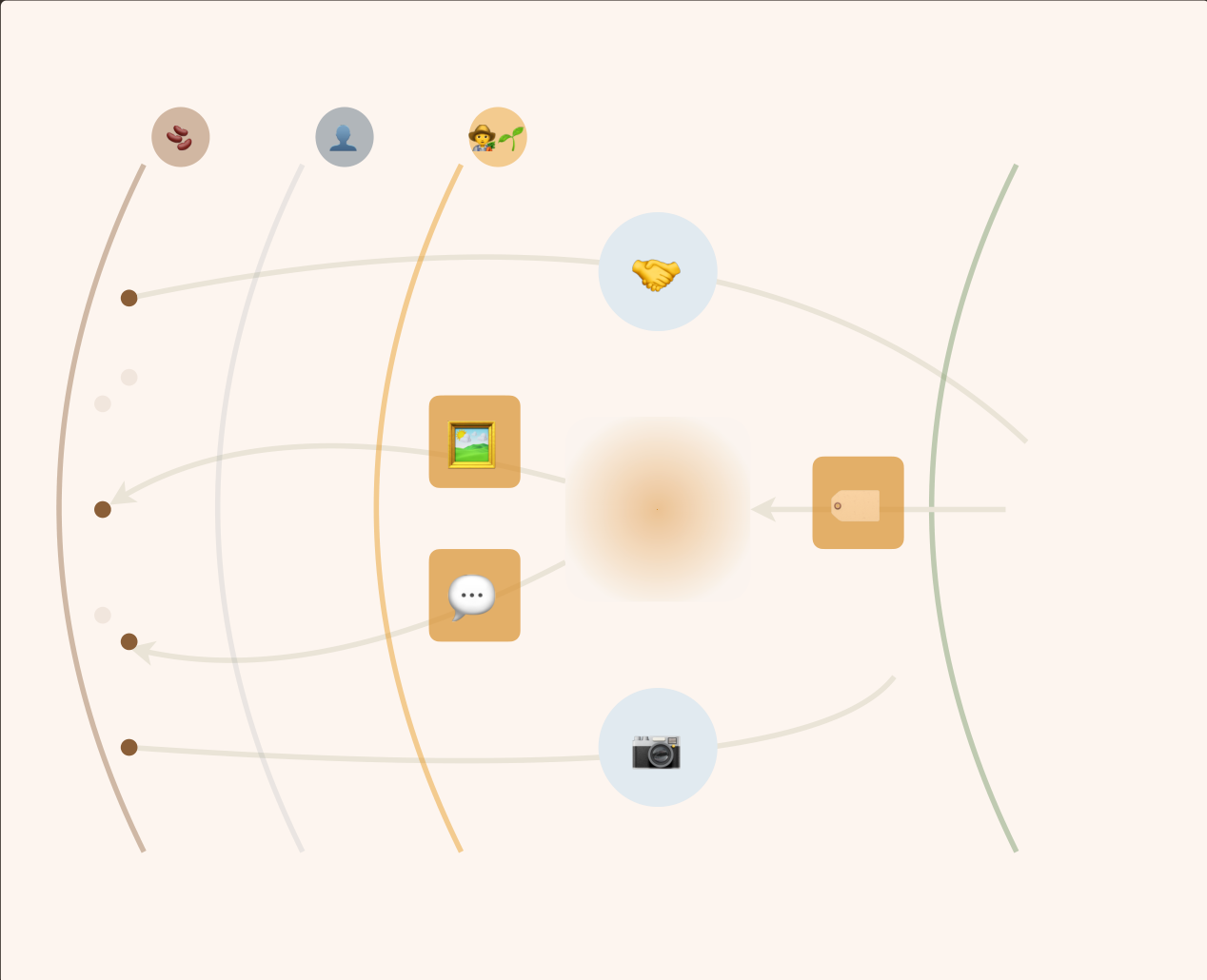
Put the two figures side by side. The bowl has gone, and everything else is where it was. Contact still reaches. Perception still makes a sign, and the sign is still stored. Only the sign has changed: it is now a sign of open space, which is fainter than a sign of a bowl of oranges.
You cannot perceive nothing. There is always something you are aware of. Here, it is space.
The seventh level: limitless consciousness
Then you notice the awareness that was holding that space.
To hold space with no edge, that awareness had to reach that far. So it has no edge either. You let the space go and rest on the awareness instead. The book’s name for the level says what its object is: the Realm of Limitless Consciousness. The level is not called limitless because it is grand. Its object was limitless, and an awareness that reaches boundless space is as wide as what it knows.
This is where people go wrong. It feels as though there is a self standing behind you, watching. There is not. Here is why, and the reason is the book’s.
Thầy writes, in his commentary on Verse 24:
“Knowing always includes the subject who knows and the object that is known. Before we can speak about awareness, we have to ask, ‘awareness of what?’ This is basic, but not easy to understand.”
Awareness is always awareness of something. So the moment you rest on the awareness, it has become the something. It is now the thing you are aware of, sitting in front of you, the same as the space was a moment ago. Anything that can be looked at is an object. And an object is not a self. The watcher you thought you had found is one more thing being watched.
The book puts the same point a second way, in its chapter on Verse 17, and borrows a philosopher to do it: “The German phenomenologist Edmund Husserl stated that consciousness must be consciousness of something. In the Manifestation Only teachings, the same point is made. To be angry means to be angry at someone or something… To think is to think something.” Consciousness has a perceiver side and a perceived side, and they come together, like the top and the bottom of a plate. There is no perceiver left over, standing outside the pair. (Going Deeper takes up why nothing turns around and sees itself, and where the book’s account differs from another tradition’s.)
If the sixth level’s figure were redrawn for this level, the blur would be gone. Contact and perception would still reach out, and what they reach would be a faint copy of the mind’s own curve. The object at this level is not a thing, and not a space. It is the mind’s own knowing, taken as a sign.
The eighth and the ninth
At the eighth level, which the book calls the Realm of No Object, you let go of that boundless awareness too. Now the only thing you are aware of is that there is nothing there. But that is still something. You are aware of the nothing.
The ninth level is finer again. Perception has not stopped, but you could not honestly call it perception either. The book’s name for the level says exactly that and nothing more: the Realm of No Perception and No Non-Perception. We have run out of language. That is not the words failing us. It is the end of the nine stages.
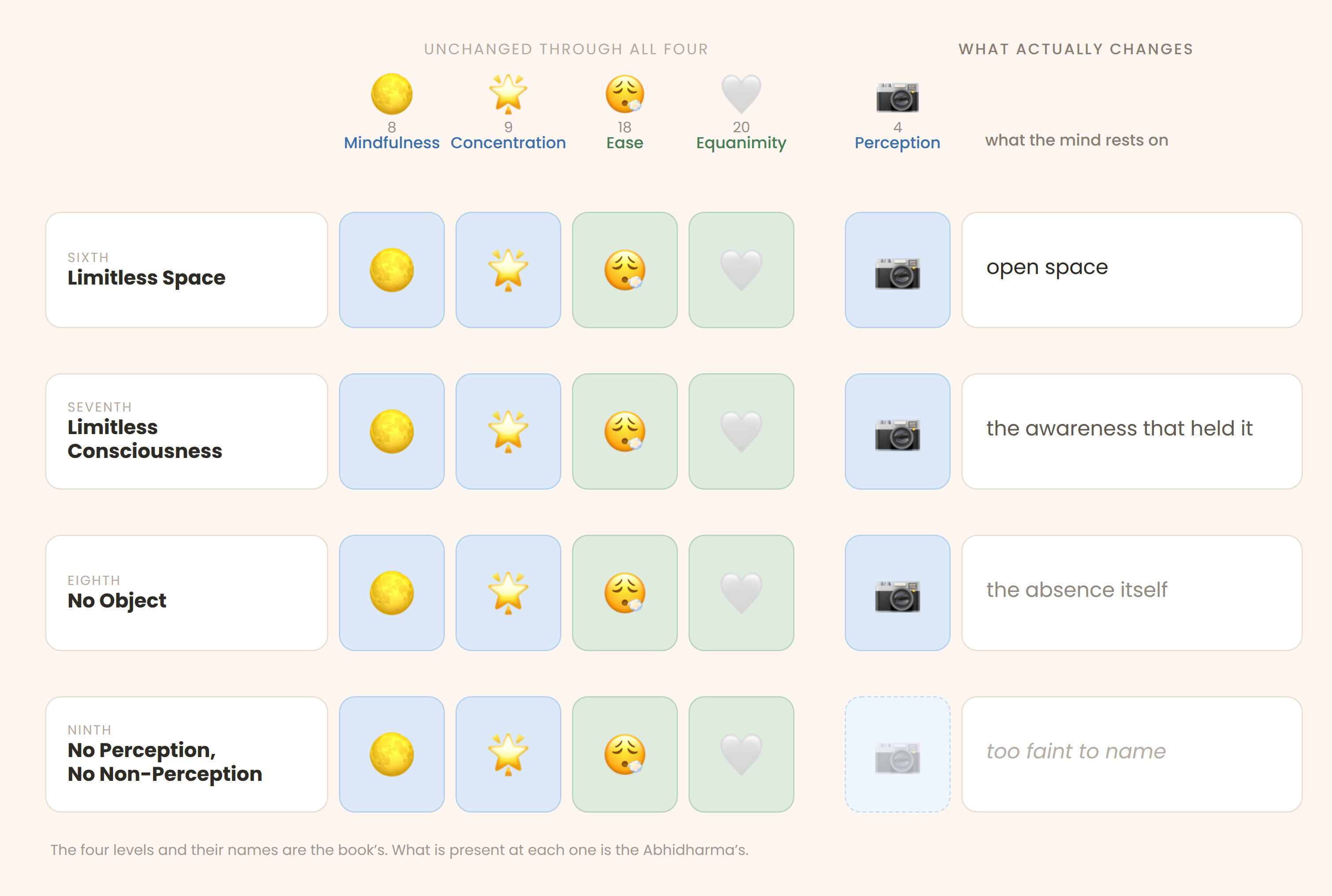
It cannot stop, because the book says perception and its object arrive together or not at all: “There cannot be a perceiver if there is no object to be perceived. Consciousness is possible only when subject and object manifest together. If there is no object of perception, there will be no perception.” Take away the last object and you do not get a perceiver with nothing in front of it. You get no perceiving. And the book puts the ninth level inside the nine stages, inside samsara, where perceiving is still going on. So there is something there. It is just too faint for the word.
There is nothing finer left to rest on. And you are still aware of something.
Nothing stopped
There were four levels, and at every one of them you were still perceiving.
The object got fainter each time. The perceiving did not. There was never a moment with nothing in it, and there was never anyone standing behind it, watching. That is what the mind is doing at the top of the nine stages.
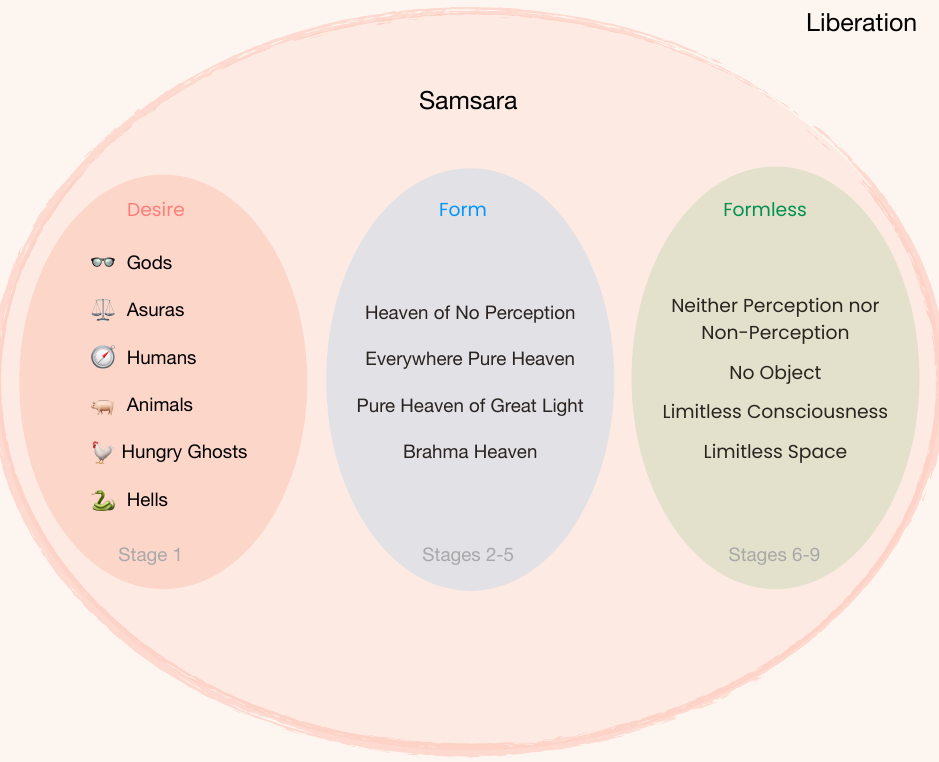
This does not show that the four levels are worthless, and it does not show that anyone should avoid them. It shows what they are made of. From the outside they look like a mind letting go of more and more until nothing is left. From the inside they are a mind doing the one thing a mind always does, perceiving, on an object it has made fainter and fainter. Chapter Three says why that leaves us where we started: “In the realm of non-form, suffering still exists because all wrong perceptions have not yet been removed and many desires are still dormant in the depth of our consciousness.” The sign got fainter. It did not get seen through.
That leaves one question, and the next two readings take it up. Does any of this set us free?
Contemplation Questions
When you turn toward your own awareness, what do you find?
Have you ever caught yourself assuming there is someone behind your experience, watching?
What happens when you look for them?
Carry whichever of these stays with you — into your own quiet reflection, or into conversation with others.
Going Deeper
3 notes ·A few notes for anyone who wants to follow a thread further.
Sign, image and name — what perception makes
This reading depends on the word sign, and the book defines it in one place, at Verse 2, where the verse itself lists seeds of perceptions, names, and words:
“When we perceive an object, we see its ‘sign’ (lakshana). The Sanskrit word ‘lakshana’ also means ‘mark,’ ‘designation,’ or ‘appearance.’ The sign of a thing is the image that is created by our perception (samjña) of it. Suppose we see a wooden platform supported by four legs. That image becomes a seed within our consciousness. The name we assign to this image, ‘table,’ is another seed.”
So the three words nest. A sign is what perception makes of a thing and then meets in its place — perception does not hand the mind the bowl, it hands it a mark that stands for the bowl. The sign comes in two forms. The image is the sign as a picture: the bowl-shape that perceiving makes when the senses meet the bowl. The name is the sign as a word: the label attached to that image. The store keeps each of them as a seed of its own — two seeds, not one — which is why the first figure in the teaching sends the image and the name back to the store on two separate lines.
Once stored, they call each other up. Thầy: “every time we perceive the object we have named as a ‘table,’ or even when we simply hear the word ‘table,’ our image of a table manifests in our mind consciousness.” Hear the word and the picture comes; see the shape and the word comes. So from then on it is the sign the mind meets, not the thing — which is why the loop in the figure closes back into the store rather than ending at the bowl.
Two things follow for the four levels. First, what the mind rests on at any level is a sign it made, and the levels differ only in how faint that sign is: open space, then the awareness that held it, then the absence itself, then something too faint to call a sign, which is what the ninth level’s name says. Second, making the sign fainter is not the same as seeing through it. The book gives the second act its own name, at Verse 49: “If you see a flower only as a flower and don’t see the sunshine, clouds, earth, time, and space in it, you are caught in the sign of the flower… This is called signlessness.” A later reading, Still Not Free, takes that up.
Why nothing turns around and sees itself
The reading says that the awareness you turn toward at the seventh level is an object, not a self, and rests that on Verse 24’s “awareness of what?” A careful reader will want the mechanism. What, exactly, is the mind taking as its object when it rests on its own awareness?
The book’s answer is in its chapter on Verse 17, where Thầy sets out the three aspects of any moment of consciousness: “a subject (the perceiver, darshana-bhaga), an object (the perceived, nimitta-bhaga), and the basis that makes both subject and object possible, which is the thing-in-itself (svabhava-bhaga).” He then says these three “are together called ‘the self-revealing aspects’ and they depend upon each other,” and gives the sutras’ image of three reeds leaning on one another, none of which stands alone. A perceiver is never found on its own. It arrives with its object, as the top of a plate arrives with the bottom.
He also names the part of the mind that makes this move all day long. “The object of manas is the perceiver aspect of store consciousness. Just as the perceiver naturally embraces the perceived, manas embraces and clings to this aspect of store consciousness, makes it into an object, and that object becomes an idea of self.” That is the seventh level’s error in its everyday form. Manas takes the knowing side of the store as its object and calls it me. The book says of what manas gets hold of that way: “This perceived object of manas belongs to the field of representations and to the mode of false perception.” A perceiver made into an object is a representation of a perceiver, and not a self.
There is one account we did not use. The Theravāda commentaries explain the same experience with a rule about time: a mind cannot know itself in the same moment, so what it takes as its object is always the mind-moment just gone, and the practitioner is always a step behind. It is a tidy explanation, and an earlier draft of this reading leaned on it. We cut it, because it is another tradition’s machinery and because this book leans the other way. Thầy has one consciousness taking a perceiver-aspect as its object now, not a moment ago, and in Breathe, You Are Alive!, on the eleventh exercise, he writes: “Using the mind to observe the mind… Mind is the oneness of the subject that illumines and the object that is illuminated.” The no-watcher point does not need a mechanism about time. It needs only the book’s own question, which is why the reading stands on that.
Using the mind to observe the mind
The seventh level is a state a mind arrives at by concentration. The move at its centre, turning toward the awareness itself and finding that it is an object, is also something a person can do sitting in a chair, and Thầy gives it as a practice.
In Breathe, You Are Alive! the ninth exercise of mindful breathing is “Breathing in, I am aware of my mind,” and the eleventh is “Breathing in, I concentrate my mind.” Of the eleventh he writes: “Using the mind to observe the mind, the eleventh exercise brings us to deep concentration.” And in his commentary on the ninth, he says what the word mind covers there, and what it does not: the term citta “includes all psychological phenomena, such as feelings, perceptions, thoughts, reasoning, and so forth, along with their objects. It does not refer to a single, unchangeable psychological subject. Mind is a river of psychological phenomena that is always flowing.”
That last sentence is the seventh level’s finding, said plainly and from the other direction. Look for the one who is looking, and what you find is one more thing in the river: a feeling, a place behind the eyes, a sense of me. Each is something you are aware of. Each is in front of you, not behind you. Nothing found that way is a self, and nothing found that way is unreal either. Even a blank, empty feeling is something you are aware of, so it is an object too.
So the practice is not to find nobody and feel empty. It is to look, find an object, notice that it is an object, and come back to the breath and the body. The sutra’s exercises are the safe form of the seventh level’s move, because they never ask the mind to hold a boundless object. They ask it to look at what is already there.