10.02
Five in Every Moment
The second reading on Verse 10: what a mental formation is, the five formations the verse calls universal, and what Thầy teaches about two of them, attention and volition.
This page is our current understanding, written as we work through the book together — it changes as our understanding changes.
The Reading
Verse 10 reads:
Unobstructed and indeterminate, store consciousness is continuously flowing and changing. At the same time, it is endowed with all five universal mental formations.
The first reading on this verse took its first half, the three qualities of store consciousness. This reading begins the second half. Before Thầy can say what the store works with, he has to introduce a term that the rest of the book depends on, and he does it in one paragraph:
“The term ‘mental formations’ is a very important term in Buddhism, and it is one we will encounter throughout this book. A mental formation is the result of the manifestation of a seed in our store consciousness. The Manifestation Only school divides mental formations into fifty-one categories, which we will discuss in detail later in the Fifty Verses. To understand this verse, we need to know that there are five universal mental formations: contact (sparsha), attention (manaskara), feeling (vedana), perception, or conceptualization (samjña), and volition (chetana). … They are called universal because they are active in all eight consciousnesses.”
The paragraph does two things. It says what a mental formation is, and it names the five universal ones. This reading takes those two, follows the five through a single moment, and then follows two of them further: attention, because Thầy built a practice on it, and volition, because he calls it a food. The sentence left out of the quotation says the five are “associated,” and the rest of the chapter is about how the five work inside the store itself. The next reading on this verse takes both up.
The Teaching
What a mental formation is
The book’s definition is one sentence: “A mental formation is the result of the manifestation of a seed in our store consciousness.” The chapter on Verse 12 defines the two words it rests on: “‘Seed’ means something that has the capacity of manifesting. ‘Formation’ means what has been manifested.” A seed is something that can come up, and a formation is what has come up.
Thầy’s example there is anger. “When we don’t feel angry, the seed of anger has not manifested, though it is still present in our store consciousness. When someone says something unpleasant or hurtful to us, he waters the seed of anger in us. The seed manifests itself in our mind consciousness and becomes a mental formation.” Wholesome seeds work the same way. A seed of joy can lie in the store for a long time. Then an old friend arrives at the door, the seed is watered, and joy comes up. That joy is a mental formation.
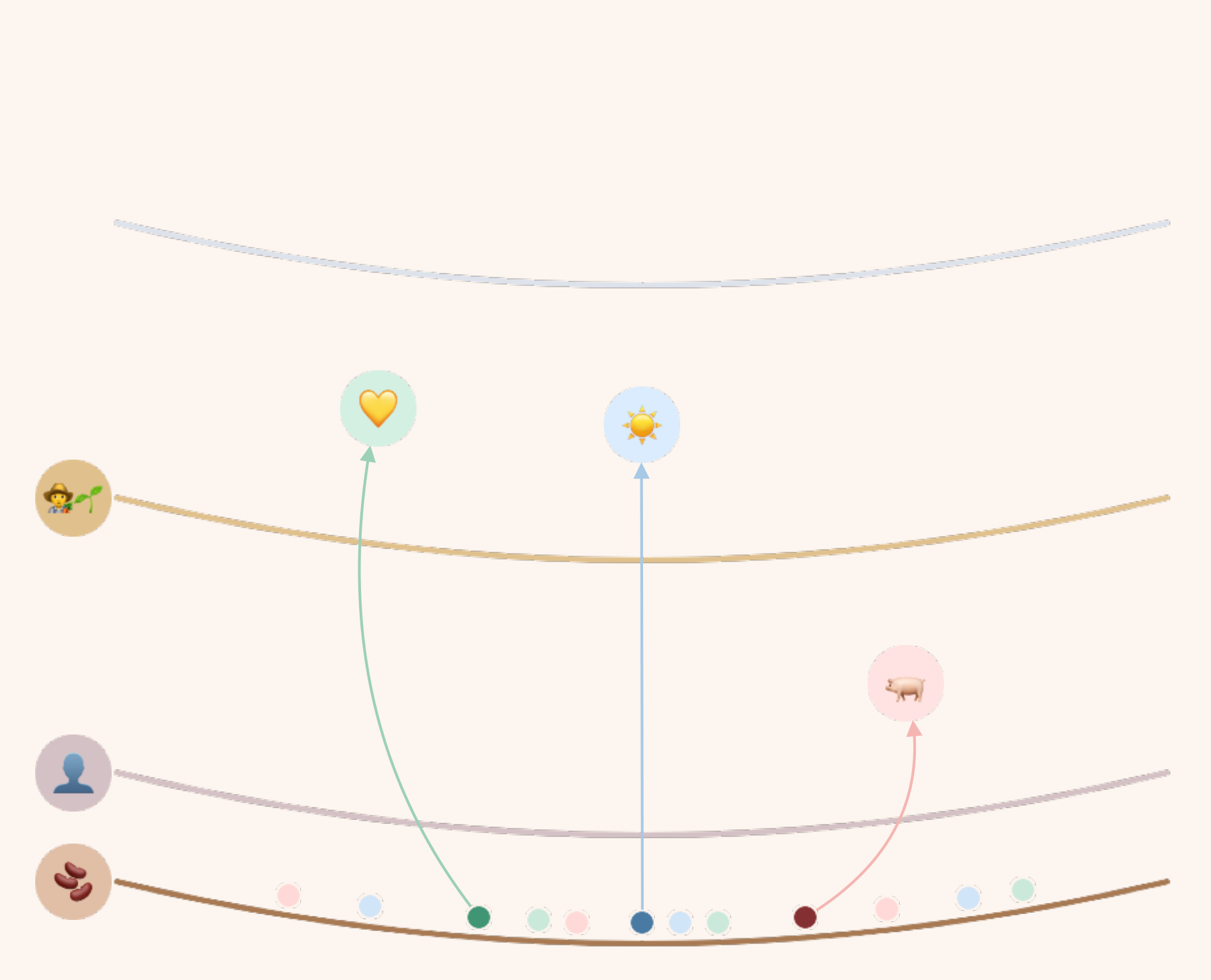
Mental formations come up in mind consciousness, and the chapter on Verse 24 says that every one of them can: “All the mental formations can manifest in mind consciousness.” Some come up with manas as well, and the chapter on Verse 20 begins: “Many of the fifty-one mental formations operate together with manas.” The figure above shows delusion coming up with manas.
At the Winter Retreat in 2013 Thầy gave an image for the difference between a seed and a formation: “the seed, when it is H2O, we call it a seed. But when it becomes rain, snow, ice, then it is called formation” (5 December 2013). The point he drew from it that day was that the seed and the formation are not two separate things. The rain is still H2O. The book makes the same point in the chapter on Verse 12: “A seed doesn’t necessarily disappear when the formation is manifested. Seeds and formations inter-are.” Rain and snow are not states of mind, so the image is about formations of every kind, and mental formations are one kind of them.
The same chapter adds what happens after a formation has come up, and the rest of this reading leans on it. “After manifesting for some time in the upper level of our consciousness, our anger will return to the root and the seed will become a little bit stronger. If we allow any seed to have occasion to manifest as a formation, that seed grows bigger and stronger.” Each time a seed comes up as a formation, the seed in the store ends up a little stronger.
The fifty-one, and the five that come first
The Manifestation Only school counts fifty-one kinds of mental formation. The book gives the count in the chapter on Verse 24: “There are fifty-one categories of mental formations: five universal, five particular, eleven wholesome, twenty-six unwholesome, and four indeterminate.” The chapter on Verse 30 lists them all, and the Inner Landscape has an entry for each one. The five universals come first.
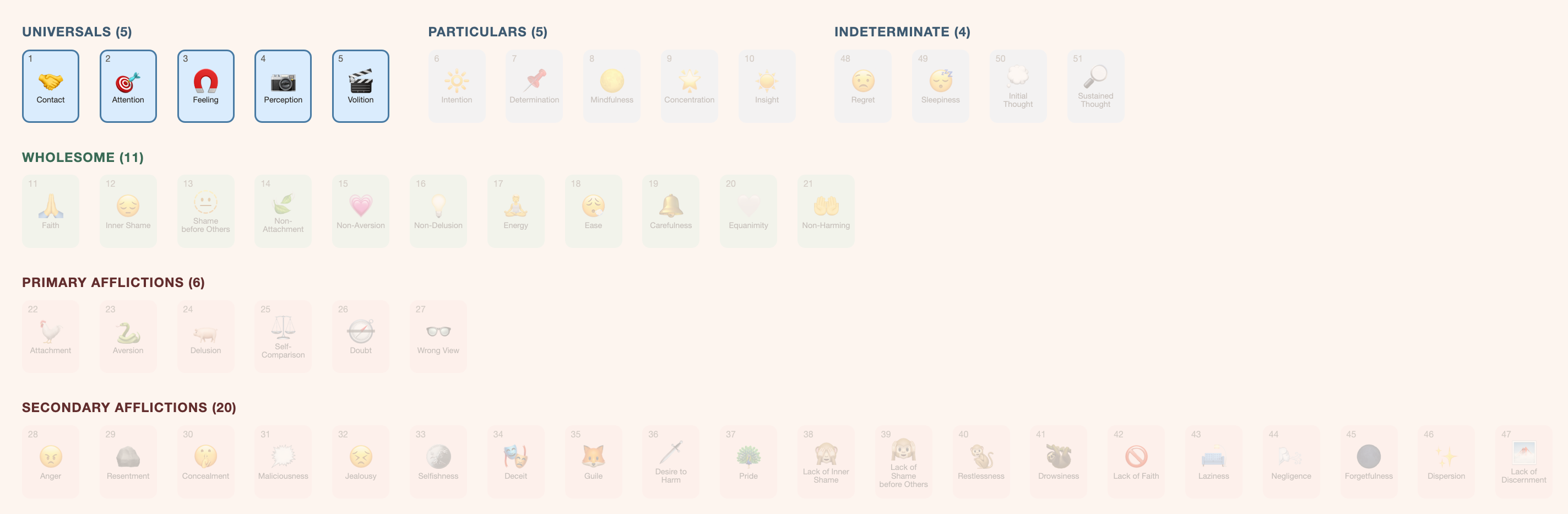
The book names the five here but does not say what each one is. Below, each has a short gloss of ours, with Thầy’s own words from a retreat in 1997, where he taught in English and took the five in the same order as the book:
- 🤝 Contact: a sense organ, an object and consciousness meet. His gloss in 1997 was “the contact between object and subject of cognition.” At the Winter Retreat he gave the traditional definition: a vibration, a change in the sense organ, when organ, object and consciousness come together (28 November 2013).
- 🎯 Attention: the mind turns toward the object. In 1997, “paying attention to the object of cognition.”
- 🧲 Feeling: what we meet feels pleasant, unpleasant or neutral. In 1997, “the feeling as a result of this kind of contact and attention.”
- 📷 Perception: the mind recognises what the thing is and names it. “After that, there’s a perception of what is there.”
- 🎬 Volition: the mind decides, and moves us to act. In 1997 he called it “the decision” that “happens after perception.”
Contact is the one the chapter has already used. In its first half Thầy explains why eye consciousness stops when we sleep: “Only through contact with its object does a sense base give rise to a sense consciousness.”
One moment, with all five
The five are easiest to see slowed down. Take one sound of the bell, which in Plum Village is an invitation to stop and come back to the breath. The sound reaches the ear and hearing begins, and that is contact. The mind turns toward the sound, which is attention. The sound feels pleasant, or unpleasant if it startles us, and that is feeling. Recognising it as the bell is perception. Then we decide what to do, which is volition, and in Plum Village what we do is stop and breathe.
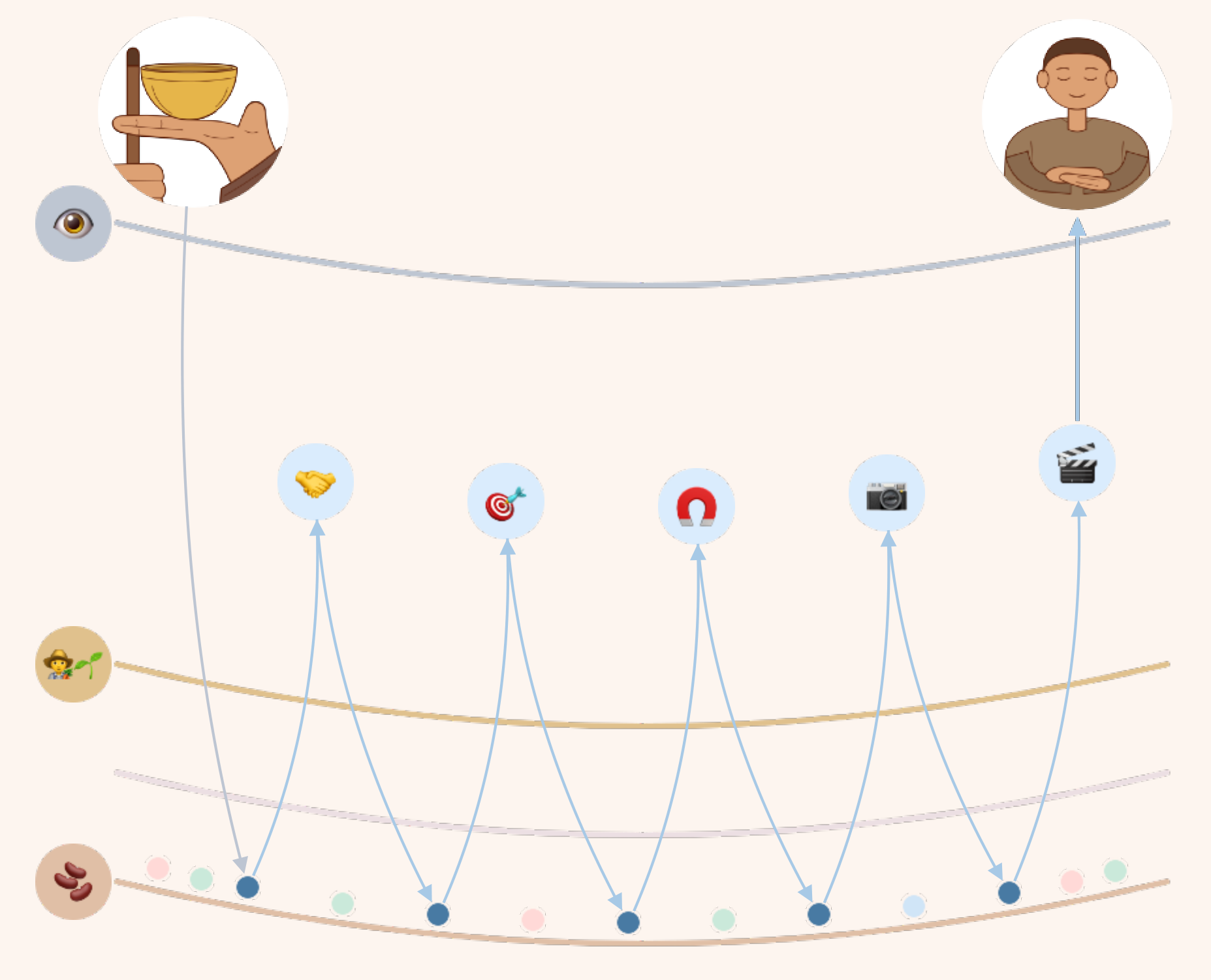
The diagram slows the moment down so that each of the five can be seen. In life they are much faster. At the Winter Retreat Thầy said they happen “in a split of a second” (28 November 2013), and that they do not always come in this order: sometimes feeling comes first.
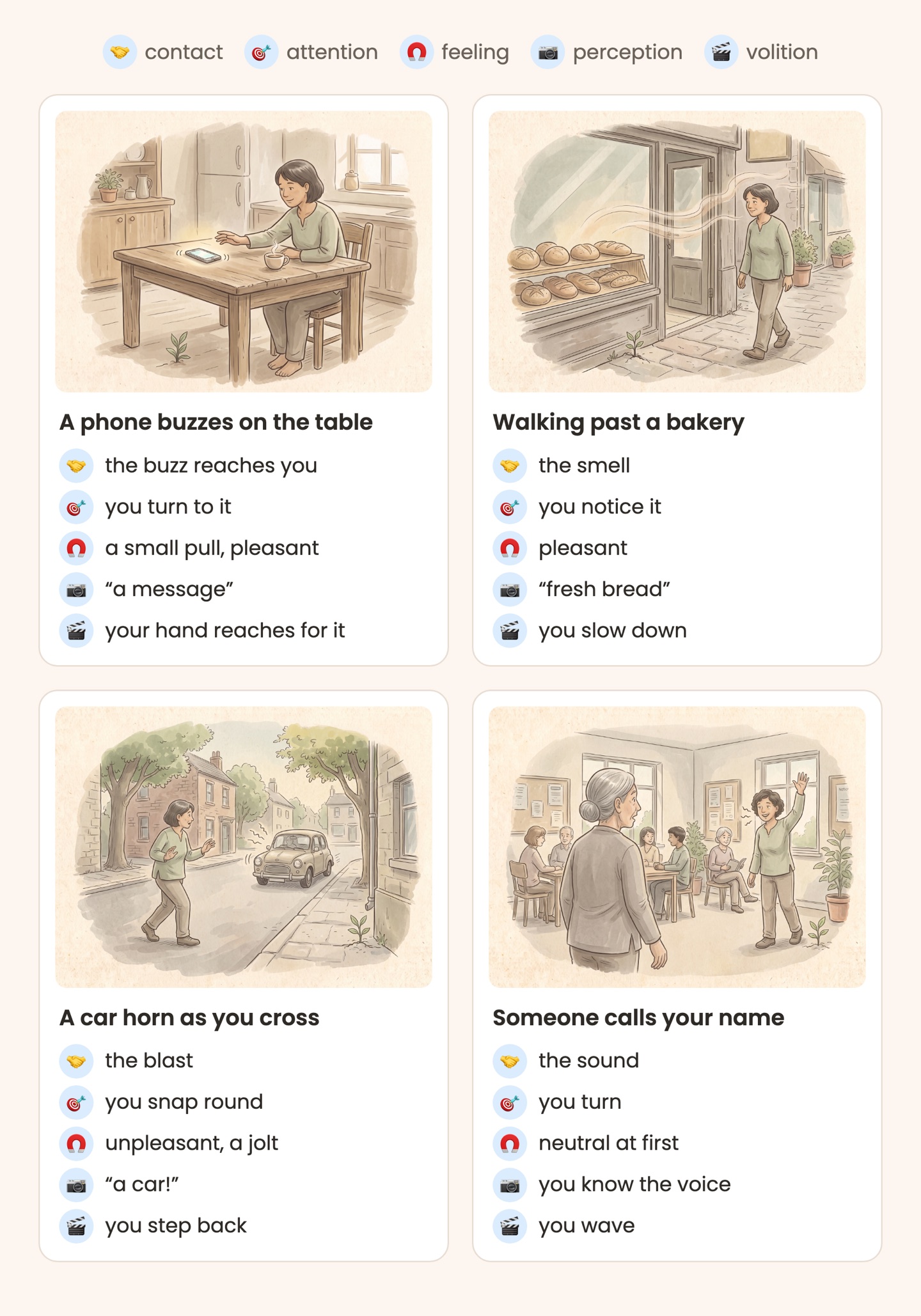
The same five are part of every moment of the day, whether anyone notices them or not. A phone buzzing on the table, the smell from a bakery, a car horn at a crossing and a name called across a room each have all five. The feeling can be pleasant, unpleasant or neutral, and it can change: the name called is neutral at first, and what we feel next depends on whose voice it is.
Appropriate attention
Thầy built a practice on attention. Our senses are in contact with many things at once. At the Winter Retreat (28 November 2013) he said that “attention only chooses one of the contacts to pay attention to,” and that there are two kinds of it: “When attention leads to something that is unwholesome, it’s called inappropriate attention. And when it directs to something that is positive, then it’s called appropriate attention.”
His example came from the meditation hall. The bell is invited while people in the room are whispering. If we follow the whispering, he said, “then our mind is dispersed. And if we pay attention to that, we can be irritated.” That is inappropriate attention. If we turn to the bell instead, “the bell becomes the object of our mind, and we have the opportunity to calm our mind,” and that is appropriate attention. He put the rule in one sentence: “As a practitioner, we have to direct our mind towards objects that are beneficial for us.”
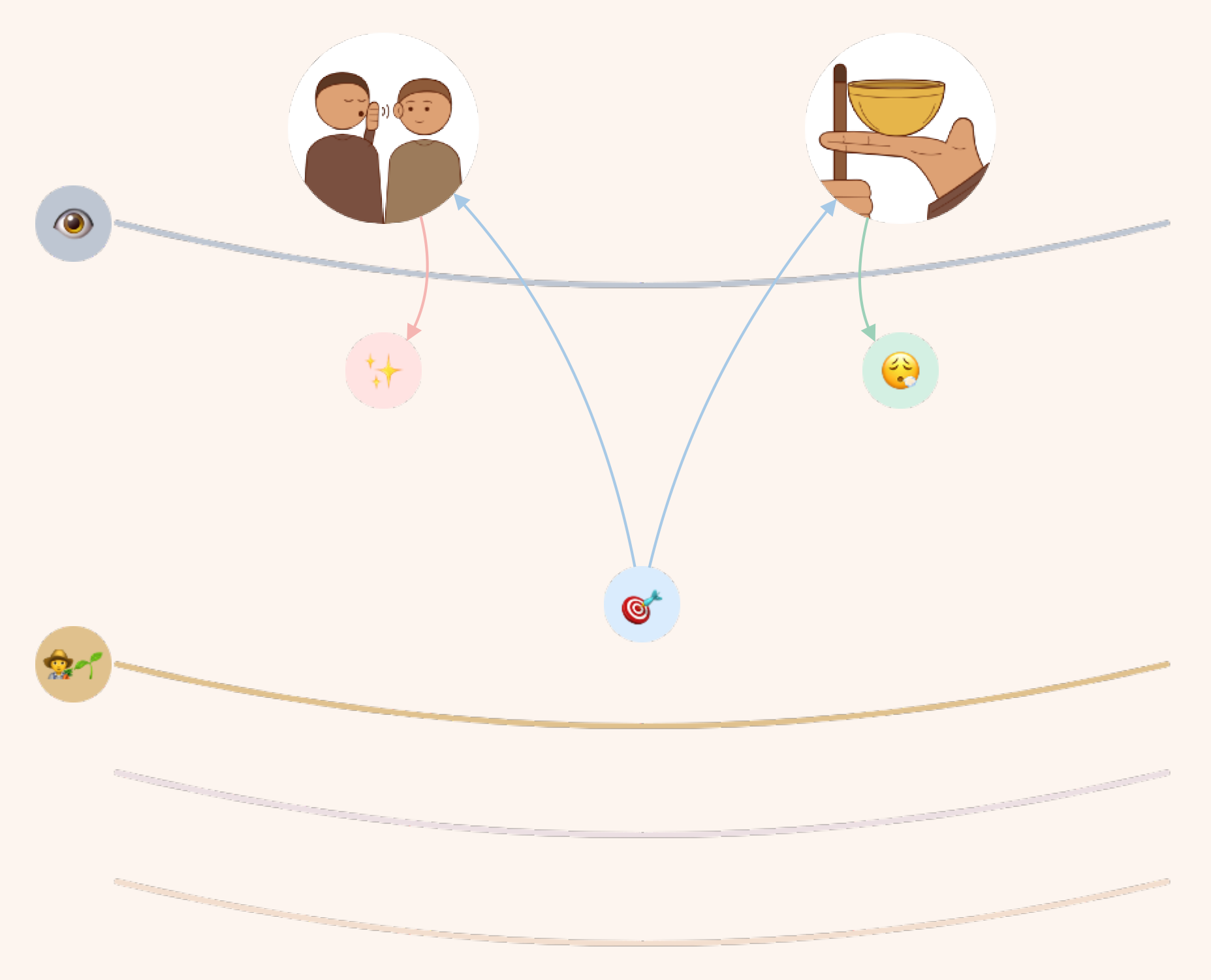
The formations at the end of each arrow are dispersion and ease.
Thầy took the same rule out of the hall. A place for practice should be arranged so that “the sounds, the images, all help us to touch appropriate attention.” The internet is full of objects for the mind, and “if there is appropriate attention, then we don’t go to websites that are unhealthy, unwholesome, that are toxic,” but to ones that teach, “such as a place where we can search for the sutras.” Because attention moves in a split second, he said, we have to train it.
In The Heart of the Buddha’s Teaching he says what this means for a day. Attention is universal, “which means we are always giving our attention to something.” It never switches off, so the practice cannot be a single decision either: “The practice is to find ways to sustain appropriate attention throughout the day.” (Why he says appropriate.)
Attention also decides which seeds get watered. Whatever attention turns to can water a seed, and each time a seed comes up as a formation, it ends up a little stronger in the store. The book’s name for choosing which seeds to water is selective watering: “We should strive to learn to identify all the positive and negative seeds in us. Then we can refrain from watering the negative seeds, and use every opportunity to water the positive seeds.” The book does not tie selective watering to attention in so many words. Putting the two together is our reading, but each half is Thầy’s.
He describes the same mechanism with fear in a short film made from a talk of 1998, The Seed of Fear in Us. Fear “is in us, in the form of a seed. And every time that seed is watered, maybe a sound, maybe a sight, anything can touch that kind of seed in us.” The opposite seed is in us too, the seed of non-fear, “but no one has helped us to identify that seed and to practice watering that seed.”
The food of volition
Volition, the fifth universal, is the push that moves us to act. At the Winter Retreat Thầy said that the word “does not mean thinking here. It is a determination, a desire to realize” (19 December 2013). He went on to call it a food, the third of the four nutriments: “Volition is a food. If we don’t have that food, we don’t have life.” Someone who wants to do nothing, he said, is about to die, and “someone who has a source of volition has a great deal of energy.”
That energy can be wholesome or not. The desire to take revenge is “also a kind of volition food,” and it gives a person a lot of energy. When the wish is to wake up in order to help others, the name for it is bodhicitta, “the mind of love.”
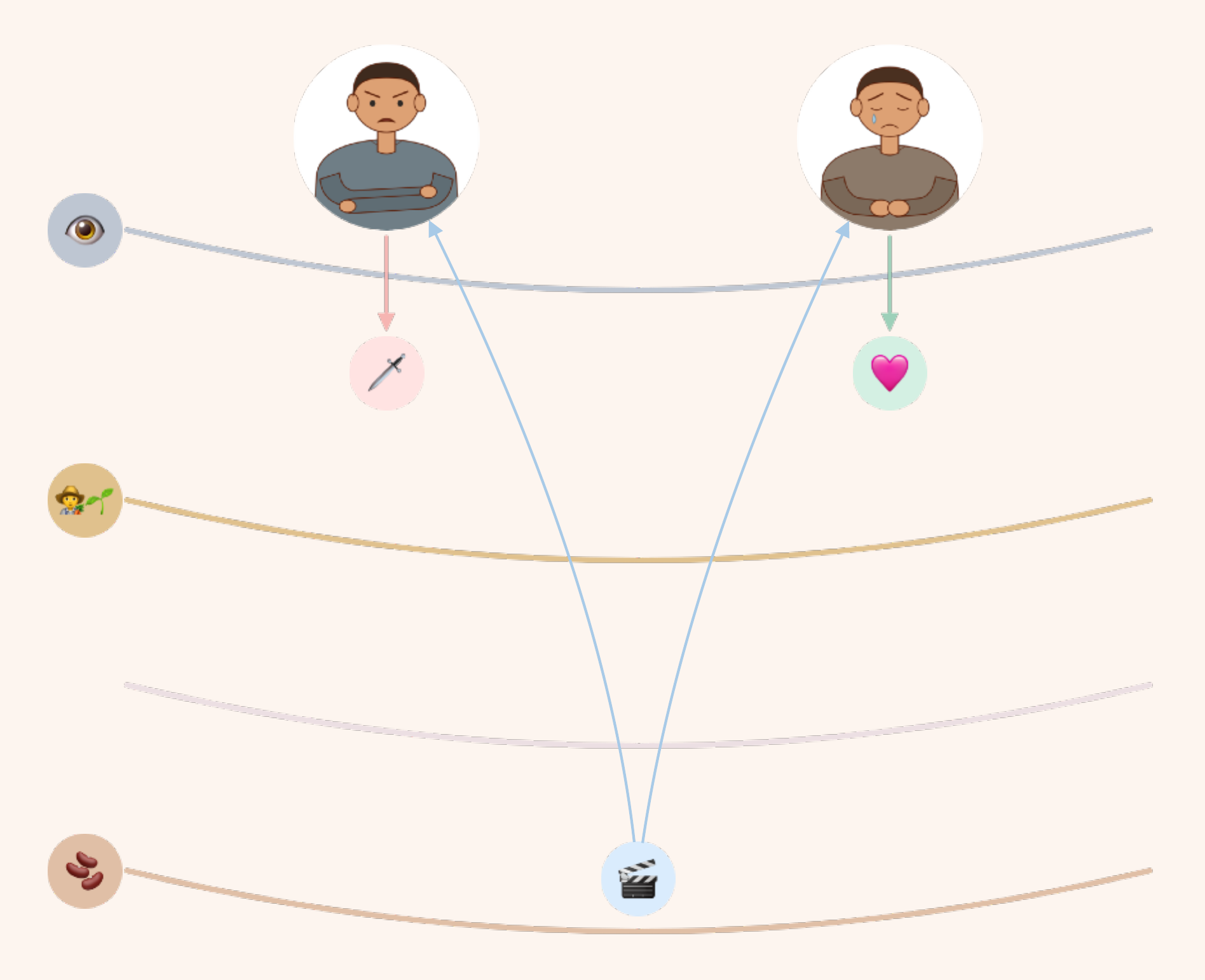
The Buddha, Thầy said, “taught us to sit quietly, look deeply, and find what is my deep desire, my deepest desire.” We do not wait until the end of the path to live that desire: “We live it in such a way that each step, each breath is the realization of our dream.”
You can watch all of this with one sound. When a bell rings, or a phone, let the sound be your object and listen until it has completely gone. Notice how it felt, pleasant, unpleasant or neutral, and that you knew what it was without deciding to know. Thoughts are objects too, and attention goes to them the same way. When it does, you can choose the breath again. Each time we come back to the breath, we water the seed of mindfulness in the store.
Contemplation Questions
The book says that when someone says something unpleasant or hurtful to us, they water the seed of anger in us. Good seeds are watered the same way. What has watered a good seed in you recently?
When a sound calls you, whether a bell, a phone or your name, can you notice any of the five: contact, attention, feeling, perception or volition? Which one is easiest to see?
Where does your attention go when you pick up your phone? Does it take you somewhere that helps you?
Carry whichever of these stays with you — into your own quiet reflection, or into conversation with others.
Going Deeper
7 notes ·A few notes for anyone who wants to follow a thread further.
Do the five come one after another, or all at once?
This reading follows the bell through the five one at a time, in the order the book lists them, and in 1997 Thầy told them as a sequence too: feeling comes “as a result of this kind of contact and attention,” and perception “after that.” At the Winter Retreat he loosened the order: “these five mental formations take place almost simultaneously. Sometimes mental attention takes place before contact, sometimes feelings come first, and then when there’s feelings, there’s more contact, more attention, and then there’s perception” (28 November 2013). His thesis of 1963 puts attention first of the five, as the cause that makes any kind of knowing happen.
The book’s own word for how the five go together is in the sentence the reading left out: “These five mental formations are ‘associated’ (samprayukta), which means they are engaged with each other.” Read that way, the order is a way of telling one very short moment slowly. The thesis says how short: “The duration of a caittas is very brief.” (A caitta is a mental formation.) A long look at an elephant feels like one seeing, but “in reality there is an entire series of sensations and perceptions and awarenesses.” Each moment in that series has all five, and that is what this reading’s title means.
The chain of seeds in the bell diagram is our drawing. It applies the book’s watering to the order Thầy gave in 1997, and no source draws the five that way.
Is every formation a mental formation?
No. In the H2O image the formations are rain, snow and ice, which are not states of mind. The book uses formation for anything that has manifested from a seed, and mental formation for one kind of it. The chapter on Verse 22 says so directly: “Not only mental formations come from the seeds in our store consciousness, but physical and physiological formations also are manifestations from seeds in our store consciousness.” The chapter on Verse 31 gives the mental kind its Sanskrit: “mental formations (chitta-samskara), which are psychological phenomena.” The fifty-one are the mental ones.
Why are these five called universal?
The paragraph this reading quotes gives the book’s reason: “they are active in all eight consciousnesses.” The chapter on manas repeats it: “They are called universal because they are present in every consciousness.” At the Winter Retreat Thầy explained the Vietnamese name, biến hành. Biến means everywhere and hành means functioning: the five are at work everywhere and at any time, and “that’s why they’re called universal” (28 November 2013). The next reading on this verse follows them through the eight.
Does the store work with only these five?
The verse says the store is “endowed with all five universal mental formations,” and the classical Manifestation Only teaching is that these five are the only formations the store works with. Thầy’s thesis of 1963 says the same: “Ālaya is only associated with the 5 universal ones, because its function is only a pure form of intuition.” At the Winter Retreat, fifty years later, he questioned it, and more than once.
On 15 December 2013 he set out the classical view, said that the Theravāda tradition counts more universals than five, adding concentration and vitality, and then said: “but we have to look again.” His argument went through the Great Mirror Wisdom, which the store becomes when it is transformed. The tradition says the Great Mirror Wisdom works with the five particular formations and the eleven wholesome ones as well as the five universals. If those were never with the store before, where did they come from? His answer: “According to Thay, Alaya also works with the five particulars.” The classical reason for denying it is that the store is dull and weak, and he rejected that too: “Alaya is very powerful.”
In later talks he named others. On 19 December: “in Plum Village we say that [the store] goes with five universals… and it also goes with concentration and life force.” On 12 January 2014, the five particulars “plus… vitality.” On 16 January, insight, because without it the store “cannot reach the ultimate reality. And why didn’t the ancestral teachers mention this?” Later that day he added mindfulness and concentration, “because without concentration, it cannot do all this work.”
We follow the book, which says five, because it is the text these readings teach. The later view is Thầy’s own. He raised it as a question, and in four talks he named different formations: concentration and vitality, the five particulars, insight, mindfulness. We give it here so that a reader who meets it in the talks knows that it differs from the book, and that the difference is his.
What are the thirteen formations Plum Village adds?
The fifty-one are the classical count, and Understanding Our Mind keeps to it. Plum Village’s own chart of the mental formations, which the Inner Landscape follows, ends with a section headed Sư Ông Làng Mai thêm vào, “added by Thầy”, which holds thirteen more. Ten are wholesome: non-fear, absence of anxiety, stability, love, compassion, joy, humility, happiness, feverlessness and freedom. Three are unwholesome: fear, anxiety and despair. The Inner Landscape numbers them 52 to 64 to keep them apart from the fifty-one.
The book does not list them, and the chart is Plum Village’s rather than the book’s, so these readings treat the thirteen as additions beside the fifty-one and not as part of the count. Three of them have already come up here. Joy, this reading’s first example of a formation, is one: the book speaks of the seed of joy, in the chapter on Verse 12 among other places, but joy is not one of the fifty-one. And the film The Seed of Fear in Us turns on two more, fear and non-fear.
Why does Thầy say appropriate attention?
Appropriate is his English word, at the Winter Retreat and in The Heart of the Buddha’s Teaching, where he gives the Sanskrit: appropriate attention is yoniso manaskara, and the other kind ayoniso manaskara. Other translations say wise and unwise attention. The two places define it a little differently, and the definitions fit together. At the retreat the test is where attention leads: to “something that is unwholesome” or to “something that is positive.” In The Heart of the Buddha’s Teaching the test is presence. Attention is appropriate “as when we dwell fully in the present moment,” and inappropriate “as when we are attentive to something that takes us away from being here and now.” The bell passes both tests: it is good for us, and it brings us back to the present.
Thầy teaching the five, in his own words
At the 1997 retreat in Key West, on 5 November, Thầy names the five, glosses each in a line, and says that eye consciousness, ear consciousness and mind consciousness each have all five: the recording on Vimeo, from 1:15:02 to about 1:19:45, and the transcript. It is a lecture, with two long pauses at the board.
At the Winter Retreat the five fill the first part of a talk, A Sense of Contact (28 November 2013): each formation with its traditional definition, the bell and the whispering, and then what happens when the same contact leads to the same reaction a thousand times.