10.05
Every Day an Opportunity
The last reading on Verse 10: the chapter’s closing paragraphs, which say that the five universals are the store itself at work and that everything in the store shares its nature, and why that makes transformation possible.
This page is our current understanding, written as we work through the book together — it changes as our understanding changes.
The Reading
Verse 10 reads:
Unobstructed and indeterminate, store consciousness is continuously flowing and changing. At the same time, it is endowed with all five universal mental formations.
The chapter ends with two paragraphs. Between them and the passage on the three modes of perception there is one more, which the previous reading takes up: the store’s mode of perception is always direct, and so is the mode of its five universals.
“The five universals are not separate from the mind—the mind is the content of the mind. The nature of the store consciousness is also the nature of these five universal mental formations. Our store consciousness and the five universal mental formations of that consciousness—both subject and object—are all unobstructed and indeterminate, changing and constantly flowing. Every seed, every object, and every perception are like drops of water in the river of the store consciousness, and they take on the nature of that consciousness.”
“The qualities of the store consciousness that make it unique are also the same qualities that allow for transformation of the seeds it contains. Because store consciousness is unobstructed and indeterminate, because its nature is neutral, and because it is always flowing and changing, it can be transformed. Every day is an opportunity for transformation. When we transform the seeds in our store consciousness, that is transformation at the base.”
The first reading on this verse ended on the second paragraph. It took the three qualities one at a time and asked how each one makes transformation possible. This reading takes up what the first paragraph adds: the store’s qualities belong to the five universals and to every seed in the store as well, so what we carry is not fixed. Then it steps back to ask why the book gives a whole verse to what the store is like.
The Teaching
Not separate from the mind
“The five universals are not separate from the mind—the mind is the content of the mind.” Earlier in the chapter Thầy said that “store consciousness operates in the form of these five universal mental formations,” and the reading on that passage followed one sound of the bell into the store. This sentence says what in the form of means. The store does not use the five the way we use tools. When contact, attention, feeling, perception and volition are going on in the store, that is the store at work.
The book’s clearest gloss on the mind is the content of the mind comes later, in the chapter on Verse 31, and it uses the river: “Just as a river is composed of drops of water and the drops of water are the content of the river itself, so the mental formations are both the content of consciousness and consciousness itself.” A river does not hold its drops the way a bucket holds water. The drops are the river. The same chapter has a tool in it: “It is naive to think that consciousness is something that exists independently, that it is already there and we can simply pick it up, like a garden tool, and use it to recognize an object.” There Thầy is speaking of consciousness and its object. We apply the picture to the five, which Verse 31 counts among the mental formations that are the content of consciousness.
Then the chapter gives the store’s nature to the five: “The nature of the store consciousness is also the nature of these five universal mental formations.” The five in the store are unobstructed, indeterminate, and flowing and changing, because the store is. The chapter adds that this holds for “both subject and object”, and Going Deeper looks at what that phrase covers.
Drops in the river
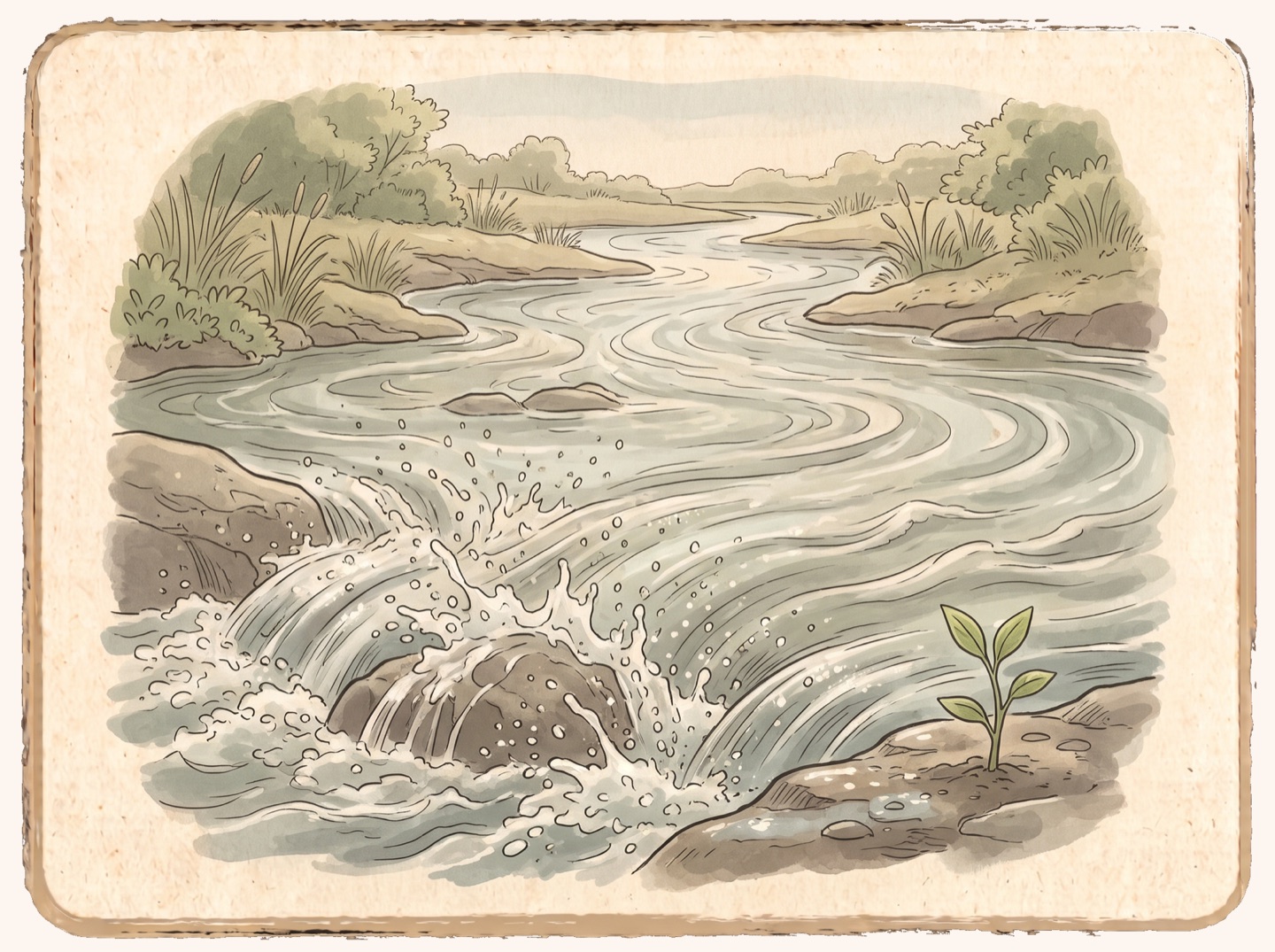
The chapter’s last step is about the seeds. “Every seed, every object, and every perception are like drops of water in the river of the store consciousness, and they take on the nature of that consciousness.” The first reading on this verse used the river for the store as a whole: the river stays the same river while its water keeps changing. This sentence turns to the water. If each drop takes on the river’s nature, then each seed in the store is also neutral, and also flowing and changing.
Thầy had used the same picture for the store in his thesis of 1963: “The stretch of water looks always the same but the innumerable drops of water in which it consists are always changing and moving.”
So the seeds of anger, sadness or fear that we carry are not fixed. A seed that has been in us for many years has been changing all that time, like every drop in a river.
Does that mean a seed of anger is neither good nor bad? The book does not ask. Thầy did, at the Winter Retreat of 2013–14, and Going Deeper gives his answer.
Why we look so closely
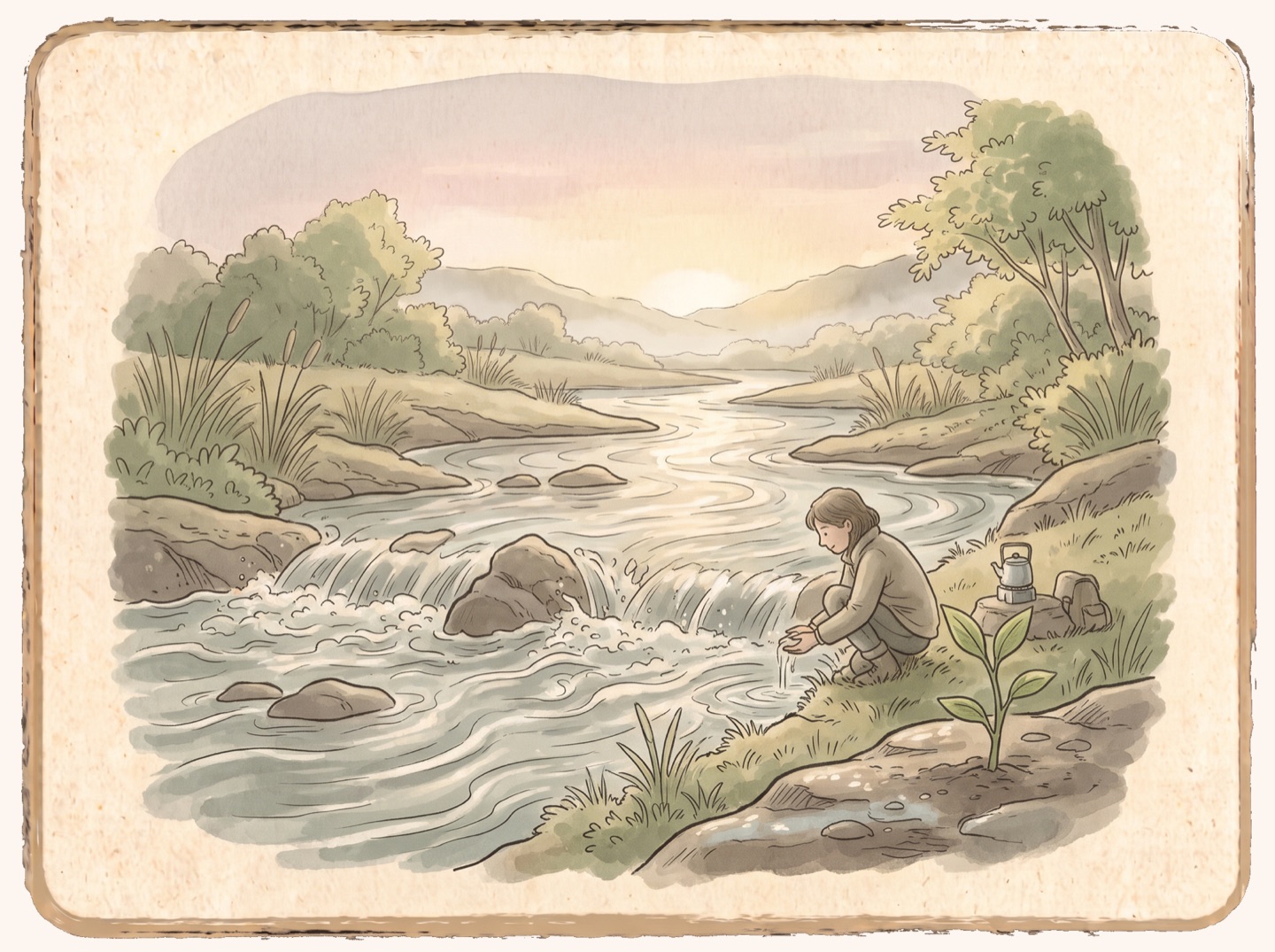
The book gives a whole chapter to what the store is like, and it has taken five readings here to go through it. Thầy gives the reason in the book’s welcome, with a line from the twelfth-century Vietnamese Zen master Thuong Chieu: “When we understand how our mind works, the practice becomes easy.”
The first nine verses are mostly about the seeds in the store: what kinds there are, where they come from, how good they are, and how they ripen and manifest. Verse 10 turns to the store itself, its three qualities and its five universals. It also sets out the three things the book asks of every consciousness from here on: its nature, its mode of perception and its object. The chapters on manas, on mind consciousness and on the senses describe each one in those terms.
Verse 10 is also the first chapter to name transformation at the base, which was once the book’s title. The book’s welcome says, “This book was originally published as Transformation at the Base.” The chapter on Verse 19 gives the Sanskrit and says what it is for: “The goal of meditation is to make a change at the root of manas and the store consciousness. This is called transformation at the base (ashraya paravritti). Paravritti means ‘revolution.’ Revolution means turning and going in a different direction.” Verse 46 has the name as its title.
Every day is an opportunity
The chapter’s last paragraph says that the store “can be transformed,” for the reasons the three qualities give, and then: “Every day is an opportunity for transformation.” In his thesis Thầy was careful about the word: the Sanskrit parāvṛtti, he wrote, “means to transform, not to destroy or to reject.” Nothing has to be thrown out of the store. A seed changes, as a drop in a river changes.
The book means every day plainly. The chapter on Verse 19 says, “Our practice is to transform the nature of manas a little bit each day and release our store consciousness more and more from its grip.” The change is made a little at a time, and mostly in ordinary moments. Each time we hear a bell and come back to our breathing, or notice a thought and come back from it, we water the seed of mindfulness in the store. Verse 12 gives this practice its name, selective watering.
A picture Thầy often used for this is the lotus that grows out of the mud. In the short film The Art of Suffering he teaches that we can make good use of suffering to make happiness, as the mud is used to grow lotus flowers, and that we begin by recognising our suffering, listening to it and embracing it.
The book says the store can be transformed. At the Winter Retreat in January 2014 Thầy said something different, that the store is “already perfect” and does not need to be transformed. A note on the first reading sets the two side by side; these readings follow the book.
Contemplation Questions
Think of a difficulty you have carried for a long time. Has it been exactly the same every day, or has it been changing, like the river?
Thầy says we can make good use of suffering, the way a lotus grows out of the mud. When has a hard time helped something good grow in you?
The book says, “Every day is an opportunity for transformation.” What is one small thing you could begin with tomorrow?
Carry whichever of these stays with you — into your own quiet reflection, or into conversation with others.
Going Deeper
2 notes ·A few notes for anyone who wants to follow a thread further.
If every seed takes on the store’s nature, is a seed of anger unwholesome?
The reading says that every seed in the store is like a drop of water in a river, and that the seeds “take on the nature of that consciousness.” The store’s nature is indeterminate. Read plainly, that means a seed of anger lying in the store is neither wholesome nor unwholesome. Yet the same chapter says that the store “contains all the seeds, both wholesome and unwholesome,” and the book talks about wholesome and unwholesome seeds from Verse 2 on. The book is using the words in two ways.
Thầy took the question up at the Winter Retreat of 2013–14, in a talk on 26 January 2014. He was going through the characteristics of seeds, and on this one he said Plum Village had changed the traditional teaching. The classical commentaries hold that a seed keeps its nature: the Cheng weishi lun, a Chinese commentary on the Thirty Verses from the seventh century, counts a fixed nature among a seed’s six marks. Thầy said, “But in Plum Village, we discovered the truth that the seeds in the store consciousness are neither wholesome nor unwholesome.” His reason was the store’s own nature: the store is indeterminate, so the seeds in it are too. “Wholesome or unwholesome is the creation of man, of human, not of nature.” His example was plants. We call flowers and rice good, and nettles and poison oak bad, but those are our labels, and the plants themselves are neither.
The words come from what a seed does when it comes up. In the same passage Thầy says that people look for the seeds that bring benefit and well-being, “And so we call them good seeds,” and avoid the ones that bring suffering. The chapter on Verse 10 gives the same test: “Wholesome means useful to ourselves and others. Unwholesome means harmful to ourselves and others.” A seed of anger is called unwholesome because anger, once it has come up in mind consciousness, harms us and the people around us. While it lies in the store it harms no one, as the note on a consciousness’s nature explains.
Our diagrams use colour the same way. We draw a seed in the colour of the formation it would become: green for wholesome, red for unwholesome, blue for indeterminate. A seed, the arrow that carries it up and the formation it becomes then share one colour, so you can follow it from the store into the mind. The colour shows what the seed would become. It does not mean the seed is doing good or harm while it sleeps in the store.
Thầy drew the practical point in the same talk. He called this nature that is not fixed an “organic nature”, and gave the mud and the lotus as his example: “The lotus can become the mud, and mud can become lotus. Suffering can be used to generate happiness.” A seed of anger is not a stain to be scrubbed out of the store. It has no fixed nature, so, in the chapter’s own words, the store “can be transformed.”
The book never asks this question outright. Its sentence about the drops in the river points the same way, and nothing in it says otherwise. The plainer answer comes from the retreat, years after the book.
What does “both subject and object” mean here?
The chapter says that the store and its five universals, “both subject and object,” are all unobstructed and indeterminate, changing and constantly flowing. It does not stop to explain the phrase, and the book teaches it properly only in Part Five, in the chapter on Verse 31, which is named for it.
The idea is that every consciousness has two sides, a side that perceives and a side that is perceived, and that both belong to the consciousness. The chapter on Verse 24 says, “Remember, consciousness has two aspects: the perceiver and the perceived. The perceiver is the subject; the perceived is the object. But both subject and object are part of consciousness.” The chapter on Verse 17 gives the everyday version: “To be angry means to be angry at someone or something.” And the chapter on Verse 31 says the same of every mental formation: “each contains both subject and object.” So the five universals have both sides too. Contact is always contact with something, and feeling is always the feeling of something.
The chapter on Verse 17 also says what the two sides of the store are. “The perceived aspect of the store consciousness is the manifestation of the world and the manifestation of the body as a sense base,” and “In the perceiver are the seeds and formations, which it stores and maintains.” The phrase in Verse 10 gives the store’s qualities to both sides at once. We leave the further question, how the world we perceive can belong to the store, to the chapter on Verse 31.