09.20
Crossing into the Realm of Form
Leaving the desire realm behind — the first steps into the realm of form.
This page is our current understanding, written as we work through the book together — it changes as our understanding changes.
The Reading
Verse 9 reads:
All manifestations bear the marks of both the individual and the collective. The maturation of store consciousness functions in the same way in its participation in the different stages and realms of being.
The words to hold onto are the different stages and realms of being. The six destinations of the desire realm — the hells, the hungry ghosts, the animals, the asuras, the gods, and the humans — now lie behind us. We step up out of desire altogether, into the next of the three great realms: the realm of form. The human state is what makes this step possible. Of the six destinations, only the human mind is steady enough for the gathering that concentration asks of us, because suffering and happiness are fairly evenly mixed there and we can still reflect and choose.
Thầy — Thich Nhat Hanh, as his students call him — describes the step. “When we choose to live simply and abandon some of our craving,” he writes, “we are in the realm of form. In this realm we suffer less and can experience a little happiness.” Elsewhere he says the desire realm is a house on fire, and that we are the ones who light it, through our own wrong perceptions. When we turn toward the realm of form, we step a little way out of the flames.
The Teaching
A map of the mind, not a map of the heavens
First, what are these realms for? The three realms, the nine stages, the six destinations are not a picture of the universe we are asked to believe in. They are a map for recognising our own states of mind. They are useful because once we can name where we are, we can do something about it. If we notice we have been “born” into a heaven of comfort and forgetfulness, we can remember how quickly it passes, and let that wake us up. Without the map we stay lost, caught in a state we cannot even name. The map is the diagnosis. The breath, as we will see, is the medicine.
The three realms
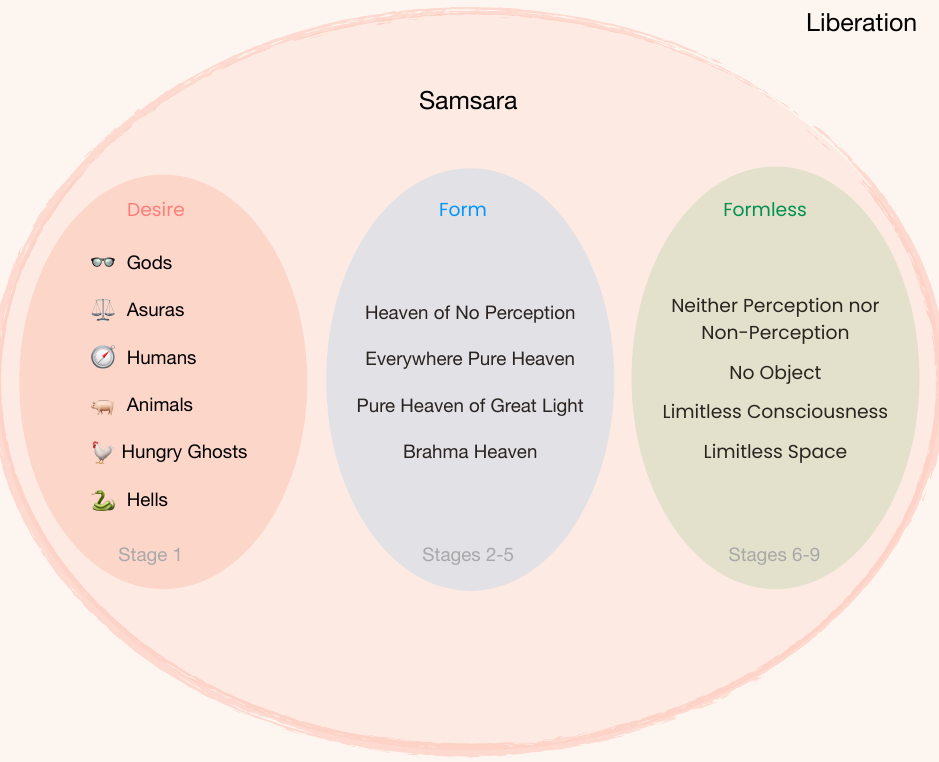
While we are still caught in our wrong perceptions, we can find ourselves in any of three realms, each subtler than the last. The desire realm is the world of ordinary sense experience, driven by wanting, aversion, and ignorance; we suffer here because we are always chasing things or running from them. The realm of form is subtler, reached through deep concentration: the coarse desires fall quiet, we suffer less, and we taste a small but real happiness — though a faint attachment to a separate self still lingers. The formless realm is subtler still: pure, boundless awareness with no sense of material form, where suffering remains only because wrong perceptions remain and old cravings lie dormant.
Each realm, Thầy stresses, is made by the shared consciousness of those who live in it, and all three can be touched right now, within us and around us. All three are samsara — the round of birth and death we keep turning in. Freedom is outside all three.
The nine stages
The one desire realm, plus four levels of form and four of the formless, make nine stages in all:
- The Realm of Desire — its six destinations: gods, asuras, and humans above; animals, hungry ghosts, and hell beings below. (the ground already behind us)
- Brahma Heaven — the first dhyāna
- The Pure Heaven of Great Light — the second dhyāna
- The Everywhere-Pure Heaven — the third dhyāna
- The Heaven of No-Perception — the fourth dhyāna
- The Realm of Limitless Space — first of the formless
- The Realm of Limitless Consciousness
- The Realm of No Object
- The Realm of No Perception and No Non-Perception
Stages two through five are the realm of form, and they are where we go next. (Dhyāna simply means deep meditative concentration.)
Concentration is the doorway
The realm of form is not a far-off place to be reborn into. It is a state of mind, and we reach it through concentration. Here is why concentration, of all things, is what carries us across.
The realms differ by how gathered the mind is. In the desire realm the mind never rests: it roams the senses, chasing the pleasant and fleeing the unpleasant, landing on one thing after another. Concentration is simply the opposite movement — drawing the mind back from that roaming and settling it on a single, quiet object, like the breath. So the moment the mind gathers and craving falls still, we have already stepped out of the desire realm. We have not gone anywhere. We have changed what the mind is doing.
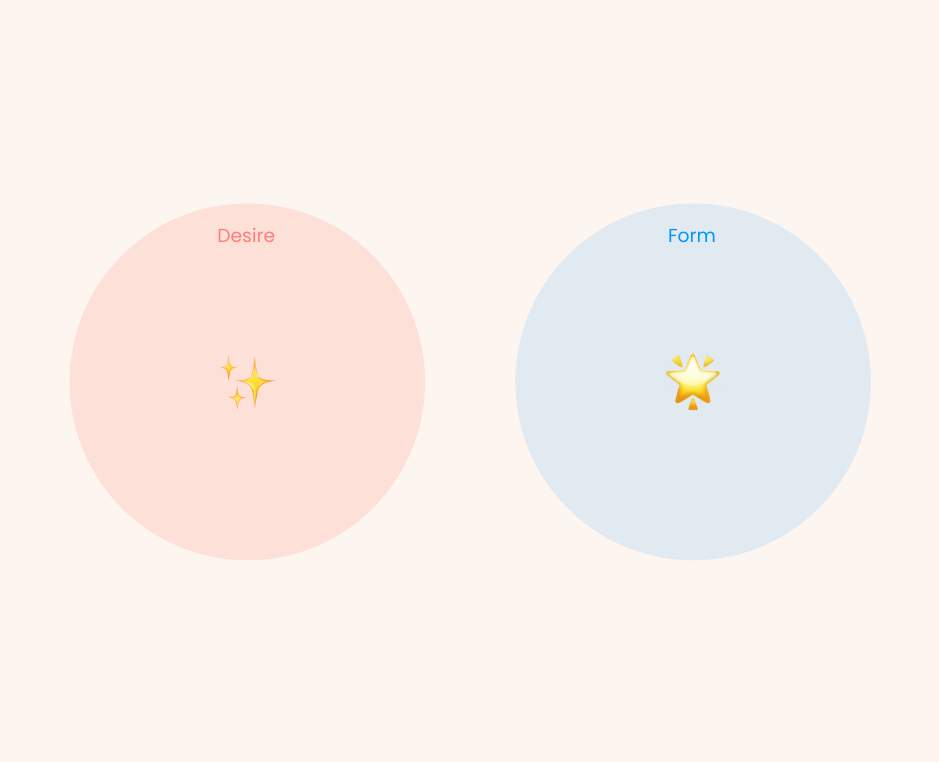
In fact, the realm of form simply is that gathered state. Its four levels are the four dhyānas — four depths of concentration. We do not enter them after concentrating; they are the concentration itself. Concentration is the vehicle the whole way up, and insight is what finally frees us from the realms altogether. (For how the four heavens line up one-to-one with the four dhyānas, see Going Deeper.)
This also shows what the five hindrances really cost us. They are often described as energies that keep us bound to the desire realm. They actually block concentration, the gathering of the mind. And since that gathering is the one way out, blocking it is exactly how they keep us stuck.
Quieting the five hindrances
Before the mind can gather and settle toward the first dhyāna, five familiar energies have to grow quiet: desire, aversion, drowsiness, restlessness, and doubt. Each clouds the mind and blocks concentration in its own way. (The five hindrances are not this book’s frame — the word does not appear in Understanding Our Mind at all. They are not foreign to Thầy either: they sit in the Discourse on the Four Establishments of Mindfulness, which he translated and taught from, where his own wording is sensual desire, anger, dullness and drowsiness, agitation and remorse, doubt. We use the plainer everyday names here, and the picture below is drawn to them.)
It helps to see them in three natural groups. Two pull and push: desire draws the mind toward what it wants; aversion shoves it away from what it cannot bear. Two throw off our energy: drowsiness is too little — the mind dull and sinking — and restlessness is too much — the mind agitated and scattering; concentration needs the middle, alert but settled. And one undercuts the wish itself: doubt, the wavering that drains our resolve before we even begin.
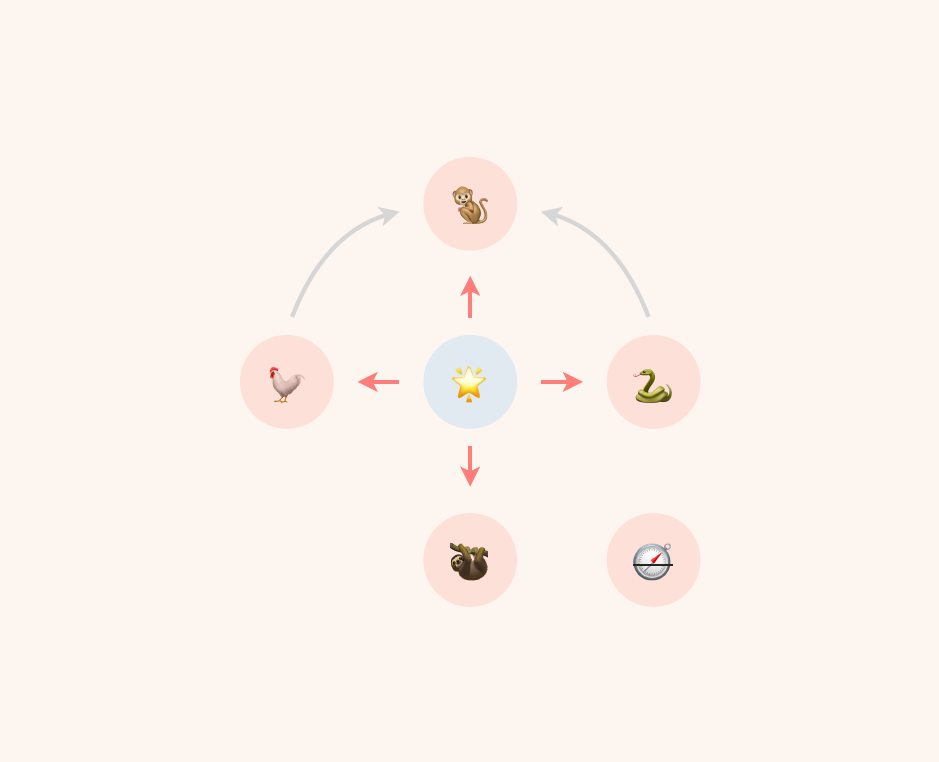
Two of these appear here for the first time as named mental formations — drowsiness and restlessness — and the crossing brings three more into view as well. Going Deeper defines the two that are new here, and sets out the two ways the hindrances undo concentration: scattering the mind, and letting it sink.
The full awareness of breathing
To quiet the hindrances and gather the mind, Thầy gives us a concrete practice: the Full Awareness of Breathing, the sixteen breathing exercises he unfolds in Breathe, You Are Alive!
The sixteen move through four areas in turn — the body, the feelings, the mind, and the objects of mind. We do not need all sixteen here; the first four are enough. Resting the attention on the breath and letting the body settle is itself the medicine: as the body calms, the hindrances quieten and the mind begins to gather.
The first tetrad
The first four exercises — the breath-and-body set — are the hindrances’ direct antidote:
- Breathing in a long breath, I know I am breathing in a long breath. Breathing out a long breath, I know I am breathing out a long breath.
- Breathing in a short breath, I know I am breathing in a short breath. Breathing out a short breath, I know I am breathing out a short breath.
- Breathing in, I am aware of my whole body. Breathing out, I am aware of my whole body.
- Breathing in, I calm my whole body. Breathing out, I calm my whole body.
Resting on the breath gives the mind one thing to hold, so desire has nothing to chase and aversion nothing to push against. Awareness of the whole body then works on the energy pair from both sides. It rouses a dull, sinking mind and gathers a scattered one, until the mind reaches the balance concentration needs: alert but settled. Calming the body releases the agitation that feeds restlessness. And the steady return to the breath, again and again, quietly builds the confidence that loosens doubt: we stop wondering whether the practice works, because we can feel it working.
As the hindrances fade, the joy and happiness of the first dhyāna arise on their own. We do not manufacture them. They are what is there once the noise dies down, and a bodily ease comes with them. (These four exercises bring us to the threshold. The joy and happiness that meet us there are the next two exercises in the sutra: Breathing in, I feel joyful and Breathing in, I feel happy.)
Thought gathered, not stopped
One misunderstanding sits right at the doorway: that concentration means switching thinking off. It does not. The gathered mind is not an empty mind — thought is present either way. What changes is not whether the mind thinks but how its thinking is arranged. The scattered mind keeps leaping: a thought here, another there, each landing on a new object. The gathered mind rests its thinking on a single object and stays. Entering the first dhyāna is the end of the leaping, not the end of thought.
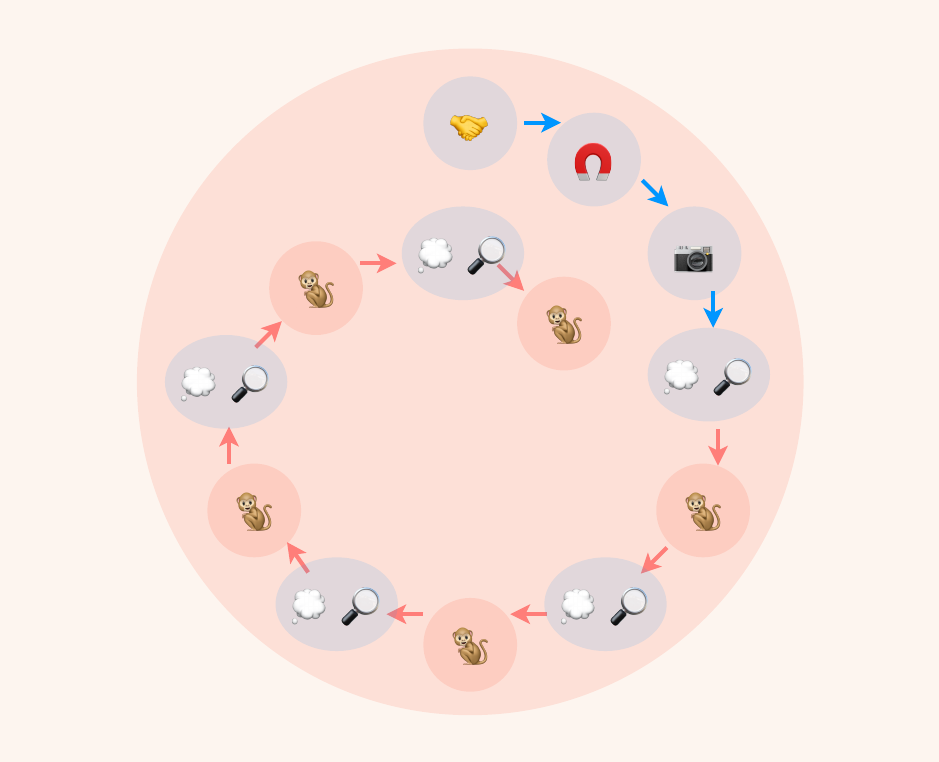
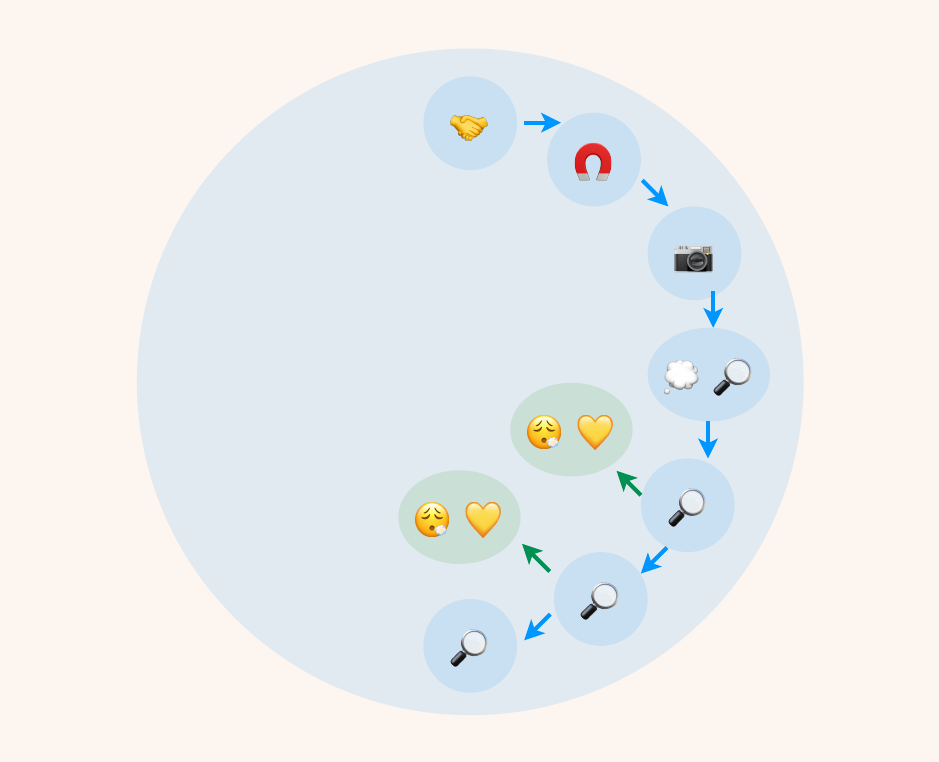
Later, on entering the second dhyāna, even this quiet, directed thought is released, and the thinking mind falls fully silent. For now we simply gather. The mind is not blank. It is resting wholeheartedly on one thing. (Going Deeper looks closer at the two small movements of thought that do the gathering — vitarka and vicāra — and at papañca, the runaway proliferation of thought that scatters us.)
What comes next
Here we reach the threshold and step into the first dhyāna: the hindrances quiet, the mind gathers, and joy and happiness arise on their own. The realm of form has three deeper levels. Each one opens when we let go of what brought us to the level before, not when we reach for more. That is where the next reflection takes up the path.
Contemplation Questions
When have you set something down — a craving, a wanting — and found, to your surprise, that you suffered less, that some ease arrived on its own?
Have you ever tasted the quiet happiness of a gathered, concentrated mind — in meditation, or in ordinary life: absorbed in work, in music, in a long walk?
What helps you “live simply and abandon some of your craving” — and what makes it hard?
And of the five hindrances — desire, aversion, drowsiness, restlessness, doubt — which one most often pulls you back into the desire realm?
Carry whichever of these stays with you — into your own quiet reflection, or into conversation with others.
Going Deeper
7 notes ·A few notes for anyone who wants to follow a thread further. Open whichever one interests you.
The five mental formations that surface here
Understanding Our Mind works through a list of fifty-one mental formations — the states and movements of mind the book names one by one, and which our own Inner Landscape lays out as a map. The crossing into the realm of form brings five of them into view for the first time. Two are hindrances we have just met:
- Drowsiness — a heaviness that sinks over the mind, draining its clarity and energy so it fogs and withdraws from its object, sliding toward sleep.
- Restlessness — the mind’s agitation: an unsettled energy that flits from one object to the next and cannot rest on any, the very opposite of the stillness concentration needs.
(Both belong to the group called the Eight Greater Secondary Unwholesome formations.)
Three more surface as we describe the crossing itself: Dispersion — the scattering of the mind, concentration’s direct mirror — and the two forms of directed thought met below, Initial Thought (vitarka) and Sustained Thought (vicāra). The other three hindrances — desire, aversion, and doubt — were named earlier in Verse 9.
The hindrances along two axes — scatter and sink
Seen together, the five hindrances undo concentration in two ways. Some scatter the mind: desire, aversion, and above all restlessness fling it across object after object. The pull of desire and the push of aversion don’t only distort the mind’s hold on its object — they stir it up and feed the restless agitation, so the three together scatter the mind. That scattering even has its own name among the fifty-one formations: dispersion (vikṣepa), the direct mirror of concentration. Others make the mind sink: drowsiness dulls and contracts it. (Doubt, meanwhile, saps the will to gather at all.) So concentration is undone from both sides — scattered or sunk. Quieting the hindrances stills both movements at once, and the mind, left to itself, gathers: dispersion gives way to concentration, its mirror.
This 2 + 2 + 1 grouping is a way of seeing the five, not a fixed doctrinal division — but it is well grounded. The tradition treats the two energy faults exactly this way, and teaches the seven factors of awakening as their remedy: three rousing factors for dullness, three calming factors for agitation, with mindfulness holding the balance.
Why the four heavens are the four dhyānas
The nine stages line up neatly, Brahma Heaven with the first dhyāna, the next heaven with the second, and so on, because the realm of form is made of concentration. Its four levels are the four dhyānas, four depths of the gathered mind. They are not realms we enter after concentrating; they are the concentration itself, named as heavens. To concentrate deeply enough that sensual craving drops away is, by definition, to be in the realm of form. And the same movement, refined further, carries on upward: the formless realm is reached when concentration releases even the subtle form. Concentration is the vehicle the whole way up; insight is what finally frees us from the realms altogether.
Vitarka and vicāra: placing and sustaining
We can watch the gathering happen in two small movements of thought. Vitarka, initial thought, places the mind on its object; vicāra, sustained thought, keeps it there. The old image is a bell: vitarka is the strike, vicāra the lingering ring. The whole difference between the scattered and the gathered mind is how this pair is arranged. The scattered mind strikes a new bell every moment — place, drop, place again — firing vitarka over and over onto fresh objects, and that endless re-striking is the proliferation of thought. The gathered mind strikes once and rests in the ringing: a single placing, then quiet sustaining on the one object. The two movements are the same. The arrangement is the opposite.
This is why concentration is a gathering and not a suppression: vitarka and vicāra are not thought’s enemies but the same faculty aimed rather than scattered. (In strict Abhidharma the two arise together in the first dhyāna and both fall away at the second; “strike once, then sustain” is the bell image for that, not a claim that one outlasts the other.)
A note on papañca
Throughout, we have spoken of the mind’s endless proliferation of thought. The tradition has a name for it: papañca (Sanskrit prapañca) — the runaway elaboration of a single perception into a branching tangle of thoughts, opinions, and stories about ourselves, each spinning off the last, until we are carried far from what is actually in front of us.
This is not Thầy’s word. In Understanding Our Mind he speaks plainly of the discursive mind, and of the Buddha’s own image of mind-consciousness as “a monkey, grasping this branch and that.” Papañca is the wider tradition’s technical term for the same thing, useful here to name precisely what the breath is quieting. It is at home in this text’s own school, though: in Yogācāra — the teaching of the brothers Asaṅga and Vasubandhu — the store consciousness carries the seeds of prapañca, and liberation is described as niṣprapañca, the going-out of proliferation.
Papañca is not the same as vitarka, the directed thought that concentration gathers; it is what vitarka becomes when it runs unchecked. The classic account (the Honeyball Sutta, MN 18) traces its arising: from contact comes feeling, from feeling perception, from perception thinking, and from thinking, proliferation — the very chain the first tetrad of breathing works back down, settling body and feelings so the proliferation has nothing to climb. Its deeper roots are three: craving, conceit, and views. Loosening them quiets papañca at its source; in the meantime, each return to the breath gathers it, one stream at a time.
The levels of thought
It helps to see all of this as one ladder. What we have been calling “thinking” is not a single thing but a whole range — from the most tangled activity down to the barest awareness — and the practice is a descent of its rungs.
At the top is proliferation — papañca — thought breeding thought, one perception snowballing into a branching tangle of stories and opinions. Beneath it is ordinary discursive thinking — vikalpa, the mind’s everyday work of naming, comparing, judging, planning — the raw material that proliferation runs away with. Quieter still is directed thought, the pair we met above: vitarka, initial thought, placing the mind on its object, and vicāra, sustained thought, keeping it there — still thinking, but a single stream held on one thing. This is as far down as the first dhyāna reaches.
Below directed thought the activity thins into something that is less thinking than simple presence. There is mindfulness — smṛti, Pali sati — the object held in awareness and recognised, with no commentary laid on top; then attention — manasikāra — the mind merely turning toward an object, the bare orienting before any elaboration; and at the base, bare knowing — vijñāna — awareness simply registering that something is present. When this knowing rests without construction — nirvikalpa — nothing at all is added, and the ladder has run out.
Two things are worth keeping straight. The rungs are a continuum, not a staircase with fixed steps: the mind slides up and down them constantly. And this blends two vocabularies — the meditation tradition’s (vitarka, vicāra, sati, manasikāra) and this book’s own Yogācāra language (vikalpa, papañca, and the mano-vijñāna where discursive thought runs) — the first laid alongside Thầy’s teaching as scaffolding, not his own frame. Two more faculties sit on a different axis, of quality rather than quantity: concentration is what carries the mind down the ladder, and insight is what the settled mind can then see. The dhyānas are simply this descent made deep — the first still holds directed thought; crossing into the second, vitarka and vicāra fall away and the discursive mind goes quiet, the very step this reading leads toward.
The beings of the form heavens
As the four form heavens rise, Thầy observes, their beings grow steadily more unified. In Brahma Heaven (the first dhyāna) their bodies differ but they think alike; in the Pure Heaven of Great Light (the second) their bodies are alike but their thinking differs; by the Everywhere-Pure Heaven (the third) they are alike in both body and mind; and in the Heaven of No-Perception (the fourth) perception is no longer accompanied by ideation. This is the same movement the whole reading has traced: as concentration deepens, the scattered many draw toward one.