09.21
Deeper by Letting Go
Letting go is what takes us deeper — we dwell in the first dhyāna’s gathered joy and happiness, then release thought and the second opens. Nothing is added; something is set down.
This page is our current understanding, written as we work through the book together — it changes as our understanding changes.
The Reading
Verse 9 reads:
All manifestations bear the marks of both the individual and the collective. The maturation of store consciousness functions in the same way in its participation in the different stages and realms of being.
The word to hold onto this time is stages. The four dhyānas are not four destinations stacked one above the other. They are four depths of a single ripening, the same store consciousness participating a little more quietly at each one. That is why the four dhyānas can be described as one movement rather than a sequence of arrivals.
The previous reading crossed a border. The six destinations of the desire realm were behind us, the five hindrances had grown quiet, the mind had gathered on the breath — and we arrived at the threshold of the first dhyāna, the first of the four levels that make up the realm of form. This reading crosses no border between realms. We stay inside the one we reached, and go further down into it.
Thầy’s own gate into this realm is a modest one, and worth keeping in view the whole way. “When we choose to live simply and abandon some of our craving,” he writes, “we are in the realm of form. In this realm we suffer less and can experience a little happiness.” That is not a feat of concentration. It is a setting-down, and what follows from it.
That sentence is the whole of this reading. The realm of form has four levels, and not one of them is reached by trying harder. Each opens when we let go of what carried us to the level before.
The Teaching
Concentration is the gateway
First, a short reminder, because everything here rests on it.
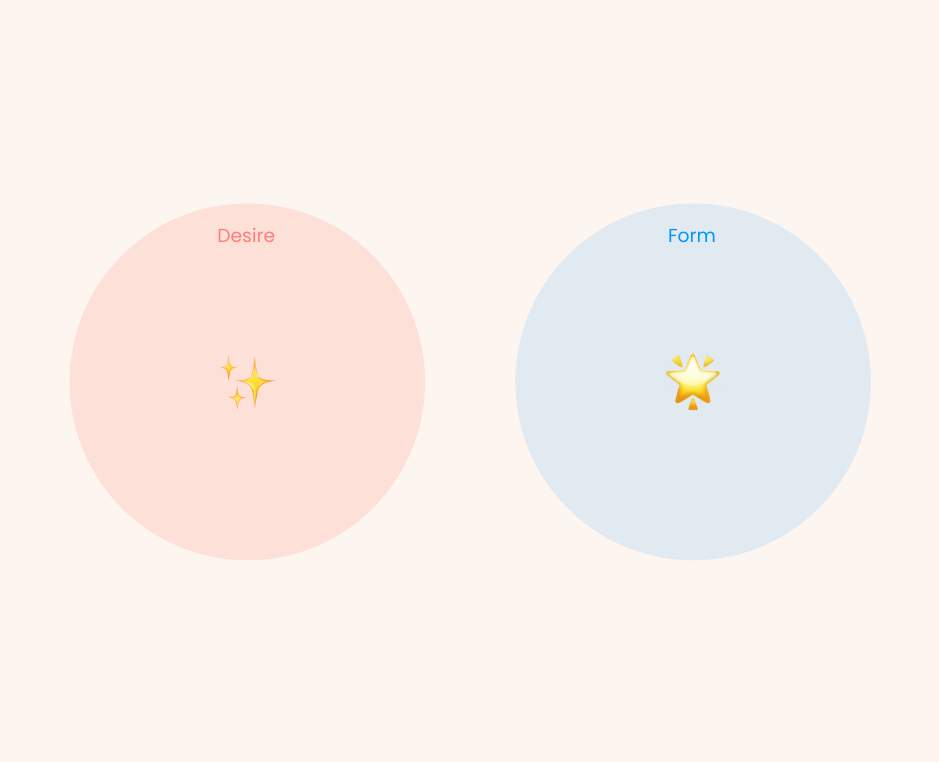
The three realms are states of mind. Where we find ourselves depends on what the mind is resting on, and on how gathered it is. The desire realm is the mind never resting — roaming the six senses, chasing what is pleasant, fleeing what is not. Concentration is simply the opposite movement: the mind gathering onto a single object, like the breath.
And the realm of form is that gathered state. Its four levels are the four dhyānas — not places we enter after concentrating, but the concentration itself, at four depths. So the moment the mind unifies and attachment falls quiet, we have already stepped out of the desire realm.
One thing from the previous reading is easy to mislay, so it is worth saying again: thought is not silenced at this door. It has simply stopped wandering.
There is a word for the gathering, and Thầy uses it: ekāgratā, one-pointedness, with his image of the mind as a swarm of bees that will only settle once the queen is there to settle around. The object comes first; the gathering forms around it. (That teaching sits far ahead of us, at Verse 27, and Going Deeper follows it properly.)
Four levels, one movement
The realm of form has four levels, each quieter and more gathered than the last. We do not reach them by trying harder, or concentrating more fiercely, or adding anything at all.
Each one opens as we let go — releasing the very thing that carried us to the one before. That is the whole movement, and it runs in one direction only: we go deeper not by reaching for more, but by setting down what we hold.
This reading goes as far as the second dhyāna, which is far enough to see the pattern. The next reading takes the rest.
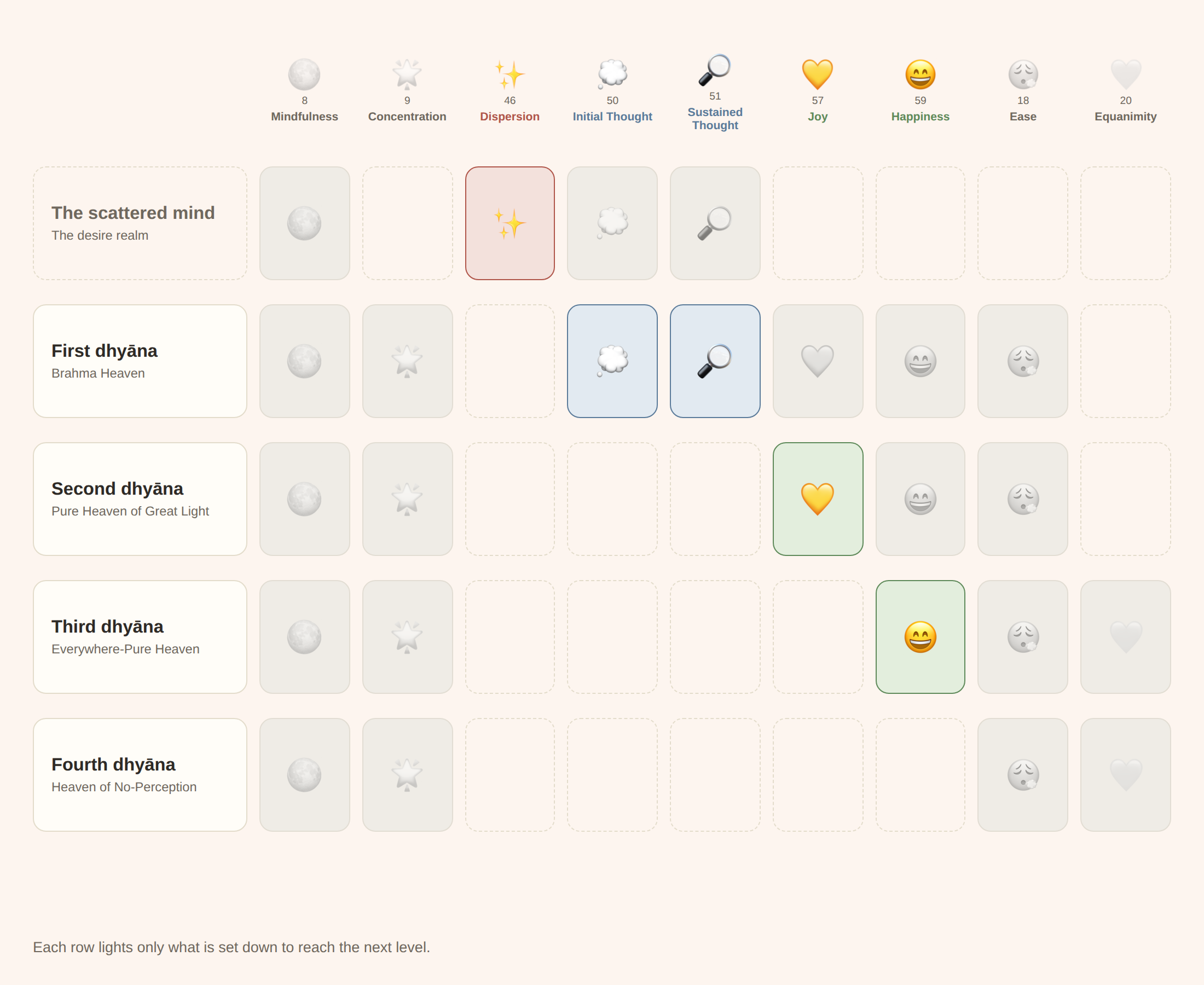
And it is worth saying at the outset, because the four levels can so easily read as a scoreboard: there is nothing to attain. Nothing here is a rank. Each level is simply what is left when something else has been released.
(The tidy scheme of factors present at the first level and released in sequence is an older tradition’s machinery rather than this book’s own — in Understanding Our Mind Thầy gives us the four heavens and does not run the analysis. We use it because it names precisely what falls away and what stays, the way the previous reading used the five hindrances, and we say whose it is.)
Gather thought — the first dhyāna
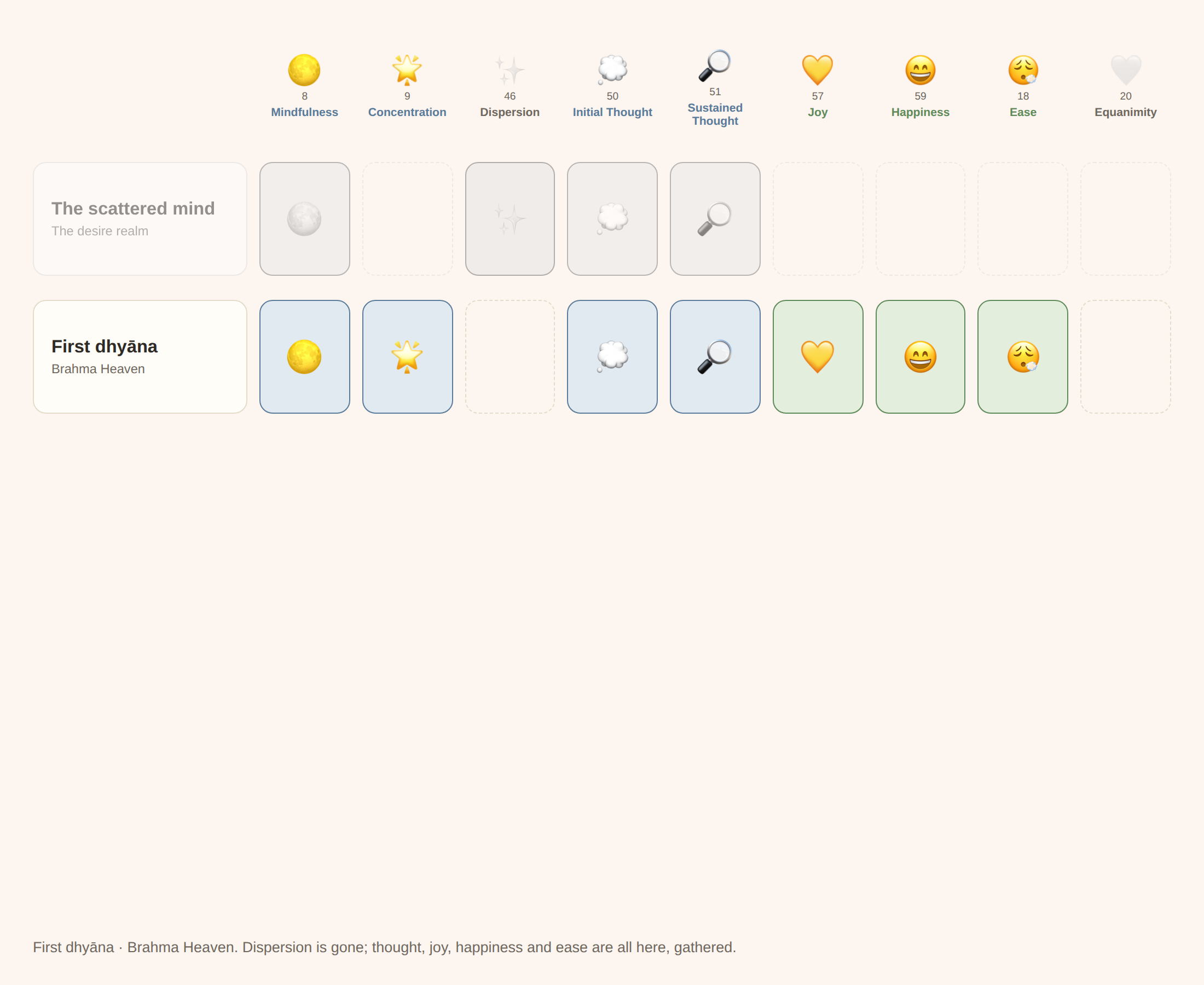
As the breath quiets the hindrances, the mind gathers and settles, and we have crossed into the first dhyāna: Brahma Heaven, the first level of the realm of form.
It is a gathered mind, but not yet a silent one. Thought is still present — placed gently on its one object, and resting there. We are concentrated, and still quietly thinking. (These are the two small movements the previous reading met: vitarka, which places the mind on its object, and vicāra, which keeps it there.)
Now notice what actually brought us here. We did not add anything. We let go of what was scattering us. Nothing produced the gathering. The hindrances stopped preventing it, and the mind, left to itself, gathered.
So the first dhyāna already shows this reading’s main point, one level before we state it. (The notes at the end explain why that is a precise claim and not a poetic one: dispersion is concentration’s mirror, and restlessness cannot be present in the same moment as a gathered mind.)
Joy and happiness arise on their own
Two things arise at this first level, and nobody asks for them:
- Joy — a quiet gladness, a lift in the heart.
- Happiness — a settled wellbeing that needs nothing added.
(Neither is among the classical fifty-one. Thầy added thirteen formations of his own to the list, and these are two of them.)
We do not manufacture them. They are what is there once the noise dies down, the natural feeling of a mind that has stopped grasping. At this level they come from leaving things behind: stepping back from wanting, setting the world’s demands down.
Ease comes in alongside them, body and mind no longer struggling. It is worth marking the difference now, because it pays off later: joy and happiness will both be set down as the levels deepen. Ease never is. It is still there at the fourth, after happiness itself has gone.
That is the surprising thing. We reached for nothing, and something arrived, because we set something down.
A taste of the first dhyāna
Most of us have already tasted a little of this, without ever calling it a dhyāna.
Washing the dishes, and for once only washing the dishes — the warm water, the weight of the bowl — with no running commentary underneath. A walk in the bush where, somewhere along the way, the arguing in the head goes quiet and there is just the path and the breath. Music you fall so far into that you forget to be a person listening to music.
These are already the realm of form — Thầy’s modest gate, met in an ordinary afternoon. Nothing was renounced; something was simply not being chased for a while, and a little happiness came in behind it.
They are not yet deep. The first dhyāna is this same movement — attachment easing, the mind gathering, joy and happiness arising on their own — only quieter, and lasting longer. The difference is degree of gathering, not a rule that says the senses have to be shut off before it counts. These everyday tastes are light and passing, but they are already the thing itself. What comes next is letting go a little more and letting it settle deeper on its own.
Release thought — the second dhyāna
Now we release the one thing still moving: thought itself.
The quiet placing and sustaining of the mind on its object falls away, and the inner talk goes silent. The joy and the happiness do not leave — but their source changes. In the first dhyāna they rose from stepping back, from what we had set down. Here they rise from the concentration itself. This happiness no longer depends on leaving anything behind. It comes from a gathered mind resting in its own depth.
Out of that stillness comes a settled clarity. Thầy’s name for this second level is the Pure Heaven of Great Light: “there is much light in this world” — the light is the heaven’s, in his telling, not a description of the mind.
Again, letting go is what took us deeper, and the happiness only grew.
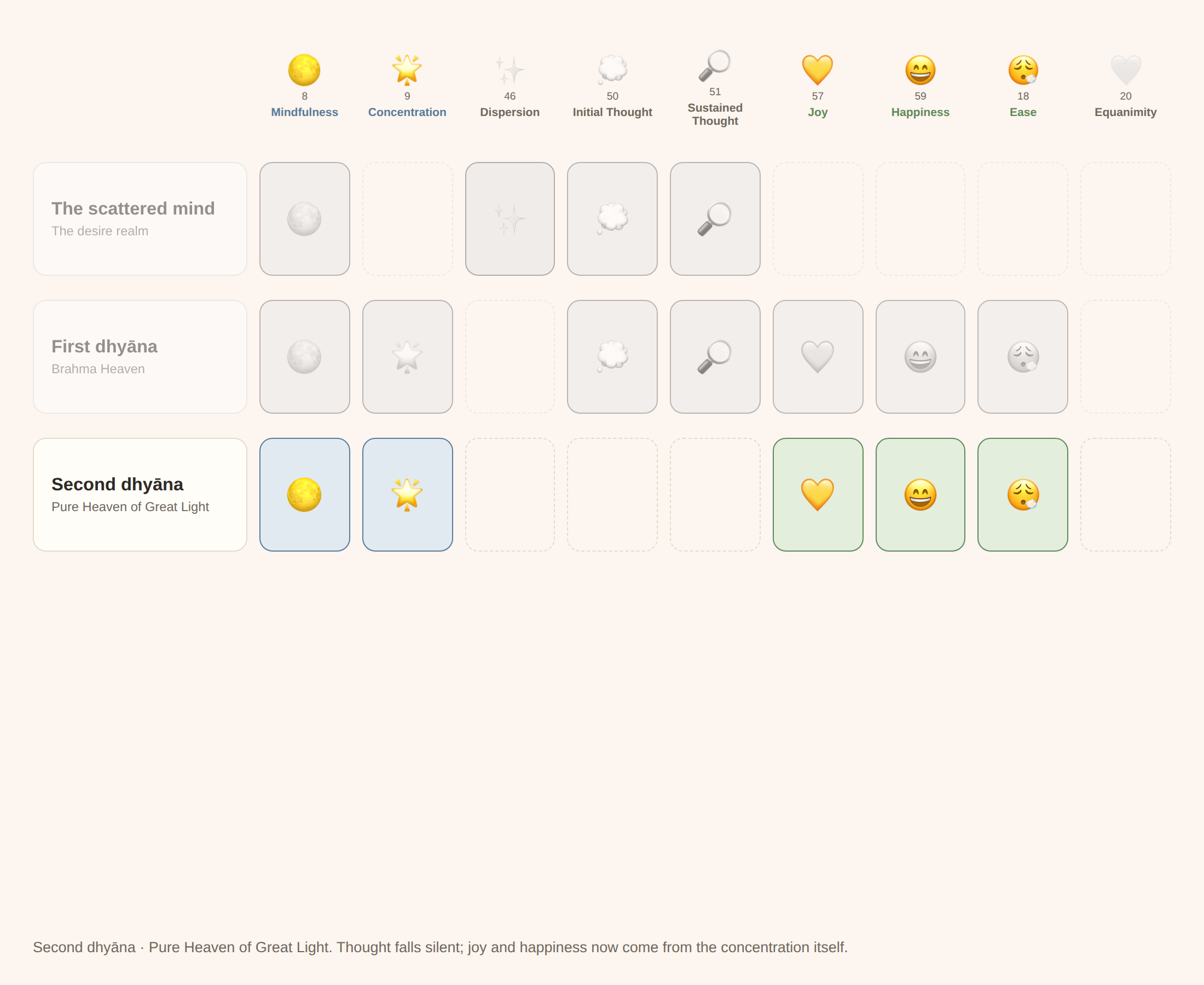
(The older tradition says something more precise about what arrives when thought goes — and its answer is faith, of all things: once the agitation of thinking stops, the mind runs clear and what is felt is confidence. Thầy says none of it, and our own list has no formation for inner clarity. Going Deeper sets out both, and why the table lights nothing new here.)
What comes next
Two more depths of stillness remain. Joy is released and the third level opens; happiness itself is released and the fourth. Each is the same move we have made twice already, and neither asks for anything to be added. That is where the next reflection takes up the path.
Contemplation Questions
When have you tasted the quiet happiness of a gathered mind — absorbed in work, in music, on a long walk?
What helps you live a little more simply and loosen some of your desires — and what makes it hard?
This reading says we go deeper by letting go. What is one thing you would have to set down?
Carry whichever of these stays with you — into your own quiet reflection, or into conversation with others.
Going Deeper
7 notes ·A few notes for anyone who wants to follow a thread further. The reading only says “the mind gathers”; these are the notes behind that phrase.
The word for it: ekāgratā
Every time we say “the mind gathers,” or “comes to rest on one thing,” we are naming something the tradition has a word for — and so does Thầy. He writes:
“In Buddhist meditation, we practice concentration, bringing everything into sharp, clear focus. This practice is called one-pointedness of mind (ekagrata). The object of our concentration — the queen bee around which our swarming thoughts can gather — may be our breathing, a leaf, a pebble, a flower…”
The image just before it is the one to keep: mind consciousness as a swarm of bees, “buzzing around wildly and not concentrating in any one spot. Only when the queen is present will all of them gather together.” So our plain phrasing is not a substitution for the technical term — the gathering is his own image for it.
This comes from Verse 27, “States of Mind,” which reads: “Mind consciousness operates in five ways — in cooperation with the five sense consciousnesses and independent of them, dispersed, concentrated, or unstably.” Notice that 09.20 already borrowed the dispersed half of that line, as dispersion, concentration’s direct mirror. The bees are the concentrated half of the same line. (Verse 27 is a long way ahead of us — this is a forward glance, not a verse we have reached.)
Gathering is concentration — not a step toward it
It is tempting to picture gathering as an early, weaker thing that ripens into concentration proper. In this school it is not. Concentration (samādhi) is defined as one-pointedness; the two words name one factor from outside and from inside. That is why concentration is present at every level of the form realm: it is not that concentration accompanies the gathering, it is that being gathered is what concentration is.
This is also where our text parts company with the Theravāda Abhidhamma, and the difference matters. There, one-pointedness is a universal — faintly present in every moment of mind, so it never really arises, it only strengthens. In this school, samādhi is one of the five particulars — the formations that come up only in relation to particular things. It arises under the right conditions and is otherwise simply absent. So in our reading the gathering genuinely begins; it is not a dial being turned up on something already running.
(A small caution on words: it is tempting to call one-pointedness the “seed” of concentration. Better not — bīja, seed, is doing specific work elsewhere in this book, in the store consciousness.)
What has to be there first: mindfulness
If anything precedes the gathering, it is mindfulness. Thầy says so on the same page as the bees: “The stronger and the clearer our mindfulness, the more stable our concentration. Mindfulness always brings about concentration.”
So the two formations that carry through all four dhyānas are not merely a pair of constants — they stand in order. Mindfulness holds the object in view; the gathering forms around it. And there has to be an object: bees do not gather without a queen, which is why the breath is given to us first, before anything is said about depth.
Why it arises by removal, not by effort
Gathering is not manufactured. It is what the mind does when nothing is scattering it.
The formations make this a precise claim rather than a poetic one. Dispersion is concentration’s exact mirror — where one gathers the mind onto a single object, the other flings it across many. And restlessness simply cannot be present at the same time as concentration; they are mutually exclusive. So quieting the hindrances does not cause the gathering. It stops preventing it. As 09.20 put it: still both movements — the scattering and the sinking — and the mind, left to itself, gathers.
So the first dhyāna already shows the whole point of this reading, one level before we state it. We do not add concentration in order to cross into the realm of form. We set down what disperses, and find that we have crossed. Releasing thought to open the second dhyāna is the same move again, one turn deeper.
The three that work together — and the one that never leaves
At the first level, three things are in play: vitarka places the mind on its object, vicāra keeps it there, and the one-pointedness is the unification they hold in place. They arise together and support each other; it is not that the two movements manufacture the third and hand it over. They are one event described two ways — what the gathering does, and what being gathered is.
And the touch is lighter than “holding” suggests. The old similes: vitarka is the bee flying to the flower, or the bell being struck; vicāra is the bee hovering there, or the sound ringing on — or a bird, wings beating to take off, then gliding with wings still. By this level the hindrances have already settled, restlessness among them, so nothing needs to be gripped: the mind rests on one thing rather than being made to stay. (These similes are Visuddhimagga commentary, not the book’s own — scaffolding, useful for precision, not to be attributed to Thầy.)
Then, level by level, everything else is set down. Thought is released and the second opens — and the tradition marks the deepening exactly there, naming the second dhyāna’s unification of mind (ekodibhāva) only once applied and sustained thought have stilled. Joy is released entering the third, happiness entering the fourth. The one-pointedness is never released. It only grows purer as the rest falls away.
The classical formula for the deepest level names three: equanimity, mindfulness made pure, and one-pointedness — upekṣā-smṛti-pariśuddhi, purity of mindfulness due to equanimity. Our own table shows four, because it also keeps ease, which is never released at any level. It is the same picture with one more column.
One boundary worth marking: the tidy scheme of five factors present at the first dhyāna, released in sequence, is Theravāda Abhidhamma and Visuddhimagga systematisation, not this book’s own machinery. Thầy gives us ekagrata at Verse 27 and the four heavens in Chapter 9, and he does not run the five-factor analysis anywhere in this book. In the discourses themselves, unification is named explicitly only from the second dhyāna onward. We use the scheme because it names precisely what falls away and what stays — the same way 09.20 used the five hindrances — and we say whose it is. (In another of his books he does describe these levels, and differently; that is the last note at the end of the next reading, Everywhere Pure.)
What arrives when thought goes
We describe the second dhyāna by what leaves: the placing and sustaining of the mind on its object fall away, and the inner talk stops. But the older tradition also names something that arrives in the space that leaving makes — and it is not what most people would guess.
The discourses describe the second dhyāna as having “inner clarity and unification of mind” (ajjhattaṁ sampasādanaṁ, cetaso ekodibhāvaṁ) — two things said of it that were not said of the first. Vasubandhu, whose verses we are reading, is more specific. In the Abhidharmakośa he lists the second dhyāna’s factors as inner clarity, joy, happiness and one-pointedness, and then identifies the first of them outright: śraddhā prasādaḥ — “purity is faith.” Once the agitation of thinking stops, he says, the mind-stream runs clear, and what appears is confidence — the confidence of someone who can now see for themselves that the noisier level really can be set down.
So the deepening is not only subtraction. Something clarifies. Faith — which the Inner Landscape defines as “confidence and trust that rest on understanding” — is, on this reading, the second dhyāna’s own flavour.
Two things need to be held alongside that.
The first is that Thầy does not say any of it here. He runs no factor analysis of the dhyānas in this book: prīti — joy as a factor of a level — does not appear in Understanding Our Mind at all, and sukha appears only far away at Verse 47, nowhere near the four levels. His four dhyānas are four heavens, described from outside. Of this one he says only: “The Pure Heaven of Great Light. This is the second level of the realm of form… There is much light in this world. The bodies of the beings of this world here are alike but their way of thinking differs.” The light belongs to the heaven in his telling — it is a name for the place, not for an inner clarity.
The second is that this is scaffolding, like the five hindrances in 09.20 and the five-factor scheme above — borrowed machinery, useful because it names things precisely, and not to be attributed to the book.
It is also why the release table lights nothing new at the second level. There is no formation in the fifty-one for inner clarity; the nearest is faith, which is not one of the columns and is nowhere tied to the dhyānas. Showing an empty gain there is the honest reading of our list, even where the classical list would fill it.
Ease and happiness — not one becoming the other
Once the fruits start being set down, a fair question arises: is ease (praśrabdhi) an earlier form of happiness (sukha)? Does one turn into the other as the dhyānas deepen?
The tradition gives two answers, and they disagree — but not in a way that matters for us.
In the discourses they are distinct, and they stand in order. The sequence runs confidence, gladness, joy, ease, happiness, concentration — saddhā → pāmojja → pīti → passaddhi → sukha → samādhi. Ease comes first and conditions happiness. Calm settles; wellbeing follows from the calm. Nothing turns into anything.
Vasubandhu gives the other answer. In the same passage that makes inner clarity into faith, he writes praśrabdhiḥ sukham ādyayoḥ — in the first two dhyānas, the “happiness” is ease. It is not a precursor to it. It is the same thing under a second name.
Both agree on the point that matters. Ease is never one of the things released. It belongs among the factors present in any wholesome state of mind, so it is still there in the fourth dhyāna, after happiness itself has been set down — which is exactly why it cannot be a cell that goes dark. What the fourth level releases is happiness as a factor of that level, not tranquillity as such.
That is why the table lights happiness and leaves ease out of the sequence altogether. That is not because ease and happiness are different kinds of thing, which Vasubandhu would dispute. It is because ease never enters the sequence in the first place.
Ease does have a column of its own on the tables, sitting between happiness and equanimity: blank in the scattered mind, since agitation and ease cannot be present at once, and there from the first dhyāna onward. It is simply never lit as a release. That is rather the point of giving it a column — on the tables that show what is present at each level you can watch it arrive with the first dhyāna and still be standing at the fourth, after happiness itself has gone dark. (One caveat, for the first two levels only: on Vasubandhu’s reading the ease cell and the happiness cell there are the same fact shown twice. We keep both, because Thầy’s fifty-one number them separately.)