09.22
Everywhere Pure
The third dhyāna — we let go of joy itself, and what is left is not a thinner joy. It is the thing joy had been standing in front of.
This page is our current understanding, written as we work through the book together — it changes as our understanding changes.
The Reading
Verse 9 reads:
All manifestations bear the marks of both the individual and the collective. The maturation of store consciousness functions in the same way in its participation in the different stages and realms of being.
The previous reading stayed inside the realm of form and went one level further down into it — resting in the first dhyāna, then letting go of thought so the second could open. This reading does the same thing once more, with one surprise: this time we let go of something that is not a fault. We let go of joy.
That is worth pausing on before we start, because it changes what kind of teaching this is. Up to this point, everything set down has been something we were better off without: craving, anger, restlessness, the mind’s endless commentary. From here on, what we release is good. Joy is a wholesome state. Nothing is wrong with it. And still it is what stands between us and something quieter.
Thầy’s gate into this realm remains the modest one: “When we choose to live simply and abandon some of our craving, we are in the realm of form.” That is not a feat of concentration. It is a setting-down, and what follows from it.
The Teaching
The two that brought us here
Before going deeper, it is worth naming what carried us across the border in the first place, because it is easy to confuse it with what happens next.
Thầy’s own sentence about the crossing describes a mental formation we have already met. To abandon some of our craving is non-attachment — not merely the absence of greed, but a warm, positive movement toward contentment and sharing. Beside it stands non-aversion, goodwill in place of pushing away. The desire realm, in Thầy’s description, is where we touch craving, anger, arrogance and delusion; those two formations are the direct antidotes to the first two.
So the crossing out of the desire realm is their work. What happens inside the realm of form is different work. From the first dhyāna onward, what is released at each step is not an affliction at all. It is thought, then joy, then happiness. Each of them is harmless, and each of them is simply in the way of what lies beneath it.
Holding those two apart keeps this reading from sounding like more renunciation. There is a fuller note on it at the end.
What gathering is
The mind scatters on its own. Thầy calls this dispersion, and he is blunt about how much of our life it accounts for: “We live in dispersion and forgetfulness much of the time… caught by the past and future, running in every direction.”
Dispersion is one of the fifty-one mental formations, and it is concentration’s exact opposite. Concentration gathers the mind onto one thing; dispersion spreads it across many. The two cannot be present in the same moment, which is why removing one is the same act as arriving at the other.
The gathering has a name — one-pointedness, ekāgratā — and Thầy gives us his image for it: mind consciousness as a swarm of bees, “buzzing around wildly and not concentrating in any one spot. Only when the queen is present will all of them gather together.” The queen is not a metaphor left hanging. He says what she is: “the object of our concentration… may be our breathing, a leaf, a pebble, a flower.”
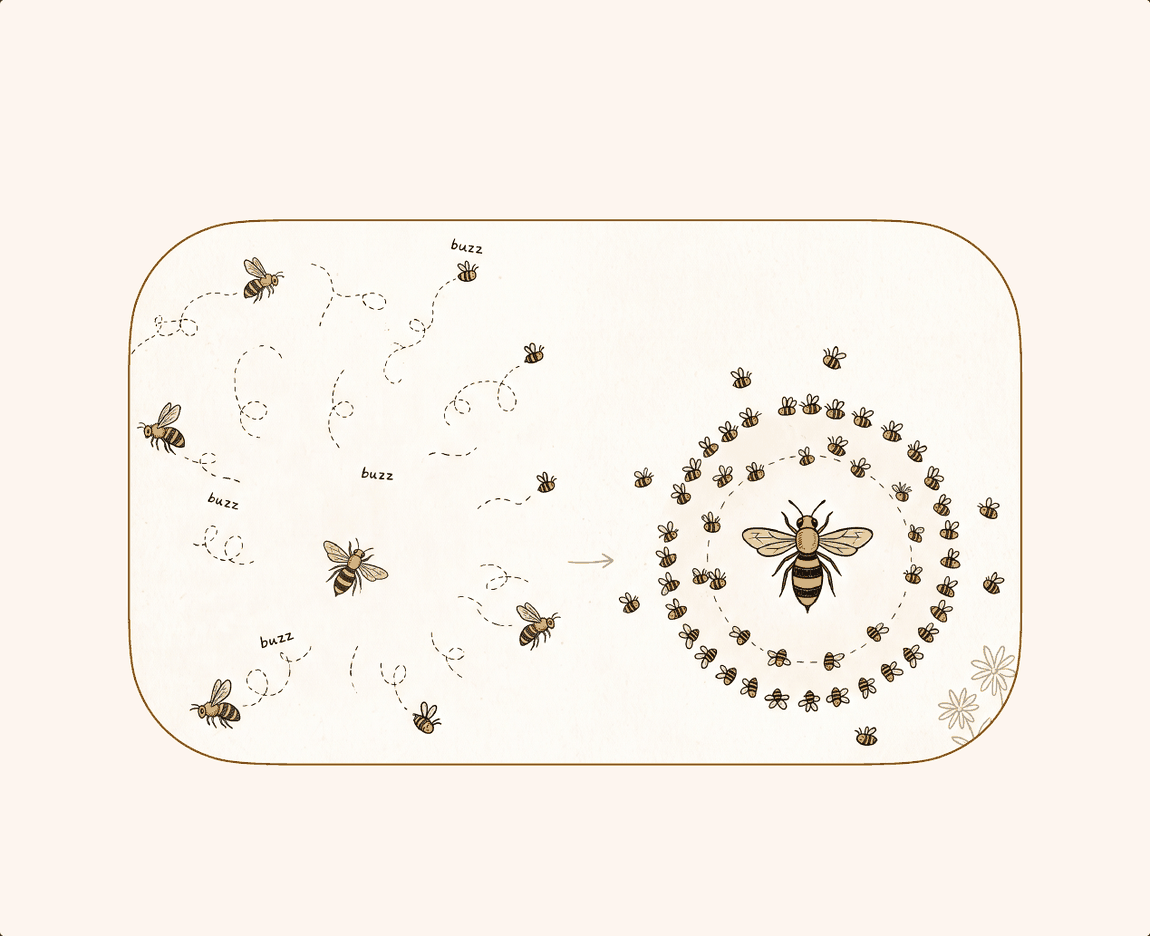
So there is something for us to do, and Thầy is not vague about it. He speaks of methods, of effort, of a lens focusing sunlight until it burns, of sitting meditation as work we make an effort at. But notice what the effort is for. It is not there to manufacture stillness. It is there to stop the scattering. The bees are not persuaded into formation; they settle because the queen is there and nothing is driving them apart.
And this is the one thing we never let go of. Thought is set down, then joy, then happiness — but the gathering stays, and it grows clearer as everything else falls away.
(This teaching sits at Verse 27, “States of Mind,” a long way ahead of where we are. We borrow it because we need it now. The step-by-step account of what is released at each level is borrowed too, from an older tradition’s machinery — the same way 09.20 borrowed the five hindrances. Where it comes from, and what Thầy himself says about it, is the last note at the end of this reading.)
The third dhyāna — Everywhere-Pure Heaven
Two depths of stillness remain, and each opens the same way: we let go of what brought us to the level before.
Here we let go of joy. It served us well. But joy has a lift to it, an excitement that still moves the mind, and it turns out that the mind can be quieter than joy allows. So we let that go too.
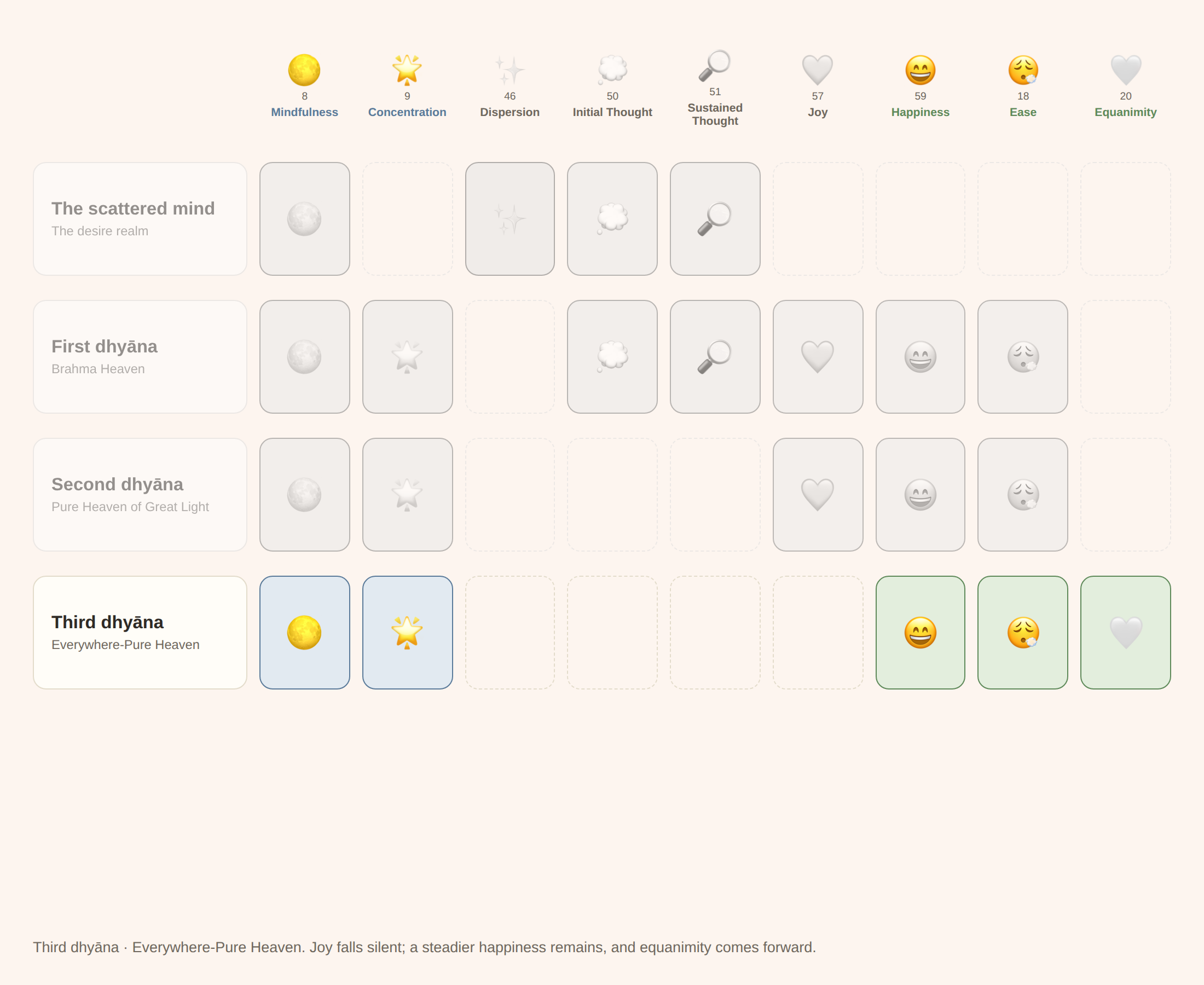
What takes its place is a quieter happiness — not the brightness of joy, but a deep, even steadiness, with equanimity and quiet mindfulness alongside it. The mind is no longer stirred. It is simply calm.
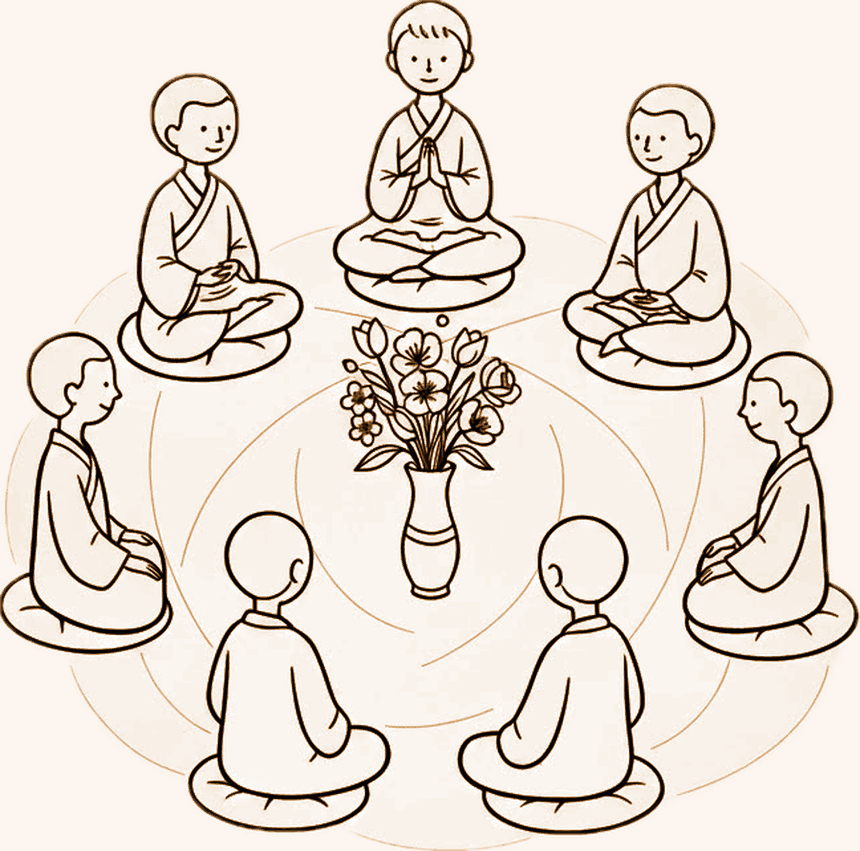
Thầy’s own description is short: “The Everywhere-Pure Heaven. This is the third level of the realm of form… it is very peaceful and pure. The beings who live here are exactly alike in body and mind.”
Not a state you reach alone
That last phrase — exactly alike in body and mind — is a description of a group, and it is not incidental. Every one of Thầy’s four dhyānas is described this way: as a heaven with inhabitants, never as an experience one person has. And a few lines later he says plainly what the whole scheme rests on: “The three realms and the nine stages are present because of the cooperation of the consciousnesses of many people.” His example is the community he lives in.
This can sound at first like a change of subject — as though the realms had stopped being states of mind and become external circumstances instead. They have not. The collective is still consciousness. It is simply more than one mind’s worth of it. That is exactly what our verse says: all manifestations bear the marks of both the individual and the collective. A quieter life is easier to live among people who are living one, and harder among people who are not. That is not a sociological observation. It is what the verse says.
What arrives as joy leaves
The old discourses describe this level in a set phrase: with the fading of joy, we rest in equanimity, mindful and clearly aware. Three qualities come forward as one departs.
Our own map can show two of them. Equanimity arrives here for the first time, and mindfulness has been steady all along. For the third — clear awareness — the fifty-one have no entry at all. They carry only its opposite, Lack of Discernment, for when it is missing. So the table shows one arrival where the phrase names three, and that is a difference between two lists rather than a disagreement about the teaching.
Either way, the point survives: this is not only a subtraction. We put one thing down, and the ground underneath turns out to be steadier than what we let go of.
A taste of the third dhyāna
We have already lived a little of this. It was not a rehearsal for the third dhyāna. It was the same movement, in a light and passing form.
After the guests have gone. The house was full all day; now the door is closed, the dishes are stacked, and you sit down in the quiet. The buzz has drained out of the room, and what’s left isn’t a let-down — you’re content, and nothing needs to happen next.

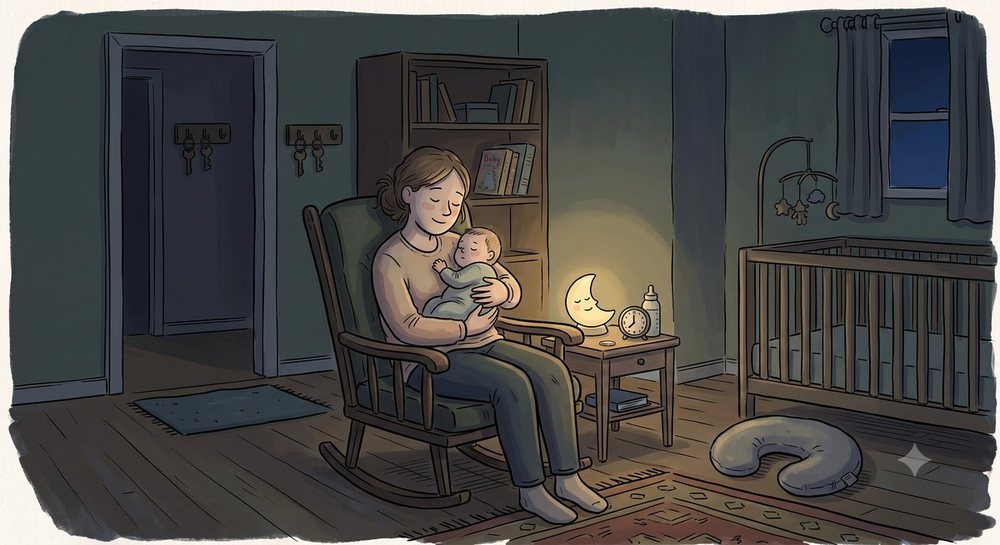
Holding a sleeping baby. The excitement passed hours ago. The room is dark, she is heavy and warm, and you’re happy just to sit there. You don’t want anything else.
Love that has been around a long time. Early on it had a flutter, a charge. That went years ago. What replaced it doesn’t sparkle, and you wouldn’t trade it back.
A sangha that has sat together for years. At the start it was exciting — a new group, a new practice, the energy of beginning. That wore off a long time ago. What’s here on a Tuesday night is quieter, and nobody would call it thrilling — but nobody wants the old days back either. Thầy’s name for this level is Everywhere-Pure.
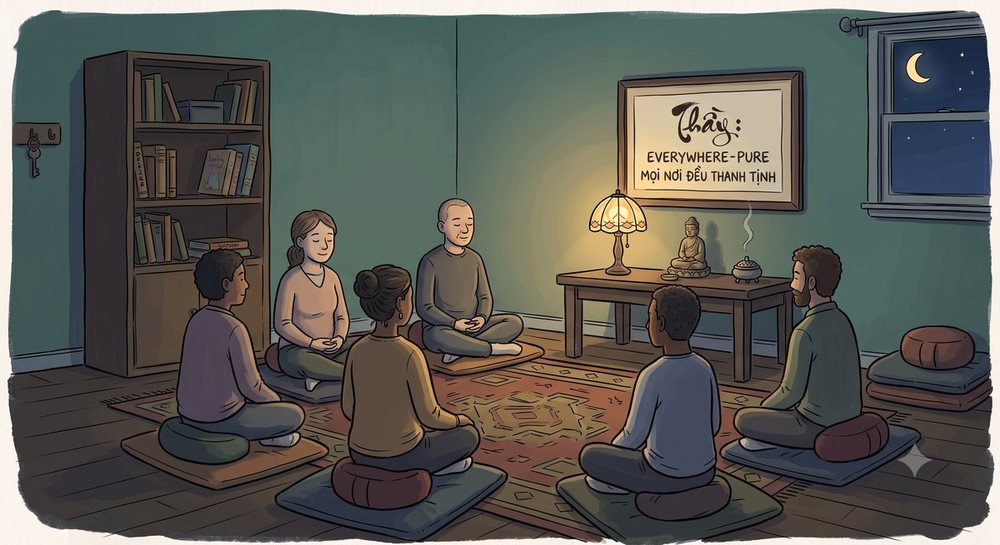
A life you have simplified. Fewer things, fewer plans, less to keep track of. The relief of first letting go has faded; what remains is plain and steady.
Each time, something bright left, and what stayed was quieter and better. That is the movement the third dhyāna is made of. The quiet that remains is not a thinner joy. It is the thing joy had been standing in front of.
One limit: Thầy describes the realm of form as a way of living, so these examples fit the realm as a whole. He never gives an everyday marker for the third level specifically. So the claim here is about the movement, not about the level — a quiet Tuesday night is not the third dhyāna.
What comes next
One dhyāna remains. The next reading releases happiness itself, comes to the stillest level of the realm of form, and finds that it is still samsara, because what frees us is insight, not the depth of the stillness.
Contemplation Questions
Where in your life have you found that letting go of something opened more peace than holding on ever did?
The dhyānas come to rest in equanimity, not in pleasure. What does equanimity feel like to you, and how is it different from indifference?
Thầy says every realm is made by the collective consciousness of the people who live in it. What are you and the people around you making together?
Carry whichever of these stays with you — into your own quiet reflection, or into conversation with others.
Going Deeper
3 notes ·A few notes for anyone who wants to follow a thread further.
Isn’t letting go of joy just non-attachment?
The answer is no, though the two look identical from outside, because the gesture is the same.
Non-attachment is one of the eleven wholesome formations. What it releases is something that was doing us harm: grasping, craving, the reaching after what cannot satisfy. Its companion non-aversion does the same for the pushing-away. Between them they answer the two dominant marks of the desire realm — craving and anger — which is precisely why Thầy can describe the crossing into the realm of form as choosing to live simply and abandoning some of our craving. That sentence describes non-attachment in everyday words.
What the third dhyāna releases is joy. Joy is wholesome. Nothing is wrong with it. It is not a defilement being cleared, an affliction being answered, or a habit being unlearned — it is a good thing that turns out to be quietly in the way of a better one. The same is true of the happiness released at the fourth level, and of the thought released at the second.
So the gesture is the same and the object is different. And the difference matters for how the whole arc reads. If letting go of joy were non-attachment doing its usual work, the dhyānas would be a purification — a ladder of getting rid of faults, with the pure at the top. They are not. From the moment we cross the border, nothing being set down is a fault, and there is no summit being approached. That is the difference between this and renunciation, and it is why the next reading can be called Nothing to Attain without it sounding like a slogan.
There is also a technical reason non-attachment and non-aversion never appear in the release sequence at all. In the older analysis they belong to the group of factors present in every wholesome state of mind. If a state is wholesome, they are there. So they are present in all four dhyānas and are never let go of — which puts them in the same position as ease, present from the first dhyāna and still standing at the fourth after happiness has gone dark. They are not steps on the way down. They are part of the ground the whole way.
The three qualities, and the one our list has no word for
The phrase quoted above is not a modern gloss. With the fading away of joy, the discourses say, one dwells equanimous, mindful and clearly aware — upekṣaka, smṛtimān, saṃprajānan. It is the stock formula for the third dhyāna, and it appears in the Pali discourses and in the Sanskrit and Chinese Āgamas alike. Vasubandhu’s Abhidharmakośa tabulates it into a tidy list of factors, but it does not invent it. (It is worth knowing whose book that is: Vasubandhu wrote the Kośa before he came over to Yogācāra with his brother Asaṅga, so when we quote it we are quoting the same author whose Thirty Verses Thầy’s Fifty extend, at an earlier stage of his thinking.)
Two of the three sit on our map. Mindfulness (smṛti) is one of the five particulars, present long before the dhyānas begin. Equanimity (upekṣā) is one of the eleven wholesome, and arrives here.
The third does not. There is no positive formation in the fifty-one for clear awareness — saṃprajanya. What the list carries is its absence: Lack of Discernment (asaṃprajanya), the haze of acting without a clear sense of what we are doing. So the table lights one arrival where the phrase names three, and the honest thing is to say so rather than quietly add a column. This is the second time the same situation has come up: at the second dhyāna the older analysis names inner clarity arriving, and the fifty-one have no formation for that either, so the table lights nothing new there too. In both cases we show our own list faithfully and name what it cannot show.
Where the four levels come from, and what Thầy says about them
These readings lean on an account of the dhyānas that Understanding Our Mind does not give, so it is worth setting out where it comes from. The other readings point back here rather than repeat it.
What is in this book. Four heavens, described from outside, in a flat list of nine stages — plus the collective gloss that follows it, and the way-of-living framing in Chapter 3. That is all. He does not say what is present at each level, or what is set down between them. Prīti — joy as a factor of a dhyāna — does not appear in the book; sukha appears twice, far away at Verse 47, and neither it nor “equanimity” ever falls within reach of the four levels.
What is ours. The step-by-step account we have been following — thought released at the second level, joy at the third, happiness at the fourth — comes from the discourses and from the schools that organised them into a scheme. So does the tidy list of five factors present at the first level, and the listing of one-pointedness among them. So do the five hindrances of 09.20. We use it because it names precisely what falls away and what stays, and because the movement it makes visible is one Thầy teaches everywhere in his own voice.
What he says in his other books. He is not silent about the dhyānas outside this one, and what he says there does not match our table. In The Heart of the Buddha’s Teaching he describes the same four levels, and the qualities grow:
“In the form realm, there are four levels of dhyana. Mindfulness, concentration, joy, happiness, peace, and equanimity continue to grow through these four levels.”
Read plainly, that is the opposite of a release sequence. In the same chapter he describes the four formless levels at length, with a reason for each.
And he has a view about where the whole map came from. In Awakening of the Heart, and again in Breathe, You Are Alive!, he makes the case that the four dhyānas and the four formless concentrations are not the Buddha’s own teaching. They appear nowhere in the two sutras he treats as the foundation of meditation practice — the Full Awareness of Breathing and the Four Establishments of Mindfulness. Before his awakening the Buddha learned the formless concentrations from two teachers, “practiced [them] with great success,” then abandoned them, saying they did not lead to freedom from suffering. Thầy’s conclusion:
“…from my research, it seems to me that the Four Jhanas, the Four Formless Concentrations, and the Nine Concentration Attainments were not introduced into Buddhism as Buddhist practices until one hundred years after the Buddha’s passing.”
Just before that sentence he says how he thinks they came in: they “became a part of Buddhist practice after the death of the Buddha, probably due to the influence of the Vedic and other Yogic meditation schools outside of Buddhism.”
And two pages earlier in the same appendix is the sentence that keeps this from becoming a dismissal:
“We need not criticize them for being later teachings, certainly not before we have practiced them and seen for ourselves if they work well.”
So how do we hold these five readings? They are not a report on something the Buddha taught, and they are not a summary of this book. What we have been walking is a map drawn later, which Thầy knows well, describes accurately, and does not treat as essential. It is still worth walking, for the reason he gives — it makes visible a movement that is real, and that he teaches everywhere: we get quieter by putting things down, not by getting hold of them. But where the map and the book differ, the book is what we are studying. And where the map and Thầy differ — as they do about whether joy and happiness grow or are set down — we say so and leave both standing, rather than quietly choosing one.