09.23
Nothing to Attain
The fourth dhyāna — even the quiet happiness is set down, and the mind comes to rest in equanimity. The stillest level of the realm of form, and still samsara: what frees us is insight, not the depth of the stillness.
This page is our current understanding, written as we work through the book together — it changes as our understanding changes.
The Reading
Verse 9 reads:
All manifestations bear the marks of both the individual and the collective. The maturation of store consciousness functions in the same way in its participation in the different stages and realms of being.
In the previous reading we let go of joy, and the third dhyāna opened. One thing is still here: the quiet happiness that arrived when joy left. This reading puts that down too, and that is the fourth level — the last one in the realm of form.
Then the reading turns and does what the previous three have been building toward. After four readings going deeper into stillness, it says plainly that stillness is not freedom. The stillest level of the realm of form is still inside the cycle. What gets us out is not a further depth of quiet. It is seeing clearly. Once that is said, the title of this reading stops being a paradox and becomes a description: there was never anything to attain, and every level opened only because something was set down.
The Teaching
The last thing we are carrying
At the third level, joy was released and a quieter happiness remained. Now that goes too — and with it the last stirring of pleasant and unpleasant feeling.
Four things stay. The first is equanimity, which arrived at the third level and is now unmixed. The second is ease, which has been present since the first dhyāna and is never let go of at any point. The third is mindfulness, which has been steady the whole way. The fourth is concentration, the gathering itself, which arose at the crossing and has carried us since.
The mind is even. Nothing lifts it and nothing weighs on it.
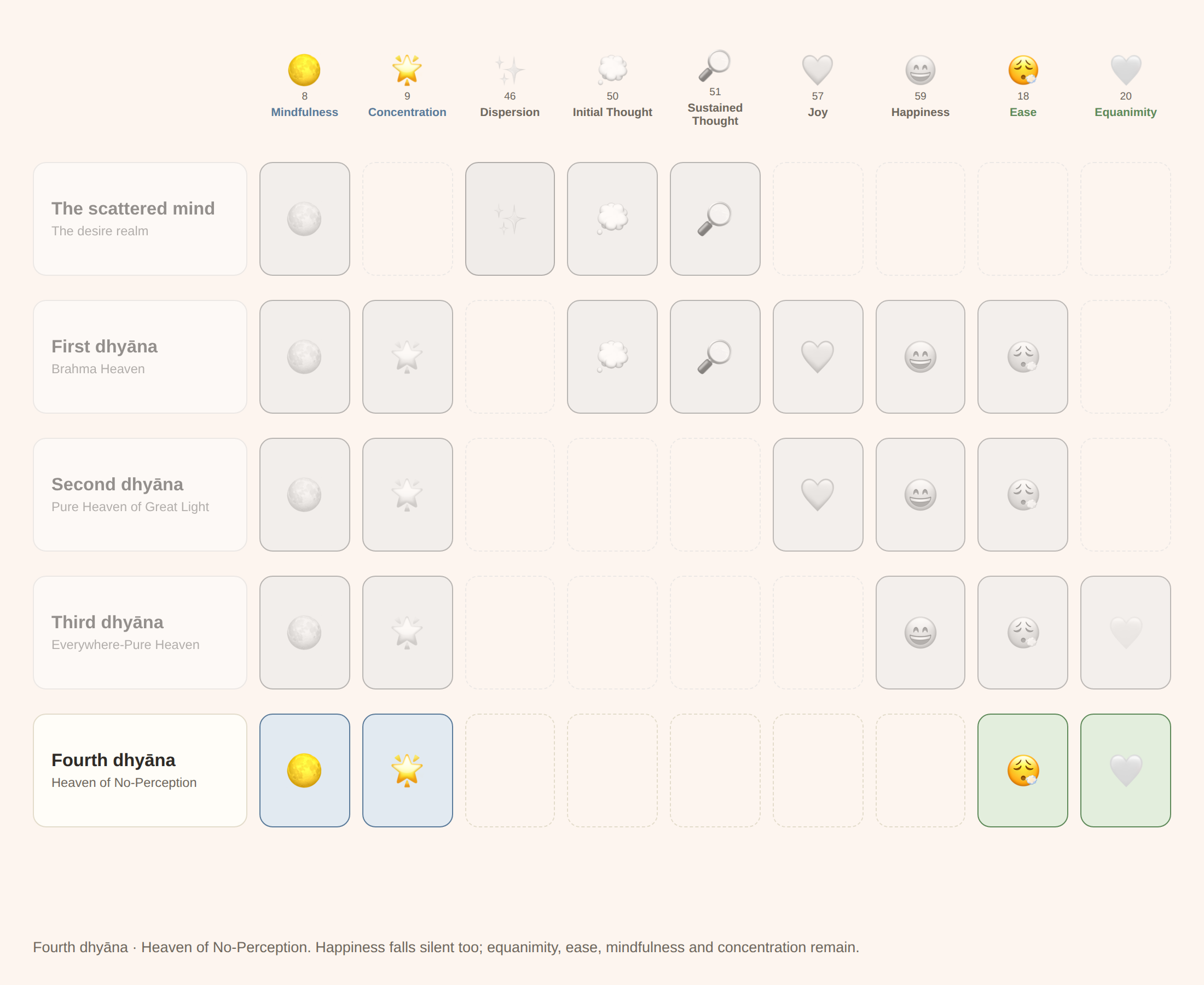
We arrived here by giving things up, not by getting them: thought, then joy, then happiness.
The name says more than he does
Thầy calls this level the Heaven of No-Perception, and it is the highest of the four. The name promises more than he delivers, and the gap is worth a moment.
His actual words are that beings here “do not have perception accompanied by ideation.” Perception has not stopped. Things are still known. The thinking about them has stopped — and that is not news at this level, because the thinking has a place on our map and it went dark two levels back. Initial thought and sustained thought were released entering the second dhyāna. So the fourth level’s name is describing something the table already shows, further up.
That raises the obvious question: why is perception itself not a column on that table? There is an answer, and it is about how the list of fifty-one is built rather than about this level.
Where this comes from
In this book, Thầy’s material is the four heavens, given as a plain list of stages with their inhabitants. He does not say what is released at each step. The account we have been following — thought, then joy, then happiness, each level opening as something is set down — comes from the discourses and from the schools that organised them into a scheme.
Outside this book he says a good deal more, and some of it cuts against our account: in The Heart of the Buddha’s Teaching he describes joy, happiness and equanimity as growing through the four levels rather than being set down, and elsewhere he argues that this whole map arrived in Buddhism long after the Buddha. We have kept our account, because it makes the movement visible and the movement is one he teaches everywhere. But it is not his, and where he differs we say so rather than choose for him. The full version of that accounting is the last note at the end of the previous reading, Everywhere Pure.
Still samsara
And all of this is still samsara.
That is not our editorial gloss on Thầy; it is his own description, and it sits in the commentary on this very verse. Introducing the nine stages, he writes that “realms of being” refers to “the three realms of samsaric existence.” All three — desire, form, formless. The stillest level of the middle one is inside the same cycle as the noisiest corner of the first.
Beyond this stillness is the realm of no-form, four levels further on. Beyond all of the realms is freedom. And the difference between the two is not depth.
The battery and the flashlight
Thầy explains why with a lamp.
“The practice of stopping brings concentration (samadhi). Concentration makes our mindfulness more stable… Concentration is the battery; the flashlight is mindfulness.”
A charged battery is not the same as light shining on something. We can be very still and still not see. That is the whole of the caution, and it is why four readings of deepening quiet do not add up to liberation on their own.
(He says it the other way round elsewhere, and means both: “mindfulness always brings about concentration.” The two grow each other. Neither is the seeing.)
But it would be a misreading, and an easy one to make after four readings on stillness, to hear that as concentration doesn’t matter. Thầy is careful in the other direction too, in the same passage: “With concentration, looking deeply (vipashyana) is much easier. In fact, concentration and looking deeply cannot be separated. As soon as there is concentration, looking deeply is already there.”
So none of this stillness is wasted. It is what makes seeing possible. We still have to look.
What frees us
What frees us is insight.
On our map it has two names. Insight (prajñā) is one of the five particular formations — direct, non-conceptual seeing, knowing the interconnected nature of things not by reasoning about them but by seeing them. Non-delusion is one of the eleven wholesome, and it is the root that transforms delusion at its source. Thầy writes: “Through the practice of looking deeply into the nature of interbeing, delusion or ignorance can be transformed into prajna, wisdom or understanding.”
And where he describes the actual moment of release, he does not describe a depth of stillness at all. Writing about the deepest of the meditative attainments, he says: “the grasping of manas begins to transform, due to the insight that the object it grasps is not self.” He names insight as the cause.
This is also why a level like the fourth dhyāna can be reached and then lost. A passage of Thầy’s is about exactly that, and it uses our own vocabulary: his example is a feeling of joy.
Nothing to attain
After four readings of this, we have added nothing. Every level opened when we let something go.
That has a name in the book, and it is a practice in its own right rather than an attitude: aimlessness, apraṇihita. Thầy puts it as directly as it can be put: “The Buddha advises us not to run away from anything in order to run toward something else. In fact, the practice of Buddhism is the practice of aimlessness, of having no goal (apranihita).”
He calls it the third of the Three Doors of Liberation, after emptiness and signlessness — “common to all the Buddhist schools.”
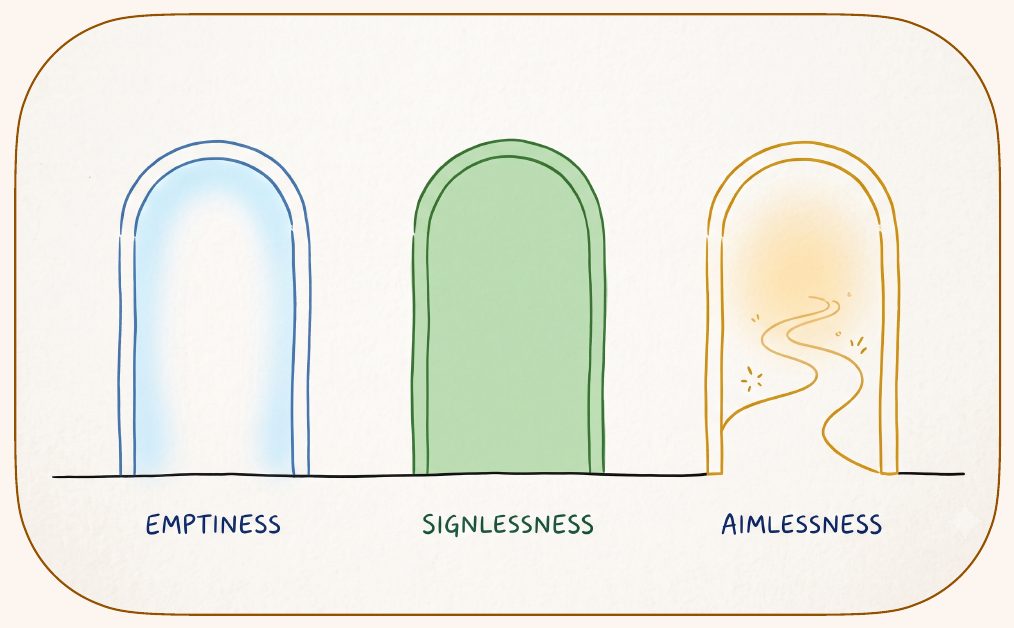
“The third door is aimlessness. We already are what we want to become. We don’t have to become someone else… We simply return to ourselves through mindfulness and touch the peace and joy that are already present within us and all around us. I have arrived. I am already home. There is nothing to do.”
And this reading’s title is his as well. Verse 49 is called Nothing to Attain, and it reads:
Nothing is born, nothing dies.Nothing to hold on to, nothing to release.Samsara is nirvana.There is nothing to attain.
That is forty verses ahead of us, and we are borrowing it early. It arrives here because this is the first place in these readings where it stops being an idea and becomes a description of what we have actually been doing.
What comes next
The realm of form is finished. Before going on, the next reading practises it rather than describing it. Then comes the realm of no-form, four further stages beginning with limitless space, and after that Chapter Nine’s own close, which our verse has been pointing at all along: the law of affinity, and transformation by watering the wholesome seeds.
Contemplation Questions
Thầy says concentration and looking deeply cannot be separated. When has being calm let you see something you had been avoiding?
We have spent four readings letting go, and nothing was ever added. Where do you still practise as though you were collecting something?
We keep meeting the same instruction: there is nothing to attain. What makes that hard to trust?
Carry whichever of these stays with you — into your own quiet reflection, or into conversation with others.
Going Deeper
2 notes ·A few notes for anyone who wants to follow a thread further.
Why perception is not a column on the table
The level is called the Heaven of No-Perception, so the obvious question is why perception is not one of the columns on our table — lit through the first three levels, going dark at the fourth. There are three reasons, and the first is how the list itself is built.
Perception is one of the Five Universals. That group is defined by being present in every single moment of mind; they come along with all consciousness. Thầy lists them at Verse 30 and states it plainly: “All eight consciousnesses are associated with the five universal mental formations.” The Inner Landscape’s entry for perception says the same thing again: it is present in every moment of consciousness. A universal cannot be released, by definition. Nothing on the release table is a universal — every column is a particular, a wholesome or an indeterminate formation, which is exactly why those columns can come and go. A perception column that went dark would put the table at odds with the list it is drawn from.
The second reason is that what the name points at is already on the table, two levels earlier. Thầy does not say perception stops. He says beings here “do not have perception accompanied by ideation.” Perception carries on; the thinking about it stops. And the thinking has a place on our map — initial thought and sustained thought — and both go dark entering the second dhyāna. So a perception column would not only say the same thing twice, it would say it in the wrong place.
The third reason is that it would break the sequence. What is set down at the fourth is happiness, sukha. That is the stock formula of the discourses, and it is the one part of this account that is not borrowed bookkeeping. If we inserted a release the sources do not have, we would lose exactly the credibility the note on sources is trying to earn.
We have met this shape before, running the other way. At the second dhyāna the older tradition names an inner clarity arriving, and at the third a clear awareness, and our fifty-one have no positive entry for either — the list carries only the negation, Lack of Discernment. The decision then was not to “fix” the table: it is showing a different list, not disagreeing with the doctrine. Here the situation is inverted, because our list does have the entry and it is a universal. The decision is the same.
This note does not settle one thing. Elsewhere in the book Thầy describes a realm of non-perception where perception really does stop — “a world in which there is no perceiving” — and he writes about it warmly, quoting the poet Nguyễn Công Trứ: “In my next life, may I not be born human / but as a pine tree singing between heaven and earth.” He never joins that description to the fourth dhyāna, and the two do not obviously agree. We have kept them apart rather than reconciling them on his behalf.
Why the fourth dhyāna can be lost
The reading says you can reach this level and lose it again, and then moves on. Here is where that comes from, because it is the reason these readings have never drawn the levels as a ladder.
At Verse 11 Thầy divides everything into phenomena with leaks and without leaks — āśrava and anāśrava. “With leaks” is his image of a cracked earthenware jar: “there is still something dripping out.” What makes an experience leak is not that it was shallow. It is that it is not yet understood: “the action or experience does not have the nature of true insight and liberation—there is still the possibility of falling down and turning back.”
What makes the passage worth quoting rather than paraphrasing is his example. He does not reach for something obviously fragile. He reaches for a feeling of joy — the same joy the third dhyāna set down:
“Suppose we have a feeling of joy. This feeling may be with or without leaks. If the experience is unstable because our understanding is superficial, our feeling of joy might be leaky. When we discover the truth of something and have understanding and insight, that feeling of joy is pure.”
So the difference between an attainment you keep and one you lose is not how deep it went. It is whether insight was there. That is the same answer this reading gives from the other direction, and it is why the fourth dhyāna is the stillest level of the realm of form and still samsara.
It is also why we have never called the four levels rungs. Thầy uses ladder, climb and rung in exactly two places in this book — at Verse 22 and at Verse 14 — and neither is the dhyānas. A ladder is something you climb and then stand on. This is something you can be at the top of and slide off.